





Arizona State University, in a major milestone decades in the making, is preparing to open its first-ever MD-granting medical school.
The new school will offer a combined Doctor of Medicine and medical engineering degree beginning in August 2026.
“There’s still that strong emphasis on the medical education curriculum. And we really are using engineering to reinforce, not to replace,” said Heather Clark, ASU’s senior associate dean for engineering integration.
ASU’s medical school is just one piece of a statewide push to reshape the future of health care. The University of Arizona has launched an expedited MD program, while Northern Arizona University in Flagstaff is investing in expanding its nursing program.
ASU medical school will welcome its inaugural class of 36 students in August 2026, offering one of the most distinctive medical-training models in the country.
Students will graduate with both an MD and a master’s in medical engineering, preparing them to work at the cutting edge of artificial intelligence, biomedical innovation and digital health, ASU officials said.

Architectural mock-up of ASU’s new School of Medicine and Medical Engineering.
ASU’s philosophy is to train physicians who can solve problems the health-care system hasn’t caught up to yet.
“One of our goals with the medical school curriculum is to really give our future physicians the ability to work with AI so they can evolve with it. It’s changing so quickly that anything we teach them now will not be relevant in five or 10 years,” Clark said. “But if we can teach them to work with these tools, I think then, we will have a strong set of solutions.”
ASU’s new state-of-the-art medical school building, set to open in downtown Phoenix in 2028, will feature collaborative labs, flexible classrooms, and an industry-designed “medical suite of the future” where students can prototype devices, test AI tools, and explore emerging digital health technology. Clinical rotations will be supported through ASU’s partnership with HonorHealth.
Clark said the spirit of collaboration stands out most.

A rendering of the research and learning spaces planned inside ASU’s new medical school.
“I think we should be very proud of having an engineering medical school,” she said. “But I don’t think we should compare ourselves to anybody else because, as ASU always is, we’re absolutely unique in our approach.”
Arizona State’s rapid expansion didn’t happen in isolation. It reflects a coordinated effort led by the Arizona Board of Regents, which has sharpened its focus on accelerating the health-care workforce pipeline.
“As Arizona has grown, so has the need for more doctors, nurses and other health-care professionals. We launched the AZ Healthy Tomorrow to map out the future of Arizona’s health care in our state,” said Megan Gilbertson, the regents’ associate vice president for public affairs. “The board asked our universities to hit the accelerator and grow more qualified medical professionals.”
Recent data reinforced that urgency. Gilbertson pointed to a Georgetown University workforce report that projects Arizona will need 29% more health-care workers by 2031, one of the sharpest jumps in the country.
“This data shows there is a need in our state, and Arizona’s public universities are stepping up to help fill this gap,” Gilbertson said.
For years, Arizona lagged behind national benchmarks in physician training. The state did not approve its first medical school until 1961, but even then, state leaders knew that as Phoenix grew, Arizona would eventually need another medical school to keep pace with population and demand.

Architectural mock-up of ASU’s new School of Medicine and Medical Engineering.
More than half a century after the UA College of Medicine launched in 1967, that need has caught up and Arizona is responding with speed and strategy.
Nearly 3 million Arizonans already face limited access to primary care, and over a third of hospitals report critical staffing shortages. State leaders agreed: the time for incremental growth had passed.
“The Regents knew decisive action was needed to grow more qualified medical professionals and do it quickly,” Gilbertson said.
Gilbertson also applauded recent action by the governor and state Legislature to fund more residency slots, a key factor in keeping medical graduates in Arizona.
While ASU prepares to open its first medical school, the University of Arizona continues to anchor the state’s physician workforce through its two long-established colleges of medicine in Tucson and Phoenix.
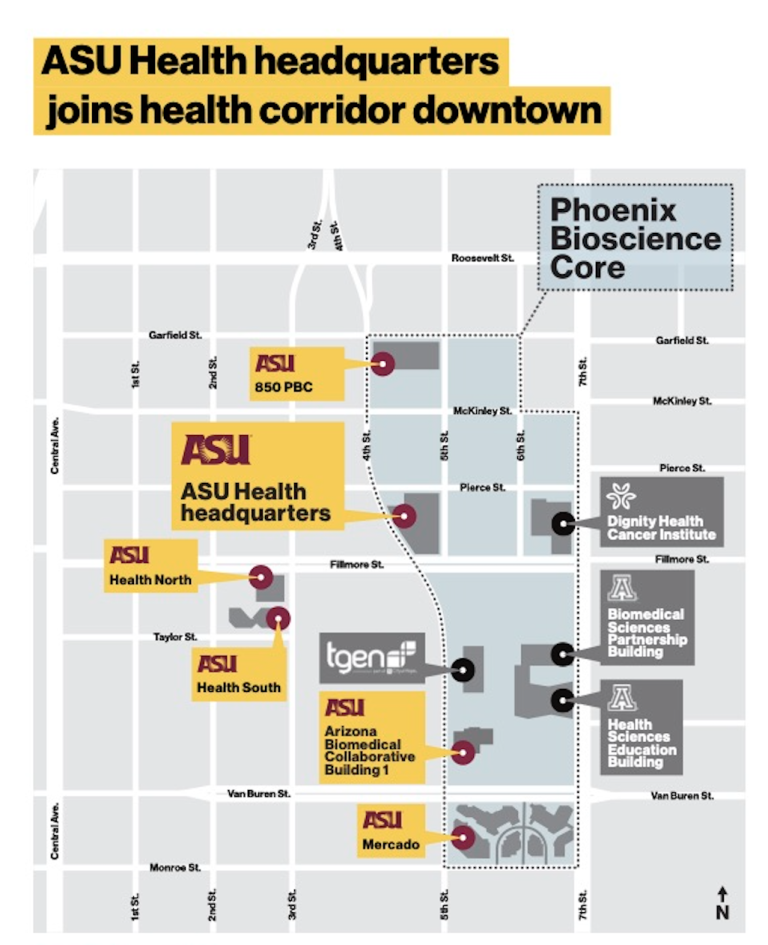
A map of ASU’s future School of Medicine site in downtown Phoenix.
The College of Medicine–Phoenix started as a downtown satellite campus to the Tucson school, founded in 1967. The Phoenix campus expanded in 2004 to a full four-year program.
The College of Medicine–Tucson plans to expand its incoming class to 160 students by 2030, a significant jump aimed at producing more doctors for Arizona’s growing population. The college actively works to retain these students in-state by encouraging them into UA–Banner Health residency programs.
“When College of Medicine–Tucson graduates complete their training in Arizona, they are far more likely to remain and practice here long term. In addition, our primary care scholarship program strengthens the pipeline of physicians committed to serving communities across the state that face the greatest shortages,” said Mitch Zak, the UA’s executive director of external communications, in a Dec. 2 email.
In addition to expanding its class size, the UA School of Medicine was given the green light by the regents to join more than 30 medical schools nationwide to offer an accelerated three-year MD program.
Meanwhile, on Dec. 4, U of A launched a groundbreaking partnership with Yuma-based Onvida Health to establish the state’s first rural regional medical branch. Beginning in July 2026, the College of Medicine–Phoenix will introduce a three-year Primary Care Accelerated Pathway based entirely in Yuma.
Up to 45 students, 15 per year, will complete all clinical training at Onvida Health and receive full tuition scholarships funded by the organization. The program targets students committed to primary care and aims to increase the number of physicians who stay and practice in rural Arizona.
Northern Arizona University is doubling the number of nursing graduates, expanding facilities statewide, and has plans to open a rural-focused medical school to serve northern, tribal and remote regions.

