Executive orders by President Donald Trump in his first week in office could affect funding for major projects in Tucson and Pima County.
That’s because of “pauses” he ordered on spending from the Inflation Reduction Act and the Bipartisan Infrastructure Law, which help local governments with expensive projects.
In September 2023, the county’s Department of Environmental Quality received a four-year, $1 million Climate Pollution Reduction Grant from the Environmental Protection Agency, which was authorized under the IRA.
Earlier this week, Kristen Randall, the department’s environmental quality manager, said on Facebook that those grant dollars “would be immediately halted.” But Natalie Schepp, the department’s environmental quality planning manager, told the Star Thursday it was her understanding that “grant amendments” had been halted.
On top of that, earlier this month, county supervisors approved by a 4-1 vote accepting a $662,489, five-year grant for the “Inflation Reduction Act — Multipollutant Air Monitoring Project” from the Environmental Protection Agency for replacing “the ambient air monitoring shelter” at C.E. Rose Elementary School, on the city’s south side, “and air monitoring equipment at various locations,” according to the grant language.
Mark Evans, a spokesman for the county, told the Star that “as it stands right now” there has been no formal communication from “any federal agency about any of our funded projects.”
“Everything right now is speculation. … We’re not getting any response from our federal partners when we are calling for clarification. And so right now, it’s just wait and see,” he said. “I think it would be very premature to say that any federally-funded project in Pima County right now is being halted until we know more information, and until we know more, that’s pretty much all we have to say about it.”
Speculation aside, both the city and county have seen a flurry of funding roll in because of these two federal laws.
Bipartisan Infrastructure Law
Trump’s decision to suspend already-approved federal funds for some projects could set back plans to widen Interstate 10 in a congested stretch between Tucson and Phoenix. That could force Arizona taxpayers to pick up the difference of “at least” $95 million, Capitol Media Services’ Howard Fischer reported Friday.
In December 2023, Gov. Katie Hobbs announced the state received a $500,000 grant, received from the U.S. Department of Transportation through the BIL, to “continue studying the potential” of a Phoenix-to-Tucson commuter train. U.S. Rep. Greg Stanton said with the investment “under the Bipartisan Infrastructure Law,” Arizona is “one step closer to bringing Amtrak service back” for the first time in more than two decades.
Earlier this month, Marana received a $20.4 million grant from the Federal Railroad Administration’s Railroad Crossing Elimination Grant Program, which funds safety improvements around highway-rail crossings. The program was created under the BIF, according to the U.S. Department of Transportation.

Drivers pass through a Union Pacific railroad crossing on West Cortaro Farms Road in Marana. Earlier this month, Marana received a $20.4 million federal grant to pay for safety improvements at highway rail crossings. But the funding comes from the Bipartisan Infrastructure Law paused by President Donald Trump.
The University of Arizona received $7.4 million from a Safe Streets and Roads for All grant to implement the EMS Physician 1 Program that would help with the immediate care of pedestrians in vehicle accidents, U.S. Rep. Raúl Grijalva announced in September 2024. The grant is funded by the Bipartisan Infrastructure Law and Pima County aims to incorporate the EMS program in the Pima County Action Plan.
In December 2023, the Pima County Board of Supervisors accepted two grants totaling over $400,000 from the Department of Energy Weatherization Assistance Program for low-income people through Bipartisan Infrastructure Law grants.
The funding was to support the installation and repair of “energy efficiency measures” for low-income households outside of Tucson but within the county, according to the grant language.
Through the BIL, the Community Wildfire Defense Grant and the U.S. Department of Agriculture gave $2.5 million to Arizona’s 7th Congressional District, which includes parts of Pima County, for wildfire migration in low-income at-risk communities. The district planned to use the 2024 grant to develop community wildlife protection plans among other mitigation projects.
Tucson’s Greenway and Bike & Pedestrian Bridge project on Interstate 19 is funded by the BIL Reconnected Communities Pilot Program. Granted in February 2023, the $900,000 fund would ease access to other parts of Tucson for residents of largely Hispanic south-side neighborhoods.
Tucson received $30 million from EPA BIL funding to protect the city from per- and polyfluoroalkyl substances in the water, also considered forever chemicals, as previously reported in November 2023.
The county also received $20 million in June of 2023 to restore West Valencia Road in Tucson from the Rebuilding American Infrastructure with Sustainability & Equity (RAISE) Grant and USDOT. RAISE grants are under the Bipartisan Infrastructure Law and aim to repair roads and increase accessibility.
“The updates and upgrades that this project will bring will help to not only reduce traffic congestion, but also provide safer and more convenient alternative forms of transportation,” Rep. Grijalva said in 2023.
Tucson received $11.3 million in July of 2024 to improve Sun Tran by adding more shelters, trees for shade, and accessible signage such as braille and large print. The funding for this USDOT award came from the Bipartisan Infrastructure Law, as did a $22 million FTA grant for Sun Tran to replace diesel buses with compressed natural gas buses in 2023.
Inflation
Reduction ActAs reported last March, Marana-based Trico Electric Cooperative was in line for $83.5 million in federal loans through the U.S. Department of Agriculture’s Powering Affordable Clean Energy (PACE) program, which is administered by the USDA’s Rural Utilities Service and funded for up to $1 billion under the Inflation Reduction Act. Before that, the co-op won a $7 million U.S. Department of Energy grant to support that initiative, which was part of $45 million in Bipartisan Infrastructure Law funding.
By August 2023, as reported by the Star, federal payouts for buying low- and zero-emission buses and for conserving Colorado River water “over the next few years” approached $100 million. By that time, total expenditures for clean energy projects and water projects had “reached or exceeded $10 billion” since the the Bipartisan Infrastructure Law and the Inflation Reduction Act passed in November 2021 and August 2022.
However, as reported by Reuters Wednesday, “The bulk of the IRA’s support for clean energy and EVs derives from tax credits that can only be revoked with an act of Congress.”
But with a Republican-held House and Senate, the prospect of revocation cannot be taken off the table.
The big-ticket item, at least on the county’s side, is its climate action plan.
The Pima County Priority Climate Action Plan, which includes projects that align with the EPA’s directive to reduce greenhouse gas emissions through this decade, “was a key deliverable after the Pima County Board of Supervisors approved a $1 million four-year Climate Pollution Reduction Grant (CPRG) from the EPA on Sept. 5, 2023,” county officials said in a news release.
The EPA has offered $4.6 billion in grant funding across the country through the Inflation Reduction Act. For its climate plan, Pima County “is expected to request” more than $150 million from for a five-year grant.
County officials said their plan is due to the EPA in the summer of 2025. But Trump’s executive order targets the climate provisions under the IRA.
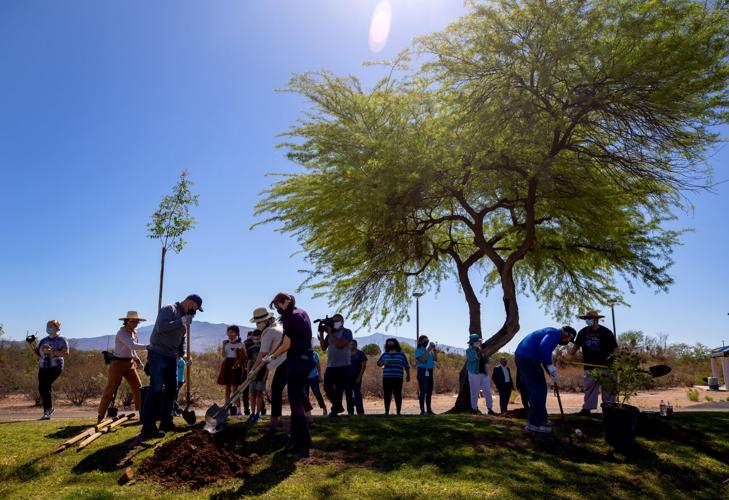
At the city level, Tucson received a $5.4 million urban forestry grant in September 2023 to create more green spaces by planting trees in urban communities. The Community Food Bank of Southern Arizona received a $400,000 grant from the same source. Those federal funds came from the Inflation Reduction Act.

Tucson received a $5.4 million grant to create more green spaces by planting trees in urban communities, under the now-paused Inflation Reduction Act.
Two billion dollars in funding from the IRA was made available to fund the EPA Community Change Grants program “to help disadvantaged communities tackle environmental and climate justice challenges through projects that reduce pollution, increase community climate resilience, and build community capacity.” In November last year, the Primavera Foundation here received nearly $20 million via the program. The city serves as the statutory partner for the grant.
You don’t have to go far back in time to see these funds are still being deployed.
During its first meeting of the year, the Tucson City Council approved plans to build a plant to treat wastewater to drinking-water standards with up to $86.7 million in federal funds made available through the Inflation Reduction Act, according to a joint news release from U.S. Sens. Ruben Gallego and Mark Kelly.

ABOVE: Treated wastewater from the Tres Rios Wastewater Reclamation Facility would be further treated to drinking water quality under a Tucson plan that would be funded by up to $86.7 million through the now-paused Inflation Reduction Act. LEFT: Drivers pass through a Union Pacific railroad crossing on West Cortaro Farms Road in Marana. Earlier this month, Marana received a $20.4 million federal grant to pay for safety improvements at highway rail crossings. But the funding comes from the Bipartisan Infrastructure Law paused by President Donald Trump.