

'Scooby-Doo' van crash; rifle sells for $1.2M; sexism part of job
- Updated
Odd and interesting news from the Midwest.
- GILES BRUCE The Times
- Updated
VALPARAISO, Ind. (AP) — At a routine ultrasound last Sept. 14, Michelle Michniewicz found out her daughter's heart had stopped beating.
At 3 a.m. the next day, Michniewicz gave birth. By 8 a.m., she was home.
"All of these things are running through your head," said Michniewicz, 29, of Hobart. "You're trying to wrap your head around that your child just passed away."
She wishes she'd had more time with baby Juno: to hold her, to take pictures, to not be rushed into making funeral arrangements.
Now she hopes to make sure other grieving families don't have a similar experience.
Not long after her Juno's death, Michniewicz reached out to Amelia Kowalisyn, who runs a Valparaiso nonprofit, Emma's Footprints, that supports families dealing with premature birth and infant loss. In 2014, Kowalisyn's 23-day-old daughter, Emma, died from complications of a stroke she suffered in utero.
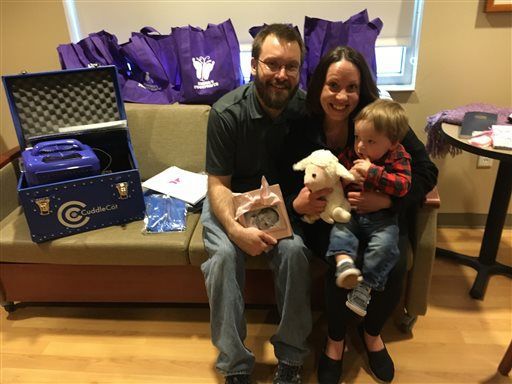
Michniewicz's story touched a nerve in Kowalisyn, who feels she at least got to spend time with her late daughter. Emma's Footprints recently donated a device to Porter Regional Hospital that preserves the bodies of stillborn babies for up to 72 hours.
"It's the gift of time for these families," Kowalisyn said in a tearful presentation to the Valparaiso hospital's labor and delivery unit last month. "You only get that one chance, that little bit of time, before you say goodbye."
The Cuddle Cot, which is manufactured in the United Kingdom, cools the bodies of stillborn babies to stall the decomposition process. A cooling pad, connected to the unit by an insulated hose, is attached to the bassinet, basket or crib.
Elaine Johnson-Merkel, director of the Women and Children's Pavilion at Porter Regional, noted that with the hospital's current laboratory policy it's hard to keep the babies with the families for more than a few hours. The hospital averages about two stillborn births per year.
"The last thing you want to do is introduce a child to a parent in the morgue," she remarked. She's had to do that more than once.
Emma's Footprints recently received a grant from the Legacy Foundation of Lake County to provide Cuddle Cots to each of the county's seven hospitals with birthing units. In 2007, the most recent year in which statistics are available, there were 38 fetal deaths in Lake County and 10 in Porter County, according to the Indiana State Department of Health.
Michniewicz and Kowalisyn also hope to break the taboo surrounding infant loss. They say parents shouldn't feel weird about wanting to hold, have skin-to-skin time with, or bathe their late child.
For her part, Michniewicz is being certified as a bereavement doula, and plans to offer support services for free to grieving parents at any Northwest Indiana labor and delivery unit. Beyond that, she says raising awareness about this issue will help the general public better interact with mothers and fathers who have lost babies; after the death of her daughter, Michniewicz heard comments such as "You can just have another child" or "Everything happens for a reason."
And by working with local hospitals, the women hope to make what will likely be the worst experience of some moms and dads' lives a tad easier.
"Very often, it's a parent who brings changes like these about," noted Porter Regional's Johnson-Merkel.
Or in this case, more than one parent.
___
Source: The (Munster) Times, http://bit.ly/1VTNfpp
___
Information from: The Times, http://www.thetimesonline.com
This is an AP-Indiana Exchange story offered by The (Munster) Times.
- By KURT HAUGLIE The Daily Mining Gazette
- Updated
DOLLAR BAY, Mich. (AP) — The third-grade class at Thomas R. Davis Elementary School in Dollar Bay is so impressive to the members of the Copper Country Intermediate School District Parent Advisory Committee, an award was created just for the students, according to Christina Norland.
Norland, who is K-12 principal for the Dollar Bay-Tamarack City Area Schools, said the students in Marissa Kentala's class have been helping out with an autistic student named Alex.
When the PAC members heard what Kentala's students were doing, Norland said they felt they had to acknowledge the children's efforts by creating the first ever Spirit of Inclusion Award, The Daily Mining Gazette (http://bit.ly/1OkFfGd ) reported.
"They were so moved by what our students did," she said.
Norland said she is also impressed with the fact the students are helping Alex without any persuasion.
"They do it naturally," she said.
Kentala said students at the school move through each grade together until they graduate, and the other students have been helping Alex since they started at the school.
"They've been very supportive of him since kindergarten," she said.
When Kentala asked at the beginning of this school year if any of the students would like would like to take part in the school's Peer to Peer program to help Alex in her class, she expected two or three would volunteer, but she was surprised by the response.
"Instead, the entire class volunteered immediately," she said.
Kentala said among other things the students play with Alex, sit with him at lunch, and give him gentle reminders to check his daily schedule.
Since the school year began, Kentala said the help the students have given Alex is having a positive effect.
"We see progress every day," she said.
Kentala said Alex doesn't often speak, but he does seem to enjoy the help the students give him.
Besides the students, Kentala said she and paraprofessionals Katie Laplander and Rae Lamamen work with Alex. also.
One of the students working with Alex is Evelyn Moilanen, who said she enjoys spending time with Alex.
"It's actually pretty nice working with him," she said.
Evelyn said Alex sometimes communicates with the other students.
"We talk with him at lunch," she said.
Evelyn said she expects to continue to work with Alex as they advance through the grades in the school system.
Norland said the award the students received was well deserved.
"I think it is fantastic," she said.
___
Information from: The Daily Mining Gazette, http://www.mininggazette.com
This is an AP Member Exchange shared by The Daily Mining Gazette
- Updated
INDIANOLA, Iowa (AP) — A judge has declared the Warren County Courthouse no longer habitable and says court employees are at risk in it.
Chief Judge Arthur Gamble of Iowa's Fifth Judicial District issued the finding this week, the Des Moines Register reported (http://dmreg.co/1rLSoDq ). He also told Warren County supervisors that if the county doesn't act soon, the court will begin a process to compel the county to provide suitable court facilitates, as required by law.
A $35 million bond referendum, which would have allowed the supervisors to borrow money to build a new justice center, failed earlier this month.
The supervisors have been looking at either making extensive repairs or building a new courthouse because the 77-year-old building has major plumbing, electrical and heating and cooling issues. Gamble closed the courts twice last year because of plumbing and sewer gas leaks.
There is $500,000 in the county's current budget to make repairs, but estimates provided by a consulting firm show the building needs about $2.3 million worth of repairs.
Gamble told County Board Chairman Doug Shull that the board will have to choose between either moving the courts out of the building or fixing the courthouse in a timely manner.
"It's up to you how you want to pursue," Gamble said.
The Warren County Supervisors will meet again Monday at the county administration building in Indianola to decide its next move.
___
Information from: The Des Moines Register, http://www.desmoinesregister.com
- Updated
PIERRE, S.D. (AP) — U.S. Attorney Randolph Seiler says two New York men have each been sentenced to two years in prison after being convicted in a scheme to usurp cell phone accounts to steal iPhones.
Seiler says 20-year-old Wilton Santana and 22-year-old Charlie Aquino were sentenced by U.S. District Judge Roberto Lange on charges of using or trafficking in an unauthorized access device and aiding and abetting.
Prosecutors say Santana, Aquino and another man in 2014 posed as AT&T customers looking to upgrade by adding new lines or phones to their plans. The trio was provided confidential subscriber information while outside an AT&T store. The phones were then mailed to an address for payment.
The men were arrested after officers found 14 new, in-the-box iPhone 5s in the trunk during a traffic stop.
- Updated
COLUMBUS, Ohio (AP) — Months after an Ohio lawmaker called his female primary opponent "sweetie" and questioned her interest in holding office while raising young children, several female Democratic legislators said they often encounter offensive jokes and remarks made by their male counterparts.
State Sen. Tom Patton, the Cleveland Republican who made the comment regarding his opponent in the Ohio House primary race, later said his remarks were misunderstood.
But some lawmakers said they've also heard comments from lawmakers and voters.
State Rep. Greta Johnson, 38, said she recently had a conversation with a male lawmaker who insisted on calling her "kiddo."
"I don't think he was trying to be disrespectful to me. We certainly have a very collegial relationship," the Akron Democrat told Cleveland.com (http://bit.ly/1Tykjxh). "Are my male colleagues being called "kiddo"? I don't think so."
State Rep. Christie Kuhns gave birth to a son about two months after she took office. She said some male lawmakers asked what she planned to do when the baby came and that one remarked: "I know you're not going to leave your baby at home."
"I think women are forced into a box a lot of times to choose one or the other," said Kuhns, a Cincinnati Democrat. "And I don't think that's fair, because men aren't forced into a box."
Women in the Legislature's Republican majority had a different take. Those interviewed said they hadn't had similar experiences or didn't take offense when they did.
"I've never, ever, ever felt that they treat me differently," Senate Majority Whip Gayle Manning, a North Ridgeville Republican, said of her male colleagues. "I think they treat me as an equal."
___
Information from: cleveland.com, http://www.cleveland.com
- Updated
ST. PAUL, Minn. (AP) — St. Paul police had a mystery on their hands when a van painted as "The Mystery Machine" from the animated TV series "Scooby-Doo" crashed into a home.
Van owner Guy Frechette was sleeping about 3 a.m. Friday when officers knocked on his door. He learned his custom-painted van had been stolen from in front of his home.
Nobody was injured when the van hit the house, but the van sustained front-end damage. A police dog caught two suspects in a garage a block away. Police identified them but did not arrest them because they lacked proof.
Guy and Theresa Frechette say this is their third Mystery Machine, which is actually a fully loaded camper. They take it to parades and on their quest to visit all of Minnesota's state parks.
- Updated
MILWAUKEE (AP) — A Milwaukee man has been sentenced to 2½ years in prison for repeatedly stabbing an unwanted cocker spaniel that kept finding its way home.
The Milwaukee Journal Sentinel reports (http://bit.ly/27mxQSB ) that 38-year-old Zachary Senner told the judge at sentencing Friday he was sincerely sorry and took full responsibility.
According to his lawyer, Senner was drunk and high on cocaine on the December night when police found the dog, Brandy, dead. Senner pleaded guilty in April.
Senner told police his brother and sister-in-law asked him to get rid of their dog. He tried abandoning Brandy but she soon found her way home. Then he slit the dog's throat and left it in some woods. But Brandy made it home again, bleeding badly. He then stabbed the dog repeatedly until it died.
___
Information from: Milwaukee Journal Sentinel, http://www.jsonline.com
- Updated
OSKALOOSA, Iowa (AP) — A $5,000 reward is being offered for information that leads to the arrest and conviction of the person who sealed a cat in a plastic tote abandoned at a south-central Iowa city dump.
The Oskaloosa Herald reports (http://bit.ly/1TChJpW ) that a woman found the cat on May 5 near the Oskaloosa City Brush Dump inside the taped-shut tote and called the local animal shelter.
Shelter officials, who have named the cat Cecilia, say the cat had been trapped inside the tote for several days, crouched in its own waste. The cat is now at the shelter and recovering.
The Human Society of the United States is offering the reward for information on whoever left the cat to die.
Oskaloosa police are investigating.
___
Information from: The Oskaloosa Herald, http://www.oskaloosaherald.com
- By COURTNEY CROWDER The Des Moines Register
- Updated
DES MOINES, Iowa (AP) — Keira Kelly squirmed with the tenuous excitement of a girl readying to open a soda can she's just finished shaking. Dressed to the nines in a black and gold University of Iowa cheerleading uniform and clutching a Hawkeye-emblazoned backpack, Kelly focused with rapt attention on the nondescript dance studio's door, The Des Moines Register (http://dmreg.co/1T6XOoR ) reported.
Soon, Katie Lipes came bounding in, ready to throw her arms around Kelly, and stopped short. "What are you wearing?" the 19-year-old, who has Down syndrome, asked incredulously.
"My new uniform," Kelly said, holding out the backpack. "And here, there's one for you, too."
While the pair looked the part of Iowa cheerleaders and knew the Hawkeye routines inside and out, Kelly and Lipes are so much more than cheerleaders. They are Sparkles.
The Sparkle Effect, a nonprofit founded in 2008 by 15-year-old Iowa resident Sarah Cronk, helps high schools and universities start inclusive "Sparkle" squads, cheer or dance teams that combine typically developing students and students with disabilities. So far, the group has founded more than 168 Sparkle teams in 29 states and interest continues to grow every year, Cronk said.
The idea for the Sparkle Effect came to Cronk, now 23, when she noticed systemic exclusion of students with disabilities from activities in her high school. These classmates weren't so much bullied as they were ignored, "walking through the hallways without a single person looking at them or smiling at them," she said.
Which is why the word "inclusive" comes up over and over when you talk to Cronk or Linda Mullen, her mother and the Sparkle Effect's executive director. A Sparkle squad is not a team of solely disabled teens, it is a team that very purposely mixes kids of all abilities, they emphasize.
"We as a society have decided that segregation is not OK anymore and yet there are still organizations creating separate programs just for kids with disabilities," Cronk said.
"If we aren't crossing social boundaries, can we really say we're being as inclusive as possible?" she continued. "If we aren't including people from all walks of life in our activities, can we really say we're as inclusive as possible?"
Inclusion changes lives, Cronk added, accentuating the changes.
And she would know because she's seen the staggering power of simply being included change a life within her own family.
Cronk's older brother Charlie, who is on the autism spectrum, had a hard time when he started at Pleasant Valley High School just before Sarah. He was always very bright and very socially motivated, Mullen said, but he was a bit socially awkward.
He didn't have a place to land in the hallways or in the cafeteria, she said. He'd eat lunch in the nurses' office and came to dread school.
Then, a member of the school's swim team asked Charlie to sit with him at lunch and, eventually, to join the team.
Charlie went from anxious every day to excited, Mullen said. It was a complete 180 that both Mullen and Cronk pinpoint to the moment Charlie found "a team."
"Being on that team truly changed his life," Cronk said.
Cronk took note of her older brother's experience. And one day after cheer practice, the idea hit her like a freight train: What if we had students with physical and intellectual disabilities join us for practice and perform for part of every game? Would people want to join? Would they want to watch?
She approached her coach and the administration and got a tentative yes. They told her she could try it out for one game, Cronk remembered, but if things didn't go well, the experiment was over.
So during the season's first football game, in front of a packed house, the newly formed Sparkles took the field.
"We had no idea if it would be good or awful or how the crowd would react," Cronk said. "But it was really magical, everyone loved it and the entire stadium stood up when we finished."
Cronk paused: "A million things could have gone wrong, really, but instead a million things went right."
The Hawkeye Sparkles practice began with socializing and dancing to hits from Justin Bieber and One Direction. Some girls stayed close to their able-bodied cheer partners, but others flitted from conversation to conversation.
In the center of it all was Madison Shults, 13, a Sparkle cheerleader from Iowa City. She shook her hips to Bieber's "Baby" and did a handstand, triumphantly raising her fists when she returned upright.
Her mother, Jennifer, sat with the other parents and clapped to the beat, shrieking when Madison whipped out her gymnastics move.
"She is so introverted and this has brought her out of her shell," Jennifer Shults said. "I mean, look, nobody is staring at her, she just gets to be herself. She puts all of her energy into this and she spends all week looking forward to it. She'll ask, 'Is it Sparkles day?'"
Her voice caught in her throat: "It makes me really emotional actually. There hasn't been anything like this in her life before."
Many other Hawkeye Sparkle parents echoed this story: Finally, their daughter has a place to just have fun, to not feel so different.
Cronk hears stories like this all time, too, she said. But she's quick to add that both groups of students, typically developing and those with disabilities, are "learning and growing in equal measure." Being a part of Sparkles isn't an act of charity by the typically developing students, Mullen said.
Karly Dankert, 22, one of the founders of the Hawkeye Sparkles, was on a Sparkle squad associated with her high school's dance team. Her dance partner was a girl who had Down syndrome who she'd known her entire school career.
In elementary school, the pair would hang out after school, but as they grew older they drifted apart, Dankert said. Then the Sparkles offered them a new way to find common ground.
"She enjoyed dance and I enjoyed dance and we could connect over our shared interest, so we started spending more time together," Dankert said. "She was always positive and I tried to learn from her and instill that sort of unbridled happiness into my life.
"And as the team grew and grew, the atmosphere in the hallways changed," she added. "Because of Sparkles, people went out of their way to reach out to students who were different than themselves."
Laughter and echoes of "You go girl!" bounced off the wall at a recent performance of the Cyclone Sparkles, Iowa State University's Sparkles team.
Lauren Grace, 21, who has fetal alcohol syndrome, had stuck all the routine's moves and even been lifted up by her fellow teammates at the end of their routine — her favorite part, she said.
After, she and the other Sparkles settled into the stands to watch the university's cheer team practice for the upcoming national competition. At the beginning of one of their routines, a girl was thrown high into the air.
"Wow," Grace marveled. "Just look at that. That's what I want to do. I am going to practice every day."
When Cronk set out to create an inclusive team, she chose cheerleading because she was a cheerleader, but also because they needed a sport that could be modified to fit any ability. Cheer moves can be made simpler and routines can be as short as necessary, Cronk said. And, in many disability communities, making sure to get enough exercise is a major issue.
"Parents come up to me and say they have seen their child move in a new way," Dankert, a human physiology major, said. "Some girls aren't able to stretch or kick their leg up high, but even them lifting their foot up off the ground when they hear the music is something to be proud of."
Cronk also chose cheerleading because of its visibility. When she started her Sparkle team, the goal was to change game night in Bettendorf. The best way she could think of doing that was putting differently abled peers in her school's colors and having the entire group loudly and proudly show Pleasant Valley spirit.
"You can only get that from cheerleading," she said.
The Sparkle Effect is one of those activities that grabs your heart and holds on, said Mara Mapes, the captain of the Cyclone Sparkles, and it's helped her discover her life's passion.
"From Sparkles, I've figured out I want to work with people," Mapes said. "I want to take all the things I've learned from Sparkles — treating people right, integrity, being authentic and genuine to everyone no matter what — and make it a job."
When Cronk founded her nonprofit, her goal was to start Sparkle squads at 100 schools, a marker she's beaten almost twice over. (In Iowa, all three public universities have a Sparkles squad and metro-area high schools are adding teams regularly, including Waukee in 2013 and Johnston last fall.)
Within the last few years, Cronk has seen complete Sparkle team turnover at certain schools, meaning the teams have been in existence for five years or longer and the original founder has graduated.
"Now, the students at those schools have never known any other way except being inclusive," Cronk said. "It's no big deal and it's just accepted instead of discussed endlessly."
Because, really, the goal of the Sparkle Effect is to eventually not need the Sparkle Effect, Mullen said, to get to the point where "inclusion is the norm."
For Mullen, Cronk and many others touched by being on a Sparkle Effect team, inclusion is more than an extracurricular, it is a way of life.
"Our organization started to create inclusive cheer squads, but now we are trying to advance all forms of social inclusion," Mullen said. "And we're getting there — slowly.
"But until total inclusion happens," she added, "we'll be out there on game night, on the field, cheering loudly."
___
Information from: The Des Moines Register, http://www.desmoinesregister.com
An AP Member Exchange shared by The Des Moines Register.
- By DAVID SKOLNICK The Vindicator
- Updated
YOUNGSTOWN, Ohio (AP) — After turning three abandoned and garbage-filled inner-city parcels into gardens offering free fruits and vegetables, Mason Carratt is embarking on another way to feed the hungry: a vineyard in which the grapes will be used to make jellies and jams.
Carratt received a donation of 100 Concord grapevines and 700 linear feet of wooden posts and metal wire for trellising from Kosicek Vineyards in Geneva, with the work being done by volunteers in two weeks.
The Steel Valley Vineyard is at Ravenwood and Idlewood avenues on the city's South Side. It's only a few feet from Carratt's Idlewood house.
"The whole purpose is to give food to those in need," he said. "I enjoy knowing that people who are hungry can come here."
Carratt started growing fruits and vegetables to reduce his expenses after a serious injury to his left foot seven years ago. The back of his property abuts 3406 Hillman St., which was an overgrown, debris-filled parcel for years. For much of 2012, Carratt filled a couple of bags with trash from that Hillman parcel and threw it out with his garbage.
In 2013, Carratt started a major cleanup of that property, eventually removing tons of trash, including tires, concrete, bricks, roofing materials and lumber. He mowed the parcel and planted fruits and vegetables. Later that year, he created the Youngstown Inner City Garden, allowing anyone— though his focus is on seniors and the disabled —access to fresh produce.
"I was homeless and an alcoholic for so many years," Carratt said. "I'm trying to be a productive member of society to give back because I took so much."
Various organizations that feed the hungry pick up bags of fresh fruits and vegetables from Carratt's garden and distribute them.
In 2014, with the help of others, Carratt created the Youngstown Food Forest on two vacant parcels across the street from the garden on Hillman Street.
"It was a dump yard with several hundred tires and a lot of roofing materials," he said.
It currently has about 200 berry bushes and 70 fruit trees.
"Anyone can come and eat what's grown," he said.
That includes raspberries, blueberries, blackberries, strawberries, apples, pears, plumbs and peaches.
Among those who visit the garden and food forest are Philip and Mary Leyman, residents of the nearby Grovewood Manor, a housing complex on Hillman Street for seniors and the disabled.
"It's good for the neighborhood," Mary said. "It's helped improve the neighborhood, and everyone always feels welcomed."
"What's been done is really improving the community, and the food is very good," her husband added.
The food grown at the garden and forest fed about 13,000 people last year, Carratt said.
As for the vineyard, about a dozen kids will learn how to grow grapes and turn them into jelly and jam, he said.
"It's an awesome project," said Tony Kosicek, owner of Kosicek Vineyards. "I'm kind of amazed at all the stuff that's going on here. It's very impressive."
Carratt said: "I'm very thankful and grateful to all of the organizations and volunteers who've been so helpful. It was just me and a wheelbarrow to start. It went from a few tomato plants to all of this. We've cleaned up abandoned, trash-filled lots and have made the properties productive."
___
Information from: The Vindicator, http://www.vindy.com
- Updated
INDIANAPOLIS (AP) — The leader of a new state panel says it will be doing a deep analysis to recommend a replacement for Indiana's unpopular ISTEP student exam.
Nicole Fama, the principal of a charter-like Indianapolis school, was appointed by Republican Gov. Mike Pence as chairwoman of the 23-member committee. Other members include Democratic state schools Superintendent Glenda Ritz, legislators and educators from traditional public and charter schools.
The panel will look at all options for a new standardized test starting with the 2017-18 school year, Fama told The Indianapolis Star (http://indy.st/1T60RbB ).
"The test is just too long," she said. "So we want to look for a better option — collectively. I think we want to do right by kids, and we want to do right by teachers."
Committee members are expected to begin meeting this month, Fama said, with the deadline of recommending an alternative test to the General Assembly by December.
Legislators created the panel during this year's session after complaints from parents and educators over the ISTEP exam, which is now taken by students in grades 3-8 and 10.
While Ritz has long called for student testing to be rethought, the idea to scrap the ISTEP did not gain currency until recent months with Pence and legislative Republicans, who have supported school accountability measures that use student scores on the test to determine school grades and help award teacher merit pay.
Fama leads a school that the Indianapolis Public Schools this fall will convert to a setup similar to a charter school where it remains in the district but won't have to follow the district's collective bargaining agreement with the teachers union.
Other committee members say they're worried about deciding on test recommendations by the December deadline.
Those members said they were open to Indiana moving toward an off-the-shelf test as opposed to writing its own standardized exam from scratch. They also want the test to mirror the types of skills that will eventually help students succeed in college admission tests, such as the SAT and ACT.
"I want to make sure we get it done right. I don't want to work for the next five months, six months, and say two years from now that we didn't quite get it right and we need to go back to the drawing board," said Scot Croner, superintendent of Blackford County Schools, who was appointed to the panel by Republican House Speaker Brian Bosma.
___
Information from: The Indianapolis Star, http://www.indystar.com
- By MARY COOLEY Belleville News-Democrat
- Updated
BELLEVILLE, Ill. (AP) — At first look, it's hard to tell who in the peer mentoring program has autism and who is in regular education at Belleville's Westhaven Elementary school.
But then a balloon pops, and a kindergartner with autism shrieks — as would many regular education kindergartners — and a sixth-grader claps his hands over his ears and keeps them there.
"Did you hear that POP?" he excitedly asked a few minutes later. "Did you hear POP?"
James Moton, 11, was soon calm on April 20, alternately appearing either bored or highly engaged when talking about outer space or the show "How it's Made" with his peer mentor, William Hein.
James and William are part of the Belleville District 118 program that pairs students in regular education with students on the autism spectrum. April is Autism Awareness month. The students with autism are gently coached in social skills, and the mentors like William get to exercise their empathy as well as educate others about the disorder.
The program has gradually grown, says Autism Consulting Teacher Chris Gibson, and now includes all but three of the district's 11 schools.
Autism is a neurological disorder, says Gibson, and the wide spectrum of needs that falls under the term make it difficult for schools to provide for every student. But she says peer mentoring makes a huge impact for the district's 100-plus students with the disorder. She says mentors don't need to be the smartest students in the class, but they do need to have the maturity and social skills to help others.
Students who are interested in becoming peer mentors begin by hanging out with the students who have autism a day or two a week at lunch. From there, those who form a special bond — like William and James — are paired for the next year, after the mentor undergoes training over the summer.
"He's always been smart and inquisitive," says James' dad, Marco Moton. "He opens up more (now)."
Gibson said that like many young children with autism, James had trouble when he was in kindergarten with controlling outbursts. Now, he's learned some coping techniques that William helps him with. Gibson says one perk of the program is that when a teacher sees that a child is starting to have difficulties, the teacher can call upon the trusted peer mentor to help out.
The district will expand the program next year to all but Washington School, which is pre-kindergarten and early childhood, Gibson said. At that age, they are identifying children who might have delayed social skills and providing more opportunities for the students to develop those skills. Henry Raab and Jefferson are the final schools that will have the program next year.
She said the district chose the slow-but-steady approach to adding peer mentoring throughout the district because it's a time-consuming process.
"Over 100 children in the district fall somewhere on the spectrum," Gibson said. To add the peer mentor program means not just training the student mentors, but also the teachers who will assist.
She says compassion and understanding go a long way when interacting with children who have autism.
"This is the fastest growing — with the most diverse spectrum — ever had in our district," she said. "They are in every aspect of every program we have in this district: regular education, special education, learning disabilities and behavior disorders."
According to the Centers for Disease Control and Prevention, about 1 in 200 children born in the year 2000 would be on the autism spectrum. The latest numbers show that to be 1 in 45, with boys having the disorder at a higher rate than girls.
Gibson is seeing more children diagnosed with autism than she had previously.
"But when I walk into an (Early Learning Center) now versus 20 years ago, you see much more autism. Today, about half of ELC to two-thirds will have autism," she said. "There's a reason I have three kindergartners and one sixth-grader," at the Westhaven school's peer mentor program.
The ELC programs are for children who have been identified in screening as likely to benefit in some way from earlier intervention.
For Moton, the years-long intervention with James will continue.
"Right now, my main focus is on working on being more discerning about people he approaches and talks to because he can tend to be a little bit too friendly," he said. "We're working on that."
Moton said James had been shy and reserved, but is now excelling at school and growing in his social skills.
James is intelligent — Gibson estimates his IQ to be well above average — and as a sixth-grader is doing 12th-grade calculus for fun.
"I'm on the first problem, and he's finished with the fifth," said William of the times he works on their sixth-grade math with James.
"If you can get early intervention, speech and language — and there's a great deal of support — you can lead a very typical, normal life," Gibson said. "(Once, children) were sentenced to a life of special education. That's not the case anymore."
She and Moton expect James to lead a normal life.
"He 100-percent should be a functional adult, making an income and that starts with us," she said.
___
Source: Belleville News-Democrat, http://bit.ly/26CMuVm
___
Information from: Belleville News-Democrat, http://www.bnd.com
This is an AP-Illinois Exchange story offered by the Belleville News-Democrat.
- GILES BRUCE The Times
VALPARAISO, Ind. (AP) — At a routine ultrasound last Sept. 14, Michelle Michniewicz found out her daughter's heart had stopped beating.
At 3 a.m. the next day, Michniewicz gave birth. By 8 a.m., she was home.
"All of these things are running through your head," said Michniewicz, 29, of Hobart. "You're trying to wrap your head around that your child just passed away."
She wishes she'd had more time with baby Juno: to hold her, to take pictures, to not be rushed into making funeral arrangements.
Now she hopes to make sure other grieving families don't have a similar experience.
Not long after her Juno's death, Michniewicz reached out to Amelia Kowalisyn, who runs a Valparaiso nonprofit, Emma's Footprints, that supports families dealing with premature birth and infant loss. In 2014, Kowalisyn's 23-day-old daughter, Emma, died from complications of a stroke she suffered in utero.
Michniewicz's story touched a nerve in Kowalisyn, who feels she at least got to spend time with her late daughter. Emma's Footprints recently donated a device to Porter Regional Hospital that preserves the bodies of stillborn babies for up to 72 hours.
"It's the gift of time for these families," Kowalisyn said in a tearful presentation to the Valparaiso hospital's labor and delivery unit last month. "You only get that one chance, that little bit of time, before you say goodbye."
The Cuddle Cot, which is manufactured in the United Kingdom, cools the bodies of stillborn babies to stall the decomposition process. A cooling pad, connected to the unit by an insulated hose, is attached to the bassinet, basket or crib.
Elaine Johnson-Merkel, director of the Women and Children's Pavilion at Porter Regional, noted that with the hospital's current laboratory policy it's hard to keep the babies with the families for more than a few hours. The hospital averages about two stillborn births per year.
"The last thing you want to do is introduce a child to a parent in the morgue," she remarked. She's had to do that more than once.
Emma's Footprints recently received a grant from the Legacy Foundation of Lake County to provide Cuddle Cots to each of the county's seven hospitals with birthing units. In 2007, the most recent year in which statistics are available, there were 38 fetal deaths in Lake County and 10 in Porter County, according to the Indiana State Department of Health.
Michniewicz and Kowalisyn also hope to break the taboo surrounding infant loss. They say parents shouldn't feel weird about wanting to hold, have skin-to-skin time with, or bathe their late child.
For her part, Michniewicz is being certified as a bereavement doula, and plans to offer support services for free to grieving parents at any Northwest Indiana labor and delivery unit. Beyond that, she says raising awareness about this issue will help the general public better interact with mothers and fathers who have lost babies; after the death of her daughter, Michniewicz heard comments such as "You can just have another child" or "Everything happens for a reason."
And by working with local hospitals, the women hope to make what will likely be the worst experience of some moms and dads' lives a tad easier.
"Very often, it's a parent who brings changes like these about," noted Porter Regional's Johnson-Merkel.
Or in this case, more than one parent.
___
Source: The (Munster) Times, http://bit.ly/1VTNfpp
___
Information from: The Times, http://www.thetimesonline.com
This is an AP-Indiana Exchange story offered by The (Munster) Times.
- By KURT HAUGLIE The Daily Mining Gazette
DOLLAR BAY, Mich. (AP) — The third-grade class at Thomas R. Davis Elementary School in Dollar Bay is so impressive to the members of the Copper Country Intermediate School District Parent Advisory Committee, an award was created just for the students, according to Christina Norland.
Norland, who is K-12 principal for the Dollar Bay-Tamarack City Area Schools, said the students in Marissa Kentala's class have been helping out with an autistic student named Alex.
When the PAC members heard what Kentala's students were doing, Norland said they felt they had to acknowledge the children's efforts by creating the first ever Spirit of Inclusion Award, The Daily Mining Gazette (http://bit.ly/1OkFfGd ) reported.
"They were so moved by what our students did," she said.
Norland said she is also impressed with the fact the students are helping Alex without any persuasion.
"They do it naturally," she said.
Kentala said students at the school move through each grade together until they graduate, and the other students have been helping Alex since they started at the school.
"They've been very supportive of him since kindergarten," she said.
When Kentala asked at the beginning of this school year if any of the students would like would like to take part in the school's Peer to Peer program to help Alex in her class, she expected two or three would volunteer, but she was surprised by the response.
"Instead, the entire class volunteered immediately," she said.
Kentala said among other things the students play with Alex, sit with him at lunch, and give him gentle reminders to check his daily schedule.
Since the school year began, Kentala said the help the students have given Alex is having a positive effect.
"We see progress every day," she said.
Kentala said Alex doesn't often speak, but he does seem to enjoy the help the students give him.
Besides the students, Kentala said she and paraprofessionals Katie Laplander and Rae Lamamen work with Alex. also.
One of the students working with Alex is Evelyn Moilanen, who said she enjoys spending time with Alex.
"It's actually pretty nice working with him," she said.
Evelyn said Alex sometimes communicates with the other students.
"We talk with him at lunch," she said.
Evelyn said she expects to continue to work with Alex as they advance through the grades in the school system.
Norland said the award the students received was well deserved.
"I think it is fantastic," she said.
___
Information from: The Daily Mining Gazette, http://www.mininggazette.com
This is an AP Member Exchange shared by The Daily Mining Gazette
INDIANOLA, Iowa (AP) — A judge has declared the Warren County Courthouse no longer habitable and says court employees are at risk in it.
Chief Judge Arthur Gamble of Iowa's Fifth Judicial District issued the finding this week, the Des Moines Register reported (http://dmreg.co/1rLSoDq ). He also told Warren County supervisors that if the county doesn't act soon, the court will begin a process to compel the county to provide suitable court facilitates, as required by law.
A $35 million bond referendum, which would have allowed the supervisors to borrow money to build a new justice center, failed earlier this month.
The supervisors have been looking at either making extensive repairs or building a new courthouse because the 77-year-old building has major plumbing, electrical and heating and cooling issues. Gamble closed the courts twice last year because of plumbing and sewer gas leaks.
There is $500,000 in the county's current budget to make repairs, but estimates provided by a consulting firm show the building needs about $2.3 million worth of repairs.
Gamble told County Board Chairman Doug Shull that the board will have to choose between either moving the courts out of the building or fixing the courthouse in a timely manner.
"It's up to you how you want to pursue," Gamble said.
The Warren County Supervisors will meet again Monday at the county administration building in Indianola to decide its next move.
___
Information from: The Des Moines Register, http://www.desmoinesregister.com
PIERRE, S.D. (AP) — U.S. Attorney Randolph Seiler says two New York men have each been sentenced to two years in prison after being convicted in a scheme to usurp cell phone accounts to steal iPhones.
Seiler says 20-year-old Wilton Santana and 22-year-old Charlie Aquino were sentenced by U.S. District Judge Roberto Lange on charges of using or trafficking in an unauthorized access device and aiding and abetting.
Prosecutors say Santana, Aquino and another man in 2014 posed as AT&T customers looking to upgrade by adding new lines or phones to their plans. The trio was provided confidential subscriber information while outside an AT&T store. The phones were then mailed to an address for payment.
The men were arrested after officers found 14 new, in-the-box iPhone 5s in the trunk during a traffic stop.
COLUMBUS, Ohio (AP) — Months after an Ohio lawmaker called his female primary opponent "sweetie" and questioned her interest in holding office while raising young children, several female Democratic legislators said they often encounter offensive jokes and remarks made by their male counterparts.
State Sen. Tom Patton, the Cleveland Republican who made the comment regarding his opponent in the Ohio House primary race, later said his remarks were misunderstood.
But some lawmakers said they've also heard comments from lawmakers and voters.
State Rep. Greta Johnson, 38, said she recently had a conversation with a male lawmaker who insisted on calling her "kiddo."
"I don't think he was trying to be disrespectful to me. We certainly have a very collegial relationship," the Akron Democrat told Cleveland.com (http://bit.ly/1Tykjxh). "Are my male colleagues being called "kiddo"? I don't think so."
State Rep. Christie Kuhns gave birth to a son about two months after she took office. She said some male lawmakers asked what she planned to do when the baby came and that one remarked: "I know you're not going to leave your baby at home."
"I think women are forced into a box a lot of times to choose one or the other," said Kuhns, a Cincinnati Democrat. "And I don't think that's fair, because men aren't forced into a box."
Women in the Legislature's Republican majority had a different take. Those interviewed said they hadn't had similar experiences or didn't take offense when they did.
"I've never, ever, ever felt that they treat me differently," Senate Majority Whip Gayle Manning, a North Ridgeville Republican, said of her male colleagues. "I think they treat me as an equal."
___
Information from: cleveland.com, http://www.cleveland.com
ST. PAUL, Minn. (AP) — St. Paul police had a mystery on their hands when a van painted as "The Mystery Machine" from the animated TV series "Scooby-Doo" crashed into a home.
Van owner Guy Frechette was sleeping about 3 a.m. Friday when officers knocked on his door. He learned his custom-painted van had been stolen from in front of his home.
Nobody was injured when the van hit the house, but the van sustained front-end damage. A police dog caught two suspects in a garage a block away. Police identified them but did not arrest them because they lacked proof.
Guy and Theresa Frechette say this is their third Mystery Machine, which is actually a fully loaded camper. They take it to parades and on their quest to visit all of Minnesota's state parks.
MILWAUKEE (AP) — A Milwaukee man has been sentenced to 2½ years in prison for repeatedly stabbing an unwanted cocker spaniel that kept finding its way home.
The Milwaukee Journal Sentinel reports (http://bit.ly/27mxQSB ) that 38-year-old Zachary Senner told the judge at sentencing Friday he was sincerely sorry and took full responsibility.
According to his lawyer, Senner was drunk and high on cocaine on the December night when police found the dog, Brandy, dead. Senner pleaded guilty in April.
Senner told police his brother and sister-in-law asked him to get rid of their dog. He tried abandoning Brandy but she soon found her way home. Then he slit the dog's throat and left it in some woods. But Brandy made it home again, bleeding badly. He then stabbed the dog repeatedly until it died.
___
Information from: Milwaukee Journal Sentinel, http://www.jsonline.com
OSKALOOSA, Iowa (AP) — A $5,000 reward is being offered for information that leads to the arrest and conviction of the person who sealed a cat in a plastic tote abandoned at a south-central Iowa city dump.
The Oskaloosa Herald reports (http://bit.ly/1TChJpW ) that a woman found the cat on May 5 near the Oskaloosa City Brush Dump inside the taped-shut tote and called the local animal shelter.
Shelter officials, who have named the cat Cecilia, say the cat had been trapped inside the tote for several days, crouched in its own waste. The cat is now at the shelter and recovering.
The Human Society of the United States is offering the reward for information on whoever left the cat to die.
Oskaloosa police are investigating.
___
Information from: The Oskaloosa Herald, http://www.oskaloosaherald.com
- By COURTNEY CROWDER The Des Moines Register
DES MOINES, Iowa (AP) — Keira Kelly squirmed with the tenuous excitement of a girl readying to open a soda can she's just finished shaking. Dressed to the nines in a black and gold University of Iowa cheerleading uniform and clutching a Hawkeye-emblazoned backpack, Kelly focused with rapt attention on the nondescript dance studio's door, The Des Moines Register (http://dmreg.co/1T6XOoR ) reported.
Soon, Katie Lipes came bounding in, ready to throw her arms around Kelly, and stopped short. "What are you wearing?" the 19-year-old, who has Down syndrome, asked incredulously.
"My new uniform," Kelly said, holding out the backpack. "And here, there's one for you, too."
While the pair looked the part of Iowa cheerleaders and knew the Hawkeye routines inside and out, Kelly and Lipes are so much more than cheerleaders. They are Sparkles.
The Sparkle Effect, a nonprofit founded in 2008 by 15-year-old Iowa resident Sarah Cronk, helps high schools and universities start inclusive "Sparkle" squads, cheer or dance teams that combine typically developing students and students with disabilities. So far, the group has founded more than 168 Sparkle teams in 29 states and interest continues to grow every year, Cronk said.
The idea for the Sparkle Effect came to Cronk, now 23, when she noticed systemic exclusion of students with disabilities from activities in her high school. These classmates weren't so much bullied as they were ignored, "walking through the hallways without a single person looking at them or smiling at them," she said.
Which is why the word "inclusive" comes up over and over when you talk to Cronk or Linda Mullen, her mother and the Sparkle Effect's executive director. A Sparkle squad is not a team of solely disabled teens, it is a team that very purposely mixes kids of all abilities, they emphasize.
"We as a society have decided that segregation is not OK anymore and yet there are still organizations creating separate programs just for kids with disabilities," Cronk said.
"If we aren't crossing social boundaries, can we really say we're being as inclusive as possible?" she continued. "If we aren't including people from all walks of life in our activities, can we really say we're as inclusive as possible?"
Inclusion changes lives, Cronk added, accentuating the changes.
And she would know because she's seen the staggering power of simply being included change a life within her own family.
Cronk's older brother Charlie, who is on the autism spectrum, had a hard time when he started at Pleasant Valley High School just before Sarah. He was always very bright and very socially motivated, Mullen said, but he was a bit socially awkward.
He didn't have a place to land in the hallways or in the cafeteria, she said. He'd eat lunch in the nurses' office and came to dread school.
Then, a member of the school's swim team asked Charlie to sit with him at lunch and, eventually, to join the team.
Charlie went from anxious every day to excited, Mullen said. It was a complete 180 that both Mullen and Cronk pinpoint to the moment Charlie found "a team."
"Being on that team truly changed his life," Cronk said.
Cronk took note of her older brother's experience. And one day after cheer practice, the idea hit her like a freight train: What if we had students with physical and intellectual disabilities join us for practice and perform for part of every game? Would people want to join? Would they want to watch?
She approached her coach and the administration and got a tentative yes. They told her she could try it out for one game, Cronk remembered, but if things didn't go well, the experiment was over.
So during the season's first football game, in front of a packed house, the newly formed Sparkles took the field.
"We had no idea if it would be good or awful or how the crowd would react," Cronk said. "But it was really magical, everyone loved it and the entire stadium stood up when we finished."
Cronk paused: "A million things could have gone wrong, really, but instead a million things went right."
The Hawkeye Sparkles practice began with socializing and dancing to hits from Justin Bieber and One Direction. Some girls stayed close to their able-bodied cheer partners, but others flitted from conversation to conversation.
In the center of it all was Madison Shults, 13, a Sparkle cheerleader from Iowa City. She shook her hips to Bieber's "Baby" and did a handstand, triumphantly raising her fists when she returned upright.
Her mother, Jennifer, sat with the other parents and clapped to the beat, shrieking when Madison whipped out her gymnastics move.
"She is so introverted and this has brought her out of her shell," Jennifer Shults said. "I mean, look, nobody is staring at her, she just gets to be herself. She puts all of her energy into this and she spends all week looking forward to it. She'll ask, 'Is it Sparkles day?'"
Her voice caught in her throat: "It makes me really emotional actually. There hasn't been anything like this in her life before."
Many other Hawkeye Sparkle parents echoed this story: Finally, their daughter has a place to just have fun, to not feel so different.
Cronk hears stories like this all time, too, she said. But she's quick to add that both groups of students, typically developing and those with disabilities, are "learning and growing in equal measure." Being a part of Sparkles isn't an act of charity by the typically developing students, Mullen said.
Karly Dankert, 22, one of the founders of the Hawkeye Sparkles, was on a Sparkle squad associated with her high school's dance team. Her dance partner was a girl who had Down syndrome who she'd known her entire school career.
In elementary school, the pair would hang out after school, but as they grew older they drifted apart, Dankert said. Then the Sparkles offered them a new way to find common ground.
"She enjoyed dance and I enjoyed dance and we could connect over our shared interest, so we started spending more time together," Dankert said. "She was always positive and I tried to learn from her and instill that sort of unbridled happiness into my life.
"And as the team grew and grew, the atmosphere in the hallways changed," she added. "Because of Sparkles, people went out of their way to reach out to students who were different than themselves."
Laughter and echoes of "You go girl!" bounced off the wall at a recent performance of the Cyclone Sparkles, Iowa State University's Sparkles team.
Lauren Grace, 21, who has fetal alcohol syndrome, had stuck all the routine's moves and even been lifted up by her fellow teammates at the end of their routine — her favorite part, she said.
After, she and the other Sparkles settled into the stands to watch the university's cheer team practice for the upcoming national competition. At the beginning of one of their routines, a girl was thrown high into the air.
"Wow," Grace marveled. "Just look at that. That's what I want to do. I am going to practice every day."
When Cronk set out to create an inclusive team, she chose cheerleading because she was a cheerleader, but also because they needed a sport that could be modified to fit any ability. Cheer moves can be made simpler and routines can be as short as necessary, Cronk said. And, in many disability communities, making sure to get enough exercise is a major issue.
"Parents come up to me and say they have seen their child move in a new way," Dankert, a human physiology major, said. "Some girls aren't able to stretch or kick their leg up high, but even them lifting their foot up off the ground when they hear the music is something to be proud of."
Cronk also chose cheerleading because of its visibility. When she started her Sparkle team, the goal was to change game night in Bettendorf. The best way she could think of doing that was putting differently abled peers in her school's colors and having the entire group loudly and proudly show Pleasant Valley spirit.
"You can only get that from cheerleading," she said.
The Sparkle Effect is one of those activities that grabs your heart and holds on, said Mara Mapes, the captain of the Cyclone Sparkles, and it's helped her discover her life's passion.
"From Sparkles, I've figured out I want to work with people," Mapes said. "I want to take all the things I've learned from Sparkles — treating people right, integrity, being authentic and genuine to everyone no matter what — and make it a job."
When Cronk founded her nonprofit, her goal was to start Sparkle squads at 100 schools, a marker she's beaten almost twice over. (In Iowa, all three public universities have a Sparkles squad and metro-area high schools are adding teams regularly, including Waukee in 2013 and Johnston last fall.)
Within the last few years, Cronk has seen complete Sparkle team turnover at certain schools, meaning the teams have been in existence for five years or longer and the original founder has graduated.
"Now, the students at those schools have never known any other way except being inclusive," Cronk said. "It's no big deal and it's just accepted instead of discussed endlessly."
Because, really, the goal of the Sparkle Effect is to eventually not need the Sparkle Effect, Mullen said, to get to the point where "inclusion is the norm."
For Mullen, Cronk and many others touched by being on a Sparkle Effect team, inclusion is more than an extracurricular, it is a way of life.
"Our organization started to create inclusive cheer squads, but now we are trying to advance all forms of social inclusion," Mullen said. "And we're getting there — slowly.
"But until total inclusion happens," she added, "we'll be out there on game night, on the field, cheering loudly."
___
Information from: The Des Moines Register, http://www.desmoinesregister.com
An AP Member Exchange shared by The Des Moines Register.
- By DAVID SKOLNICK The Vindicator
YOUNGSTOWN, Ohio (AP) — After turning three abandoned and garbage-filled inner-city parcels into gardens offering free fruits and vegetables, Mason Carratt is embarking on another way to feed the hungry: a vineyard in which the grapes will be used to make jellies and jams.
Carratt received a donation of 100 Concord grapevines and 700 linear feet of wooden posts and metal wire for trellising from Kosicek Vineyards in Geneva, with the work being done by volunteers in two weeks.
The Steel Valley Vineyard is at Ravenwood and Idlewood avenues on the city's South Side. It's only a few feet from Carratt's Idlewood house.
"The whole purpose is to give food to those in need," he said. "I enjoy knowing that people who are hungry can come here."
Carratt started growing fruits and vegetables to reduce his expenses after a serious injury to his left foot seven years ago. The back of his property abuts 3406 Hillman St., which was an overgrown, debris-filled parcel for years. For much of 2012, Carratt filled a couple of bags with trash from that Hillman parcel and threw it out with his garbage.
In 2013, Carratt started a major cleanup of that property, eventually removing tons of trash, including tires, concrete, bricks, roofing materials and lumber. He mowed the parcel and planted fruits and vegetables. Later that year, he created the Youngstown Inner City Garden, allowing anyone— though his focus is on seniors and the disabled —access to fresh produce.
"I was homeless and an alcoholic for so many years," Carratt said. "I'm trying to be a productive member of society to give back because I took so much."
Various organizations that feed the hungry pick up bags of fresh fruits and vegetables from Carratt's garden and distribute them.
In 2014, with the help of others, Carratt created the Youngstown Food Forest on two vacant parcels across the street from the garden on Hillman Street.
"It was a dump yard with several hundred tires and a lot of roofing materials," he said.
It currently has about 200 berry bushes and 70 fruit trees.
"Anyone can come and eat what's grown," he said.
That includes raspberries, blueberries, blackberries, strawberries, apples, pears, plumbs and peaches.
Among those who visit the garden and food forest are Philip and Mary Leyman, residents of the nearby Grovewood Manor, a housing complex on Hillman Street for seniors and the disabled.
"It's good for the neighborhood," Mary said. "It's helped improve the neighborhood, and everyone always feels welcomed."
"What's been done is really improving the community, and the food is very good," her husband added.
The food grown at the garden and forest fed about 13,000 people last year, Carratt said.
As for the vineyard, about a dozen kids will learn how to grow grapes and turn them into jelly and jam, he said.
"It's an awesome project," said Tony Kosicek, owner of Kosicek Vineyards. "I'm kind of amazed at all the stuff that's going on here. It's very impressive."
Carratt said: "I'm very thankful and grateful to all of the organizations and volunteers who've been so helpful. It was just me and a wheelbarrow to start. It went from a few tomato plants to all of this. We've cleaned up abandoned, trash-filled lots and have made the properties productive."
___
Information from: The Vindicator, http://www.vindy.com
INDIANAPOLIS (AP) — The leader of a new state panel says it will be doing a deep analysis to recommend a replacement for Indiana's unpopular ISTEP student exam.
Nicole Fama, the principal of a charter-like Indianapolis school, was appointed by Republican Gov. Mike Pence as chairwoman of the 23-member committee. Other members include Democratic state schools Superintendent Glenda Ritz, legislators and educators from traditional public and charter schools.
The panel will look at all options for a new standardized test starting with the 2017-18 school year, Fama told The Indianapolis Star (http://indy.st/1T60RbB ).
"The test is just too long," she said. "So we want to look for a better option — collectively. I think we want to do right by kids, and we want to do right by teachers."
Committee members are expected to begin meeting this month, Fama said, with the deadline of recommending an alternative test to the General Assembly by December.
Legislators created the panel during this year's session after complaints from parents and educators over the ISTEP exam, which is now taken by students in grades 3-8 and 10.
While Ritz has long called for student testing to be rethought, the idea to scrap the ISTEP did not gain currency until recent months with Pence and legislative Republicans, who have supported school accountability measures that use student scores on the test to determine school grades and help award teacher merit pay.
Fama leads a school that the Indianapolis Public Schools this fall will convert to a setup similar to a charter school where it remains in the district but won't have to follow the district's collective bargaining agreement with the teachers union.
Other committee members say they're worried about deciding on test recommendations by the December deadline.
Those members said they were open to Indiana moving toward an off-the-shelf test as opposed to writing its own standardized exam from scratch. They also want the test to mirror the types of skills that will eventually help students succeed in college admission tests, such as the SAT and ACT.
"I want to make sure we get it done right. I don't want to work for the next five months, six months, and say two years from now that we didn't quite get it right and we need to go back to the drawing board," said Scot Croner, superintendent of Blackford County Schools, who was appointed to the panel by Republican House Speaker Brian Bosma.
___
Information from: The Indianapolis Star, http://www.indystar.com
- By MARY COOLEY Belleville News-Democrat
BELLEVILLE, Ill. (AP) — At first look, it's hard to tell who in the peer mentoring program has autism and who is in regular education at Belleville's Westhaven Elementary school.
But then a balloon pops, and a kindergartner with autism shrieks — as would many regular education kindergartners — and a sixth-grader claps his hands over his ears and keeps them there.
"Did you hear that POP?" he excitedly asked a few minutes later. "Did you hear POP?"
James Moton, 11, was soon calm on April 20, alternately appearing either bored or highly engaged when talking about outer space or the show "How it's Made" with his peer mentor, William Hein.
James and William are part of the Belleville District 118 program that pairs students in regular education with students on the autism spectrum. April is Autism Awareness month. The students with autism are gently coached in social skills, and the mentors like William get to exercise their empathy as well as educate others about the disorder.
The program has gradually grown, says Autism Consulting Teacher Chris Gibson, and now includes all but three of the district's 11 schools.
Autism is a neurological disorder, says Gibson, and the wide spectrum of needs that falls under the term make it difficult for schools to provide for every student. But she says peer mentoring makes a huge impact for the district's 100-plus students with the disorder. She says mentors don't need to be the smartest students in the class, but they do need to have the maturity and social skills to help others.
Students who are interested in becoming peer mentors begin by hanging out with the students who have autism a day or two a week at lunch. From there, those who form a special bond — like William and James — are paired for the next year, after the mentor undergoes training over the summer.
"He's always been smart and inquisitive," says James' dad, Marco Moton. "He opens up more (now)."
Gibson said that like many young children with autism, James had trouble when he was in kindergarten with controlling outbursts. Now, he's learned some coping techniques that William helps him with. Gibson says one perk of the program is that when a teacher sees that a child is starting to have difficulties, the teacher can call upon the trusted peer mentor to help out.
The district will expand the program next year to all but Washington School, which is pre-kindergarten and early childhood, Gibson said. At that age, they are identifying children who might have delayed social skills and providing more opportunities for the students to develop those skills. Henry Raab and Jefferson are the final schools that will have the program next year.
She said the district chose the slow-but-steady approach to adding peer mentoring throughout the district because it's a time-consuming process.
"Over 100 children in the district fall somewhere on the spectrum," Gibson said. To add the peer mentor program means not just training the student mentors, but also the teachers who will assist.
She says compassion and understanding go a long way when interacting with children who have autism.
"This is the fastest growing — with the most diverse spectrum — ever had in our district," she said. "They are in every aspect of every program we have in this district: regular education, special education, learning disabilities and behavior disorders."
According to the Centers for Disease Control and Prevention, about 1 in 200 children born in the year 2000 would be on the autism spectrum. The latest numbers show that to be 1 in 45, with boys having the disorder at a higher rate than girls.
Gibson is seeing more children diagnosed with autism than she had previously.
"But when I walk into an (Early Learning Center) now versus 20 years ago, you see much more autism. Today, about half of ELC to two-thirds will have autism," she said. "There's a reason I have three kindergartners and one sixth-grader," at the Westhaven school's peer mentor program.
The ELC programs are for children who have been identified in screening as likely to benefit in some way from earlier intervention.
For Moton, the years-long intervention with James will continue.
"Right now, my main focus is on working on being more discerning about people he approaches and talks to because he can tend to be a little bit too friendly," he said. "We're working on that."
Moton said James had been shy and reserved, but is now excelling at school and growing in his social skills.
James is intelligent — Gibson estimates his IQ to be well above average — and as a sixth-grader is doing 12th-grade calculus for fun.
"I'm on the first problem, and he's finished with the fifth," said William of the times he works on their sixth-grade math with James.
"If you can get early intervention, speech and language — and there's a great deal of support — you can lead a very typical, normal life," Gibson said. "(Once, children) were sentenced to a life of special education. That's not the case anymore."
She and Moton expect James to lead a normal life.
"He 100-percent should be a functional adult, making an income and that starts with us," she said.
___
Source: Belleville News-Democrat, http://bit.ly/26CMuVm
___
Information from: Belleville News-Democrat, http://www.bnd.com
This is an AP-Illinois Exchange story offered by the Belleville News-Democrat.
 Angie's to open first drive-thru location in SW Tucson
