

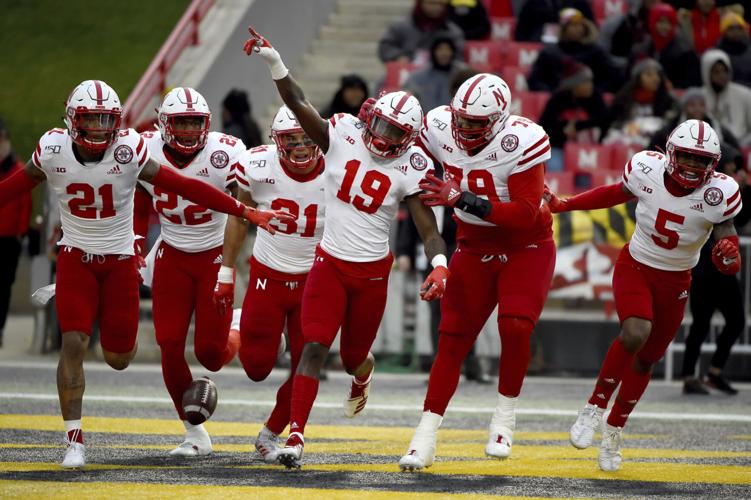
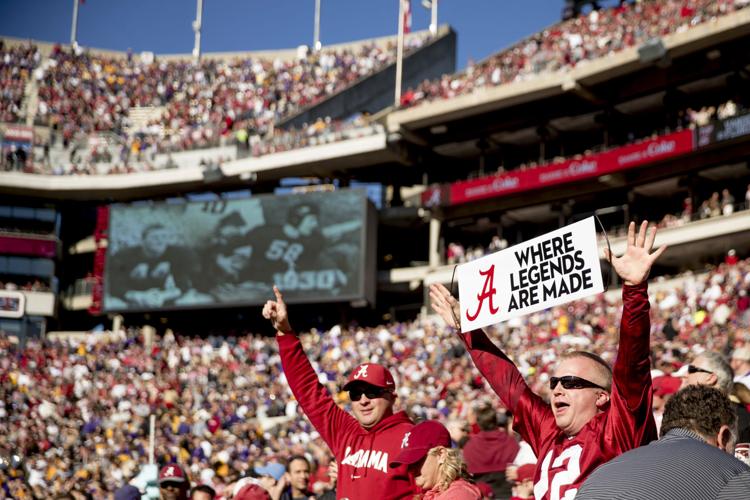
In an attempt to get a better understanding of why Nebraska so selfishly attempted to play football and act opposite of its Big Ten partners; in a move to learn more about the independent nature of NCAA football titans like Alabama and Texas, I turned off ESPN, silenced Twitter and read two very intense, very long and very insightful books on the history of college football.
Here’s what I discovered: College football has rarely operated on smooth seas. It has historically been a what’s-in-this-for-me business, more apt to deploy athletic mercenaries than student-athletes.
I mean, in 1906, Michigan withdrew from the Big Ten because its conference partners insisted that five football games a year was the safest way to operate. The Wolverines demanded to play seven games.
That sounds familiar 114 years later.
Angry at losing the vote, Michigan withdrew from the Big Ten until 1917.
Over the last week, I absorbed two books: “Unsportsmanlike Conduct: Exploiting College Athletics,” written in 1995 by Walter Byers, the first executive director of the NCAA. I followed by reading “Institutional Control Issues Within the NCAA,” written in 2002 by Allison Freedman, then an assistant athletic director at the University of Pacific.
You couldn’t get two more contrasting voices, but Byers and Freedman hit the same chord: The more things change in college athletics, the more they stay the same.
College football’s first national-level conflict arose in 1905. That’s when President Teddy Roosevelt, of all people, intervened after 18 college football players died and more than 150 were seriously injured in the days before leather-helmets and safety regulations.
Roosevelt summoned the game’s biggest names, representatives from Harvard, Yale and Princeton, to the White House and said “that’s enough.” He insisted that college football eliminate risks and restore ethical conduct.
“I wouldn’t for one moment excuse the perversion of athletics which could make it the end of life, instead of merely a means of life,” he said.
“It is a very poor business indeed for a college man to learn nothing but sport.”
James Roscoe Day, then the president of Syracuse University, said “one human life is too big a price for all the games of the season.” Day unsuccessfully attempted to abolish football at Syracuse.
Now, 115 years later — in the age of the transfer portal, one-and-done basketball players and athletic department budgets that routinely top $100 million per school per year — the debate rages. Is it safe to play college football in the thick of a pandemic?

At blue bloods like Alabama, football brings in millions of dollars each year and helps pay for other sports at the school.
Should the model for college athletics be reset with more common sense and less chase of the dollar?
In 1929, the Carnegie Foundation investigated what it termed “runaway growth” of college sports, referring to it as “demoralizing,” saying that football had “reached the proportion of university-wide commerce.”
It determined that the advent of donations from boosters, townsmen, alumni and fans were “evils.”
That was 91 years ago. If college football follows a similar course for the next 91 years, it would be the NFL times ten.
It all began so innocently.
The so-called “watershed game” of college football was played in 1869. Princeton vs. Rutgers. It was such a success that it turned the heads of college presidents, who recognized the attention a football game could bring to campus, helping to attract students, improve public relations, enhance the university’s prestige and raise the kind of revenue that hadn’t been imagined.
And then it got out of control almost overnight.
In 1876, future Michigan Hall of Fame football coach Fielding Yost was allegedly offered money to play for Lafayette in a game against mighty Penn, which had won 36 consecutive games. Never mind that Yost was at the time a student at West Virginia. He became the game’s first-ever “transfer,” playing for Lafayette as the Leopards broke Penn’s winning streak.
According to Byers and Freedman, Yost was back at West Virginia a few weeks later.
Such “ringers” led to widespread cheating. By 1905 the forerunner to the NCAA — the Intercollegiate Athletic Association of the United States — was formed. Five years later, the IAAUS became the NCAA. It had virtually no power, and wouldn’t until Byers became the NCAA’s first executive director in 1951.
College sports were so freewheeling by 1951 that 19 days after Byers became the NCAA’s executive director, he imposed the “death penalty” on Kentucky’s basketball program for such things as point-shaving and fixing games.
Almost every school in big-time college sports worked the edges. UCLA, for example, with the honorable John Wooden as its basketball coach, built Pauley Pavilion in the 1960s for $5.5 million. The financing of the arena reflected the growing big-money era of college sports.
Donor Edwin Pauley gave $1.5 million for naming rights and the school obtained $2.5 million from the state of California for including a physical education “teaching facility” in its building plan. The final $1.5 million came from UCLA students’ annual registration fees.
Fielding Yost, where are you?
The end of the innocence took longer at an isolated, frontier-school like Arizona. In 1914, UA football, basketball and baseball coach Raymond L. Quigley left Tucson to become the director of playgrounds for the city of Fresno, California.
Arizona hired Tucson High teacher/coach J.F. “Pop” McKale. His beginning salary was $1,700. His athletic department budget was $835, of which he used $575 for football. It took McKale and the UA 15 years to get enough financial donations from nine Arizona copper companies to build Arizona Stadium for roughly $160,000.
The stadium was completed in 1929, the year the Carnegie Foundation’s investigation determined there was too much commercialism in college sports.
That was 91 years ago. Over the last decade, more than $100 million has been spent to rebuild much of Arizona Stadium. Another $150 million is needed to finish the job.
The playground days are long gone. When the pandemic is over, Arizona is still going to have to find a way to get that $150 million if it wants to remain in the company of Nebraska and Alabama.
You don’t need to read a few books to understand that.
Photos: Every U of A vs. ASU football game since 1975
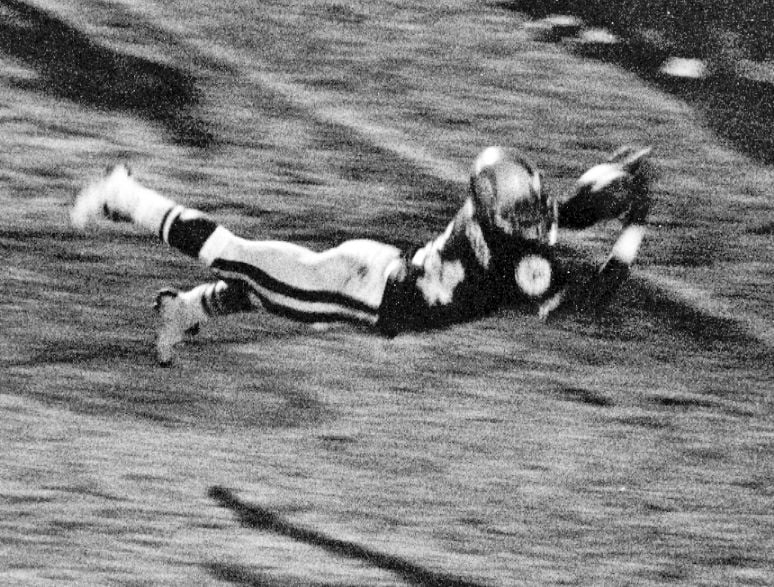
1975: ASU 24, UA 21 – "The Catch" by Arizona State University receiver John Jefferson during the 1975 ASU/UA football game. Courtesy ASU

1976: ASU 27, UA 10 – This ASU receiver missed the catch, but ASU won the game against UA on Nov. 27, 1976. Arizona Daily Star
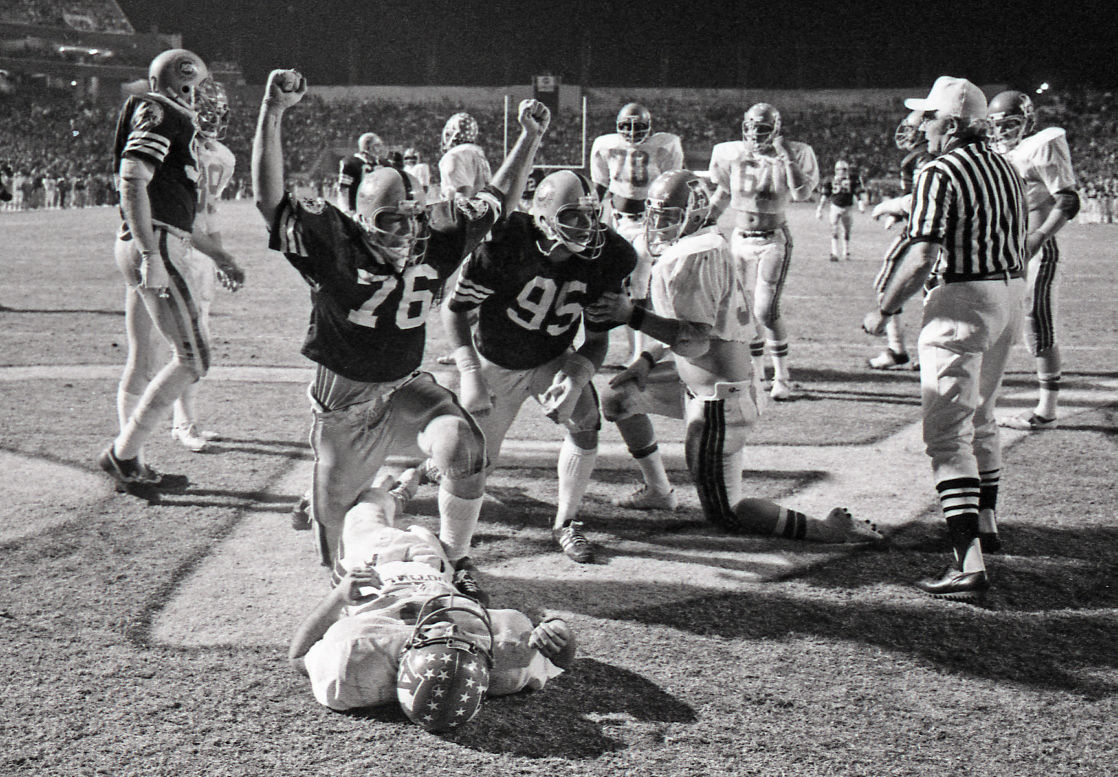
1977: ASU 23, UA 7 – Arizona State’s Bob Pfister raises his arms over a downed University of Arizona quarterback Marc Lunsford after ASU forced a 2-point safety on Nov. 26, 1977 in Tempe, Ariz. ASU won, 23-7. P.K. Weis / Tucson Citizen

1978: ASU 18, UA 17 – Arizona State quarterback Mark Malone is sacked by an University of Arizona defender in Arizona Stadium on Nov. 25, 1978. H. Darr. Beiser / Tucson Citizen

1979: UA 27, ASU 24 – Arizona Wildcats players celebrate after edging Arizona State, 27-24, in Tempe on Nov. 24, 1979. H. Darr Beiser / Tucson Citizen
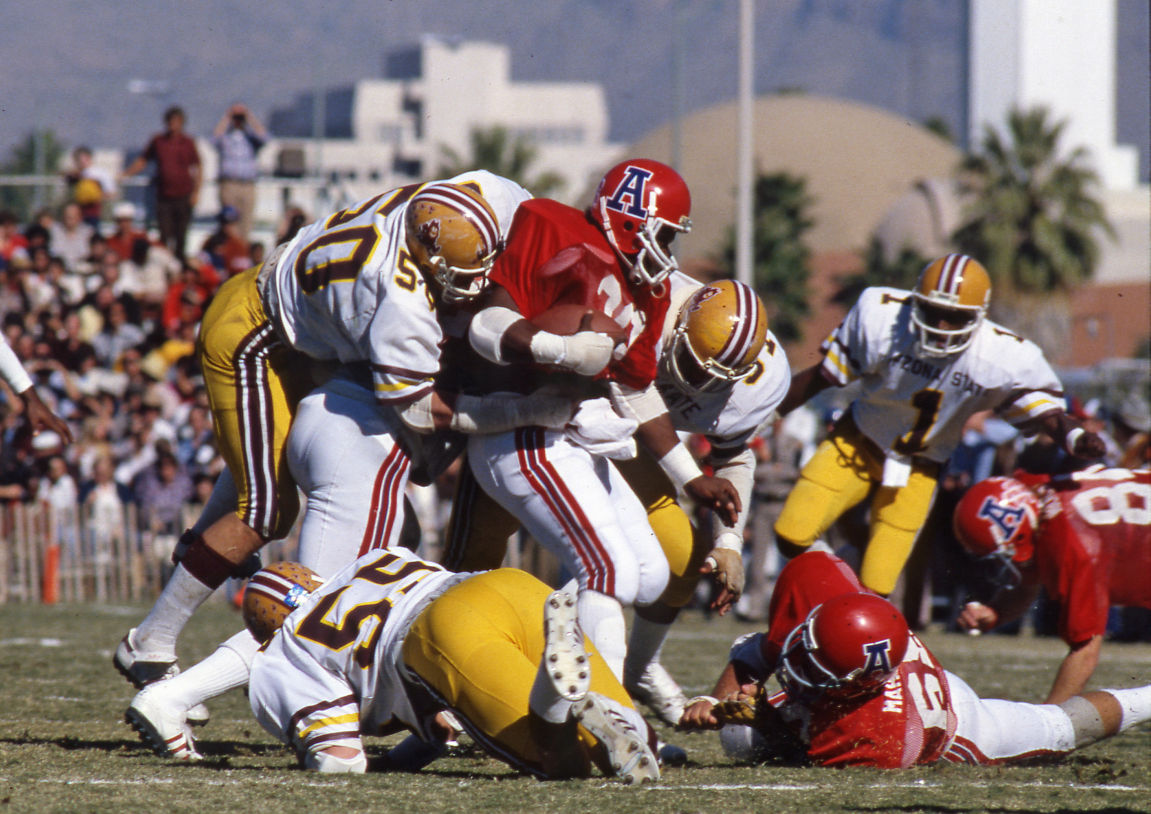
1980: ASU 44, UA 7 – UA fullback Courtney Griffin is wrapped up by the ASU defense on Nov. 29, 1980 in Tucson, when the north end zone was still wide open. P.K. Weis / Tucson Citizen

1981: ASU 24, UA 13 – The celebration was short-lived for the Wildcats, since the Sun Devils pulled off a victory on at wet, muddy day on Nov. 28, 1981. Peter Weinberger / Tucson Citizen

1982: UA 28, ASU 18 – University of Arizona quarterback Tom Tunnicliffe looks to pass during the 1982 ASU/UA football game. Tucson Citizen
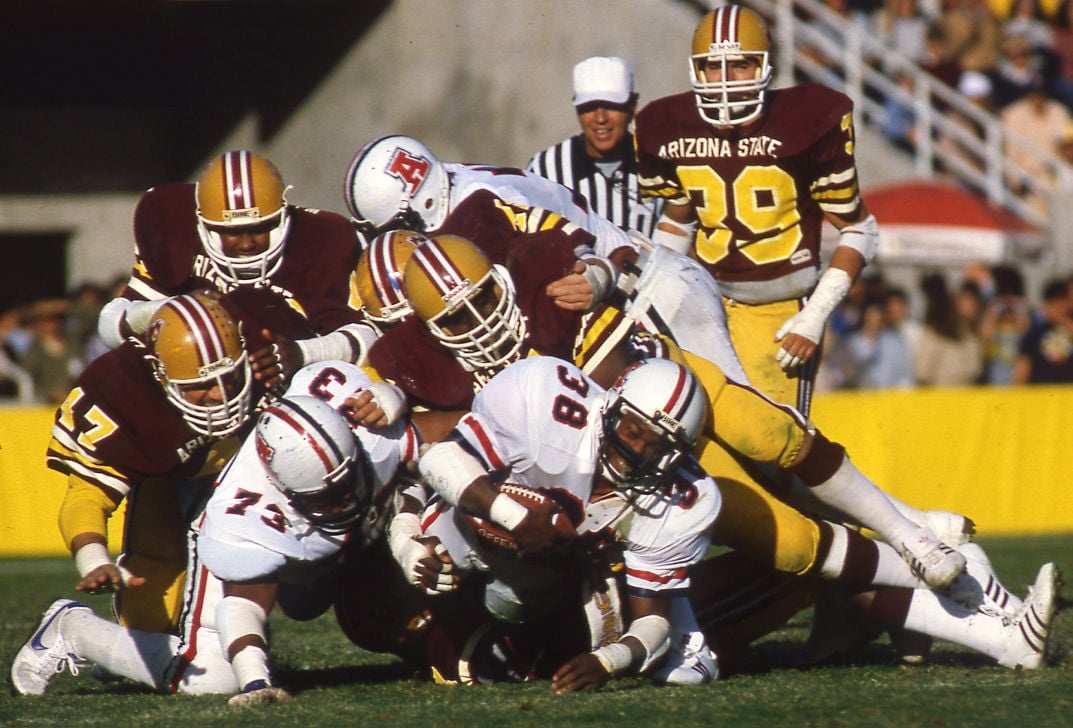
1983: UA 17, ASU 15 – The Arizona offense stretches for yardage against ASU on Nov. 26, 1983 in Tempe. Glenn Capers / Tucson Citizen

1984: UA 16, ASU 10 – The goal posts came down at Arizona Stadium on Nov. 24, 1984, as Arizona edged ASU. David Schreiber / Tucson Citizen

1985: UA 16, ASU 13 – Max Zendejas of UA leaps into the air after booting the game-winning field goal against ASU on Nov. 23, 1985 in Tempe. Warren Faidley / Tucson Citizen

1986: UA 34, ASU 17 – UA's Chuck Cecil #6 races out of the ASU end zone enroute to a 106-yard interception for a touchdown in the fourth quarter on Nov. 22, 1986. Photo by Bruce McClelland / Arizona Daily Star

1987: ASU 24, UA 24 – An Arizona running back gets wrapped up by ASU defenders on Nov. 28, 1987. Warren Faidley / Tucson Citizen
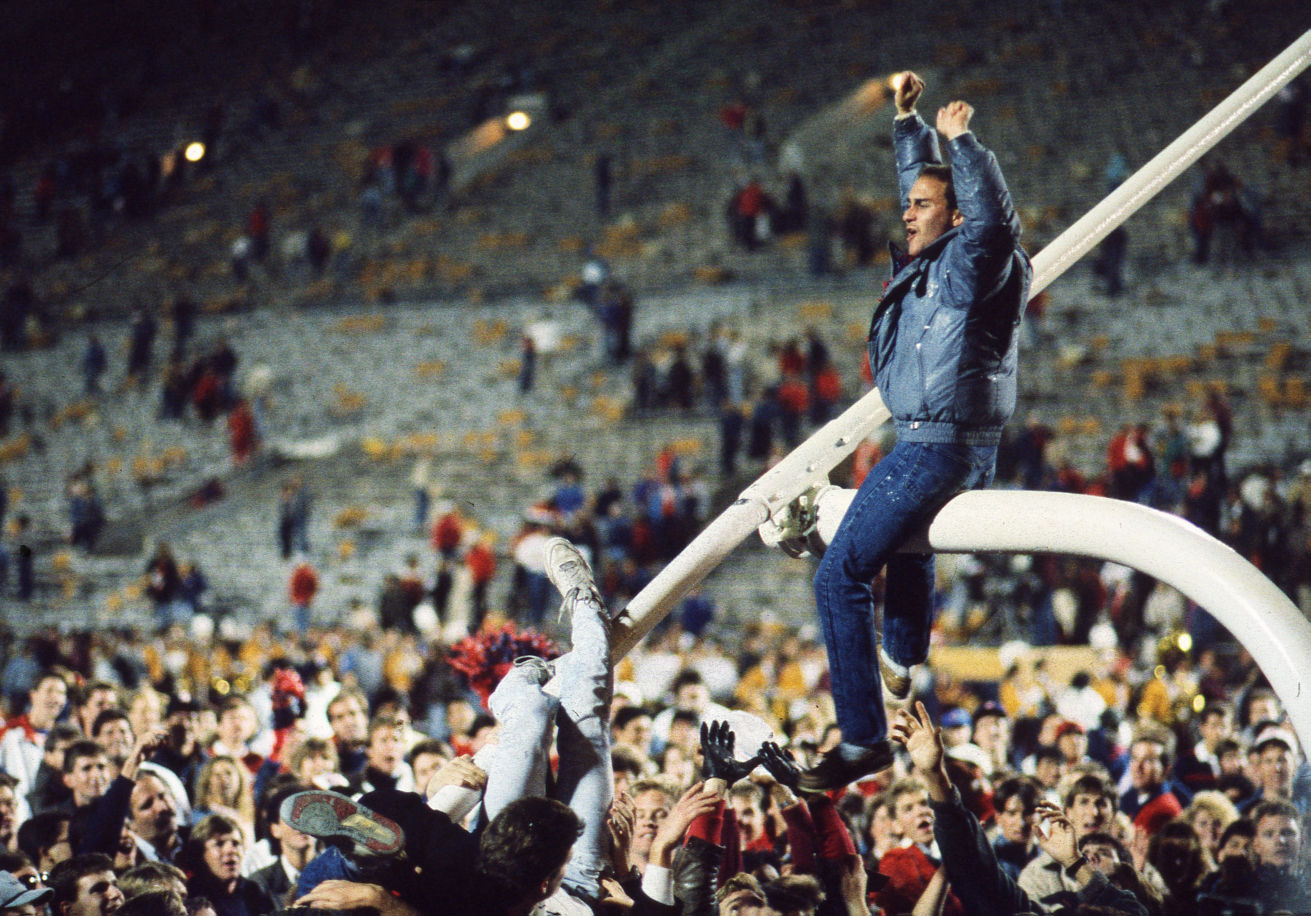
1988: UA 28, ASU 18 – Fans toppled the goal posts after UA beat ASU in Tucson on Nov. 26, 1988. Rick Wiley / Tucson Citizen

1989: UA 28, ASU 10 – UA’s Reggie Johnson forces ASU quarterback Paul Justin to fumble, which set up a UA score on Nov. 25, 1989 in Tempe. Rick Wiley / Tucson Citizen

1990: UA 21, ASU 17 – ASU’s Adam Brass dips his head after UA scored on a bad snap on Nov. 24, 1990 in Tucson. Rick Wiley / Tucson Citizen
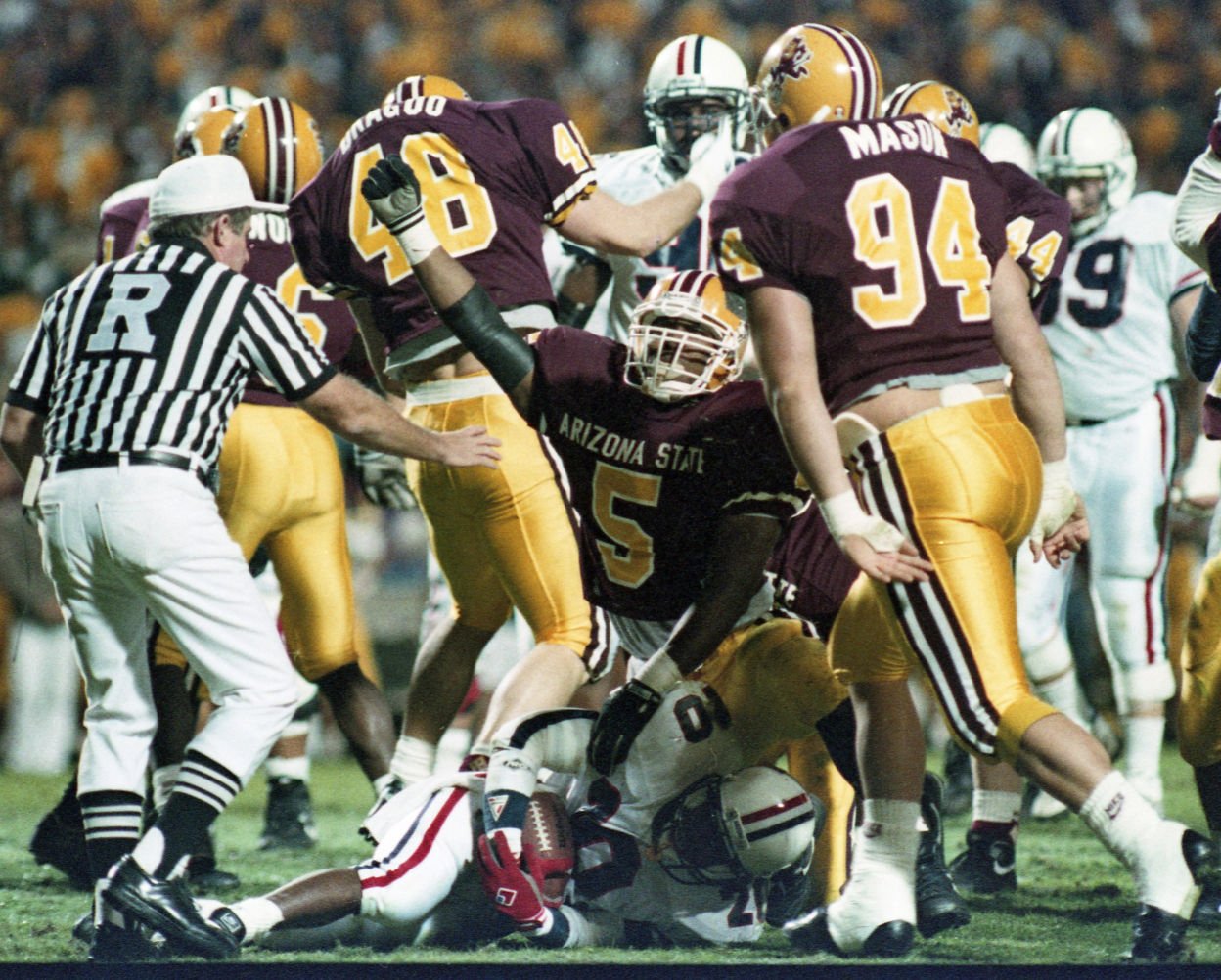
1991: ASU 37, UA 14 – ASU’s Michael Williams defiantly downs UA running back Ontiwaun Carter on Nov. 23, 1991. Rick Wiley / Tucson Citizen

1993: UA 34, ASU 20 – ASU quarterback Jake Plummer on the turf after he was downed by UA’s defense, including Tedy Bruschi, on Nov. 26, 1993 in Tempe. Rick Wiley / Tucson Citizen
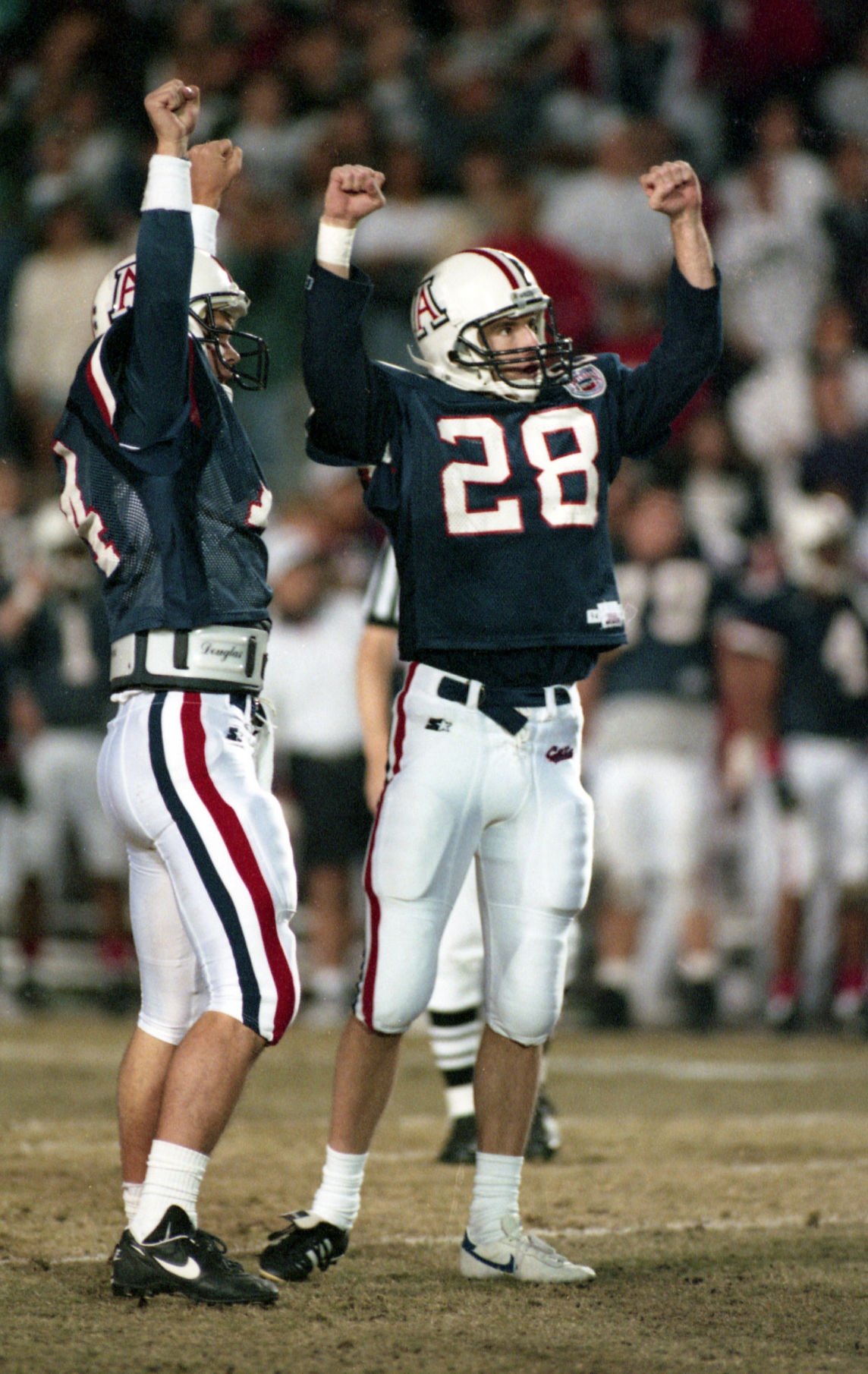
1994: UA 28, ASU 27 – UA kicker Steve McLaughlin, right, and holder Ryan Hesson watch the ball go through the uprights during the Arizona State vs. Arizona football game on Nov. 25, 1994. Photo by Rick Wiley / Tucson Citizen

1995: UA 31, ASU 28 – ASU head coach Bruce Snyder greets UA head coach Dick Tomey after the game during the 1995 Arizona vs. Arizona State football game on Nov. 24, 1995. Photo by Bruce McClelland / Arizona Daily Star

1996: ASU 56, UA 14 – ASU's Jake Plummer got his revenge, powering the Sun Devils to victory on Nov. 23, 1996 and a trip to the Rose Bowl. Brian Winter / Arizona Daily Star

1997: UA 28, ASU 16 – UA Tight End Mike Lucky #88, catches a pass in front of ASU's Damien Richardson #39 on Nov. 28, 1997. Jeffry Scott / Arizona Daily Star

1998: UA 50, ASU 42 – ASU QB Ryan Kealy #8 is sacked by UA's Mike Robertson #55 on Nov. 27, 1998. UA went on to finish the season with a 11-1 record, the best the school has ever had. Benjie Sanders / Arizona Daily Star

1999: ASU 42, UA 27 – UA's Dennis Northcutt is trying to get away from ASU defender Adam Archuleta #40, who dragged down Northcutt for a loss on Nov. 27, 1999. Benjie Sanders / Arizona Daily Star

2000: ASU 30, UA 17 – UA football coach Dick Tomey walks off the field at Arizona Stadium after congratulating ASU coach Bruce Snyder on Nov. 24, 2000. Tomey resigned after the game.
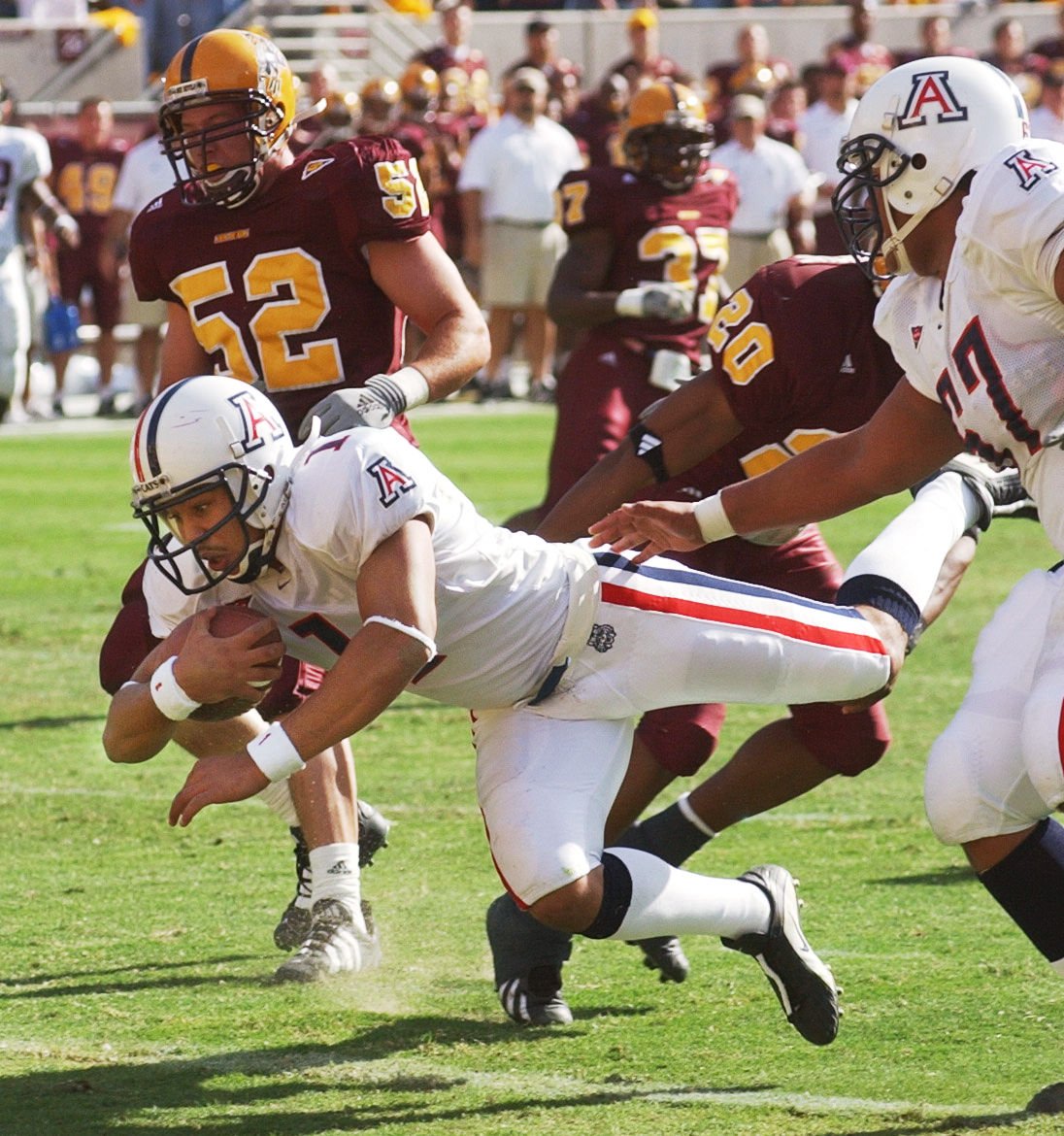
2001: UA 34, ASU 21 – Arizona's Bobby Wade, a Phoenix native, scores the first touchdown of the game on Nov. 24, 2001. His 11 catches and 157 yards were career bests for the junior. David Sanders / Arizona Daily Star

2002: ASU 34, UA 20 – ASU tailback Mike Williams dives into the end zone for one of his three second-half touchdowns Nov. 29, 2002 against Arizona. Aaron J. Latham / Arizona Daily Star

2003: ASU 28, UA 7 – Arizona State's Chris McKenzie, left, holds on to Arizona wide receiver Ricky Williams after Williams caught a pass from Kris Heavner on Nov. 28, 2003, in Tempe. (AP Photo/Roy Dabner)

2004: UA 34, ASU 27 – Arizona's Steve Fleming (87) out runs Arizona State's Chad Green (21) for a second quarter touch down. Xavier Gallegos / Tucson Citizen

2005: ASU 23, UA 20 – Off and running: ASU's Terry Richardson sprints down the sidelines on the way to a 71-yard punt return for a touchdown against Arizona on Nov. 26, 2005, that tied the game at 20. David Sanders / Arizona Daily Star

2006: ASU 28, UA 7 – Arizona State wide receiver Chris McGaha (13) and Jamaal Lewis celebrate McGaha's touchdown at Arizona Stadium on Nov. 25, 2006. Greg Bryan / Arizona Daily Star
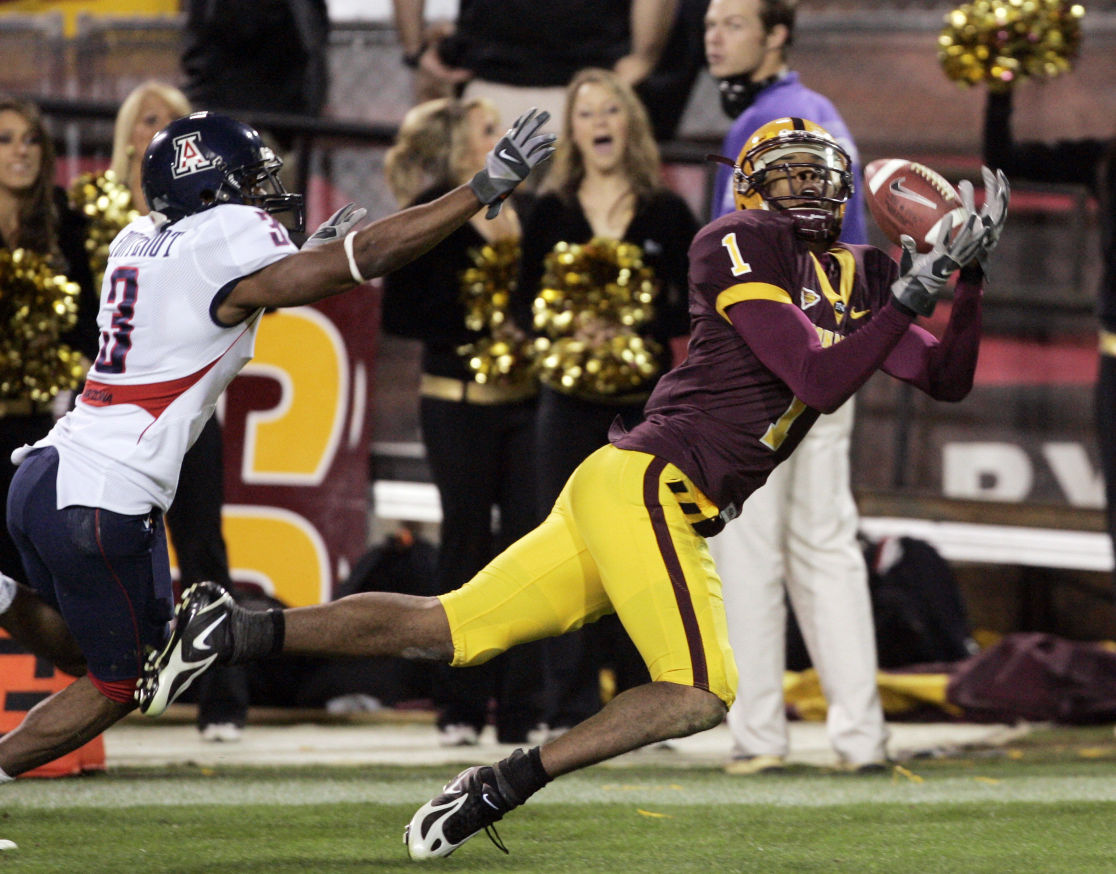
2007: ASU 20, UA 17 – ASU Receiver Michael Jones hauls in a TD pass in front of UA's Wilrey Fontenot in the fourth quarter in Tempe on Dec. 1, 2007. David Sanders / Arizona Daily Star

2008: UA 31, ASU 10 – Arizona's quarterback Willie Tuitama is carried off the field by the crowd after engineering a 31-10 win against ASU at in Tucson on Dec. 6, 2008. Kelly Presnell / Arizona Daily Star
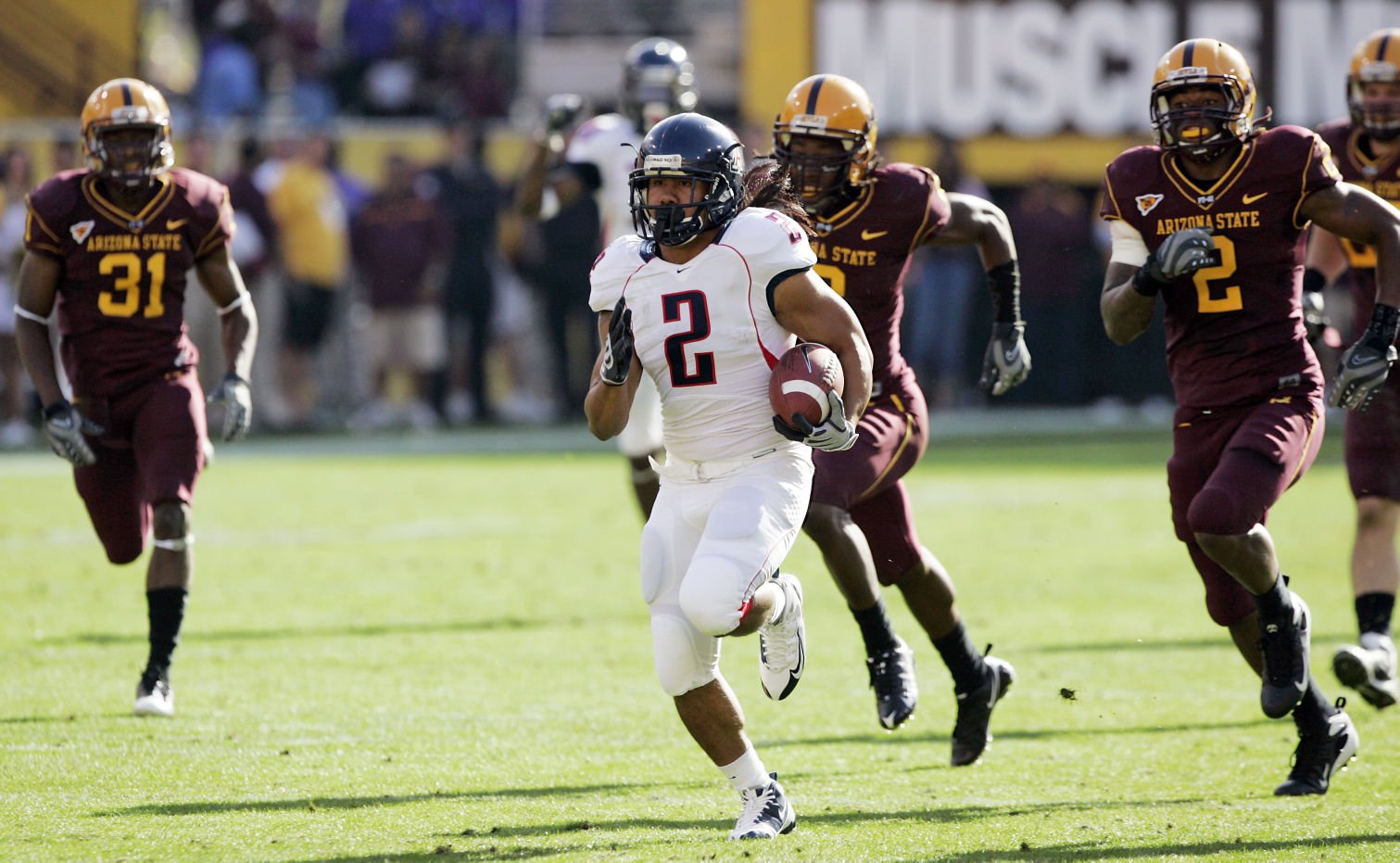
2009: UA 20, ASU 17 – University of Arizona running back Keola Antolin breaks downfield for Arizona's first score against ASU on Nov. 28, 2009 in Tempe. Dean Knuth / Arizona Daily Star
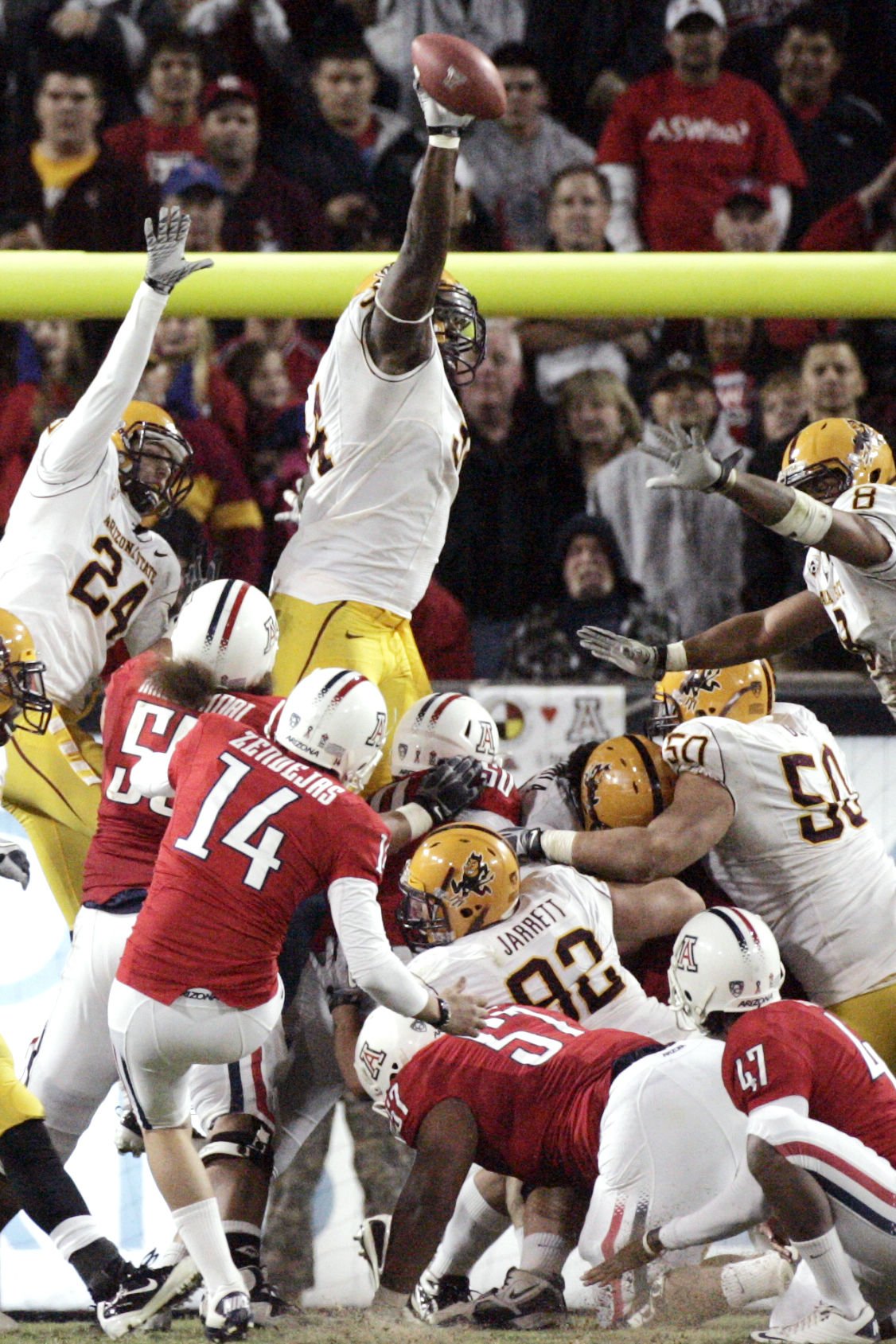
2010: ASU 30, UA 29 2OT – With the scored tied 20-20, University of Arizona's Alex Zendejas has his game winning extra point blocked by ASU's James Brooks at Arizona Stadium on December 2, 2010. Arizona lost in double overtime 30-29. Dean Knuth / Arizona Daily Star

2011: UA 31, ASU 27 – After Mike Stoops was fired, interim coach Tim Kish and quarterback Nick Foles carried Arizona through the end of the season, culminating in a victory over ASU in Tempe on Nov. 19, 2011. David Sanders / Arizona Daily Star

2012: ASU 41, UA 34 – Arizona State's Marion Grice leaps over a teammate on Nov. 23, 2012, at Arizona Stadium.

2013: ASU 58, UA 21 – Arizona head coach Rich Rodriguez looks on none too pleased during the fourth quarter on Nov. 30, 2013 in Tempe.

2014: UA 42, ASU 35 – Arizona wide receiver Samajie Grant strides into the end zone on a 69-yard touchdown pass on Nov. 28, 2014

2015: ASU 52, UA 37 – Arizona State Sun Devil running back Demario Richard (4) runs into a swarm of Arizona Wildcats defenders during the fourth quarter of the Territorial Cup at Sun Devil Stadium on Nov. 21.

2016: UA 56, ASU 35 – Arizona Wildcats cornerback DaVonte' Neal (19) celebrates his interception during the first quarter of the Arizona State University Sun Devils vs. University of Arizona Wildcats in the Territorial Cup college football game on Nov. 25 at Arizona Stadium. The Wildcats redeemed a dismal season, beating the Sun Devils, 56-35.

2017: ASU 42, Arizona 30 — Arizona State Sun Devils players celebrate with the Territorial Cup after the University of Arizona Wildcats vs. Arizona State University Sun Devils in the Territorial Cup college football game on Nov. 25.

2018: ASU 41, Arizona 40 — Arizona State Sun Devils offensive lineman Steven Miller (71) rams the pitchfork into the Arizona Wildcats end zone after the Territorial Cup on Nov. 24 at Arizona Stadium in Tucson. Arizona State rallied in the fourth quarter for the win.

2019: ASU 24, UA 14 – Arizona Wildcats wide receiver Jamarye Joiner (10) jukes Arizona State defensive back Evan Fields (4) as he moves the ball up field for a touchdown during the Territorial Cup at Sun Devil Stadium in Tempe on Nov. 30.

Arizona’s bench watches the second quarter unfold in the Wildcats’ 70-7 loss against Arizona State at Arizona Stadium on Dec. 11, 2020. Head coach Kevin Sumlin was fired afterward.

2021: ASU 38, UA 15: Arizona Wildcats safety Jaxen Turner brings down Arizona State wide receiver Ricky Pearsall after a midair catch in the third quarter at Sun Devil Stadium. The loss ended a disappointing first season for new head coach Jedd Fisch at 1-11. But the slow rebuilding process was showing fruit, with better morale and a Homecoming win over Cal.

