

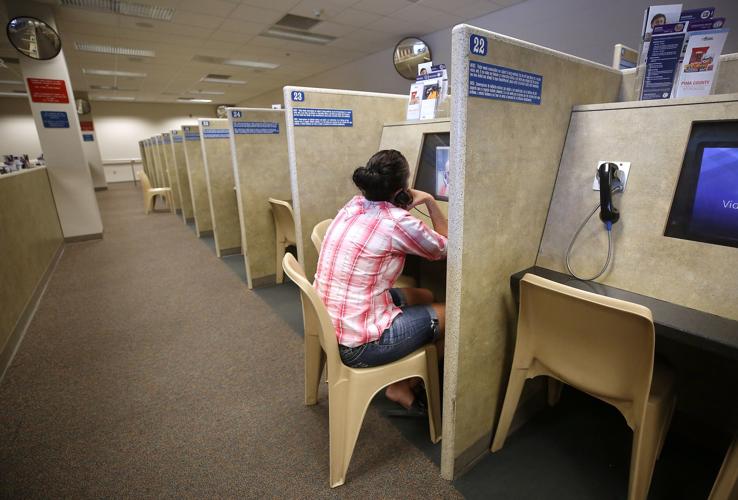
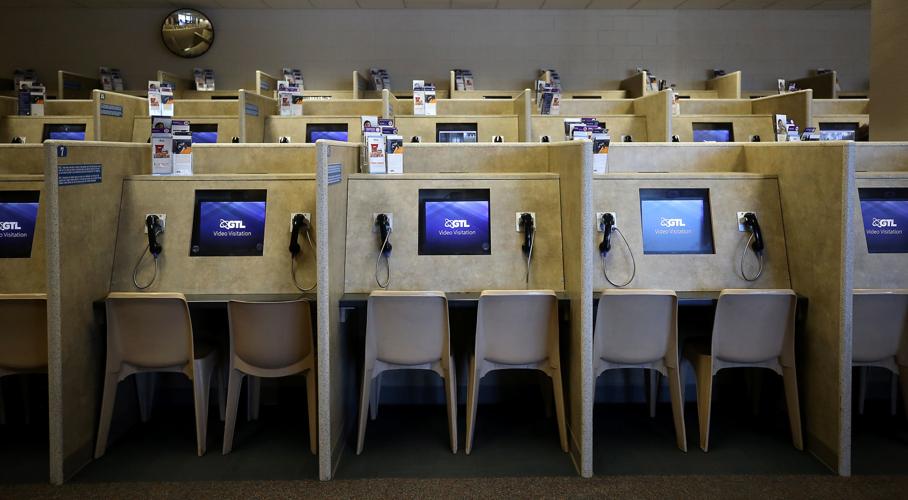

Charging families of Pima County jail inmates for video visits creates an unfair burden on low-income and poor families, says a new Tucson grass-roots organization sponsored by the Alliance for Global Justice.
“We should not charge people to see their loved one because they are incarcerated. It’s extortion,” said Lola Rainey, who heads the Tucson Second Chance Community Bail Fund.
Sheriff’s Capt. Sean Stewart said it’s not extortion, but rather a practice that allows more family members who live far away to connect with loved ones in jail. Every inmate gets one free half-hour visit each week, he said, and has since the jail switched from in-person visits to video visits more than a decade ago.
Families started being offered the chance to pay for more video visits — and to also visit remotely via smartphones or computers — after the jail entered into a contract with Global Tel Link in 2014, he said. The jail started receiving a 50 percent commission on what’s earned in 2016 after Global Tel Link recouped its installation costs.
Video visitations brought in about $300,000 from July 2016 to March 2018, Stewart said, and the jail’s half goes to a fund that covers services for the inmates. This includes ankle monitors for in-home detention, education services, religious services and changing swamp coolers at the jail over to air conditioning.
“So the argument that this doesn’t help the poor isn’t accurate because without it we wouldn’t have been able to afford any of this,” Steward said, referring to the inmate fund. “These are things that the taxpayers wouldn’t necessarily want to fund.”
Wanda Bertram, spokeswoman for the Massachusetts-based Prison Policy Initiative, said she wonders why a community wouldn’t already be investing in services like that, services that she says help prevent recidivism. Instead, she said, it’s “falling on the backs of the people whose family members are incarcerated to pay for this.”
Her organization keeps tracks of which counties are implementing video visitation and current totals are about 600 nationwide.
Of these, she said about 75 percent of those have also eliminated the option of so-called in-person visits, which take place with plexiglass separating the inmate from his or her visitor.
There are nine counties in Arizona that have implemented video visits, she said, and Pima, Pinal and Maricopa counties have banned in-person visitation.
Bertram and Rainey both think it’s important to offer inmates in-person visitation.
“A lot of people are still going to prefer to sit across from a loved one, even if it’s looking through glass,” said Rainey, who worked as a prosecutor and defense attorney. “Why don’t we give people the choice?”
As of last week, there were approximately 1,820 people being held at the jail and, of that number, about 250 were serving sentences handed down after their case was processed. The rest of the inmates have been charged but their cases have yet to be resolved. The average length of stay at the jail is about 22 days, Stewart said.
Shawna Barton’s son is being held at the jail. She’s worried about his mental health and finds scheduling and paying for the visits very stressful.
“If by chance you can’t make it to that scheduled visit, it’s canceled for an entire week and you have to wait until the next week,” she said of the one free visit.
Barton wants to see her son more than once a week, but said she can’t afford to pay for the visits. She’s received some help from Rainey’s organization.
If family or friends want to do more than the free half-hour each week, they can pay $9 for another 30 minutes at the jail, $7.50 for another 25 minutes from a remote site or $16.50 for another 55 minutes remotely, said Sheriff’s Lt. Elsa Navarro.
Reservations are made online with a credit card or debit card, which Rainey said further limits access for some families.
“If you are poor, this adds up,” she said.
Spending time in jail is often traumatic, Bertram said, and frequent visitation, especially in-person, can help inmates by keeping them connected to family and friends. She said Texas and California have passed legislation banning counties from eliminating the choice of in-person visitation for this reason.
Stewart said switching over has allowed the jail to save money and time previously spent supervising the metal detectors people had to use in order to do in-person visitation. It’s also reduced the amount of contraband getting into the jail because family members and friends do not leave the front lobby area where the kiosks are located.
“I might give more credence to that argument if it were a prison because, over time, that deterioration could take place,” Stewart said, referring to inmates’ family relationships. “We get nothing but thank yous and accolades from family members who get to use (video visitation) from other states and internationally.”
In-person visits still take place between attorneys and clergy and the inmates, he said.
Hassan Clement said the jail’s rules are making it hard for him to assist a neighbor who was recently arrested. He’s trying to help her keep up with bills, the care of her cat and other details. But since he’s tight on money, he said it’s creating a hardship for him to pay for his visits. The one free visit she gets is usually used by another visitor, he said.
“Everything costs, and it’s the poor people who are getting shafted,” said Clement, who is part of Tucson’s Culture of Peace Alliance. “These are mostly people who have just been charged with a crime, not convicted of anything.”

