

A U.S. Supreme Court ruling Friday empowers states and cities to enact laws designed to keep homeless people from sleeping on the street.
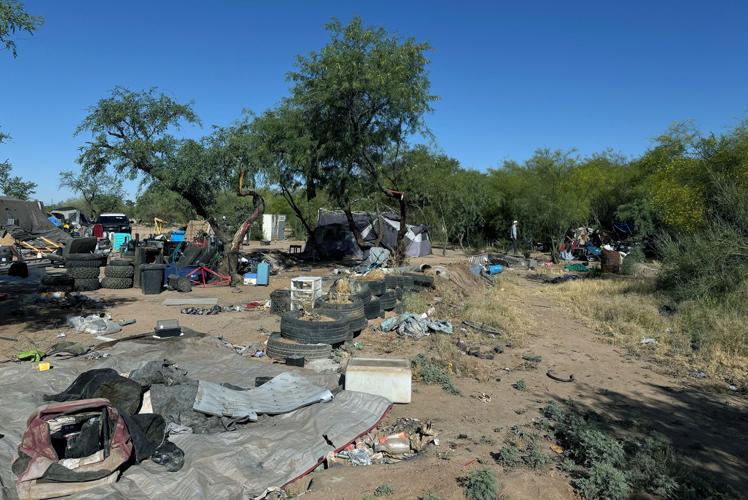
Arizona lawmakers are already making legislative plans and the Tucson City Council is now likely to consider a proposed ordinance banning people from camping in washes.
In a split decision, the justices ruled that laws banning camping on public property do not violate the Eighth Amendment ban against “cruel and unusual punishment.’’ The court also said such laws do not make being homeless a crime.
That overturns a decision by the 9th Circuit Court of Appeals, which had blocked the city of Grants Pass, Oregon, from enforcing anti-camping laws in a precedent for all Western states including Arizona.
Some communities in Arizona had cited the 9th Circuit ruling as a reason they could not close down homeless encampments. Friday’s ruling frees up state and local lawmakers to reconsider the issues.
In Tucson, the 9th Circuit’s Grants Pass ruling was the specific reason the City Council paused consideration in February of a proposed ordinance to ban camping in washes, pending the Supreme Court ruling that has now come down.
Camping, under the proposal’s draft language, could be defined as “the placement of any tent, temporary shelter or structure, blanket, cloth, or other sleeping instruments for the purpose of protection from the elements” across Tucson’s three dozen washes.
An ordinance to bar wash encampments is necessary, Tucson officials have said, because of the potential for monsoon season floods to endanger homeless people camping in them.
But even if such an ordinance is approved, the city doesn’t have the resources to enforce it “to some incredible level,” then-City Manager Michael Ortega said in February. It would only be “a tool” to address dangerous situations in the community, he said.
Ortega and Tucson City Attorney Mike Rankin indicated at the time that the city’s enforcement protocols would continue, such as public outreach and encampment notifications when clear-outs are set to occur.
Last fall, two homeowners and one business owner in Tucson’s Hendrick Acres neighborhood brought a lawsuit against the city of Tucson over homeless people camping at Navajo Wash. The complaint said fires have burned out of control at the wash at least twice “in the recent past,” while drug use at the camps spills “into alleys and streets and on to private property.”
The lawsuit “remains necessary” despite Friday’s ruling, Ilan Wurman of Tully Bailey LLP, an attorney representing the three plaintiffs in the neighborhood, told the Arizona Daily Star Friday.
“The Supreme Court’s Grants Pass decision removes one obstacle to enforcing camping bans: cities can no longer use the Ninth Circuit decisions as an excuse to refuse to enforce the laws,” Wurman said.
“In Tucson, there were over 1,000 available and unoccupied beds in last year’s point-in-time count. City officials testified that they always had shelter available,” Wurman said. “The Ninth Circuit decisions were never an obstacle. The City of Tucson chooses to allow public camping. That is why a public nuisance lawsuit remains necessary.”
But Pima County Attorney Laura Conover, a Democrat, said the justices got it wrong — as do people who see living on the street as a voluntary activity, she said.
She said the justices are saying that “even with there’s no space available, we can just pretend that people are deliberately outside in 105-degree heat.’’
Conover said refusing to arrest homeless people does not give them a license to commit crimes. She said when laws are violated, her prosecuting office will hold people accountable.
“Let me be clear, when criminal behavior is afoot, we have and will continue to hold people accountable. But arresting people for sleeping is not the way,” Conover said Friday. “Fortunately, I don’t foresee our local authorities using precious resources in an attempt to arrest our way out of chronic illness. While the Supreme Court might tolerate cruelty, our community does not.”
Proposed Arizona laws
Justice Neil Gorsuch, who wrote Friday’s majority 6-3 decision overturning the lower court ruling, invited state and local measures to ensue.
“A handful of federal judges cannot begin to match the collective wisdom the American people possess in deciding how to handle a pressing social question like homelessness,’’ he wrote. “The Constitution’s Eighth Amendment serves many important functions, but it does not authorize federal judges to wrest those rights and responsibilities from the American people and in their place dictate this nation’s homelessness policy.’’
“I’m definitely looking into it,’’ said Arizona state Sen. Justine Wadsack, a Tucson Republican.
She sponsored legislation last year that would have required Arizona cities to tear down homeless encampments and charge those living there with criminal trespass. It was approved by the Republican-controlled Legislature on party-line votes, with Wadsack saying much of the opposition from Democrats was over the Eighth Amendment issue.

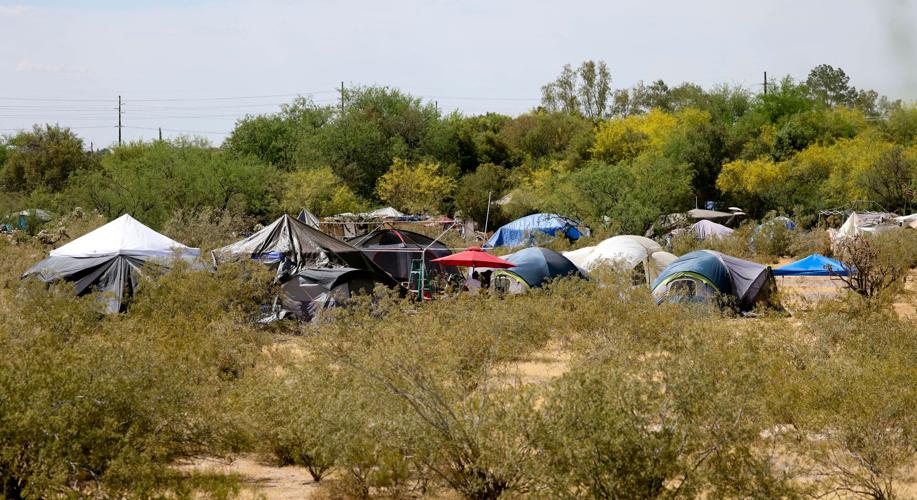
City crews and volunteers began loading debris from a large homeless camp into a garbage truck early Thursday. A section of the encampment was being cleared for soil testing, but the whole camp is set to be cleared before the end of the year for park improvements.
In vetoing the measure, Democratic Gov. Katie Hobbs did not cite the Grants Pass case. Instead, she said people become unsheltered for a variety of reasons and “this legislation addresses none of those root causes, offers no pathways to assistance, and effectively criminalizes experiencing homelessness.’’
Wadsack told Capitol Media Services Friday she will now “try a different approach’’ to see if she can get some sort of measure enacted into law.
One factor that played a role in the 9th Circuit ruling was the question of whether it is wrong to make it a crime to sleep on the street when people have nowhere else to go.
Wadsack said that’s not the case. “There are shelters, there are beds,’’ she said. She said the issue is more political, and that this isn’t a question of finding a balance between the rights of a neighborhood and the rights of the homeless.
“I think it’s one in the same,’’ she said. “Everybody has a right to safety and be free from crime. When you have a home and you walk out into your back alley to throw away your trash or to park your car, you shouldn’t have to step over tents and people’s human feces to get there.’’
Still, she said she recognizes the other side.
“People who are in a situation that is dire and living on the street because they don’t have other options, they have a right to dignity and their humanity as well,’’ Wadsack said. “When there are options there, there’s nothing worse than government getting in the way.’’
It’s not just Wadsack who wants the greater flexibility that Friday’s ruling provides.
Arizona Senate President Warren Petersen and House Speaker Ben Toma spent $15,000 of taxpayer funds last year to file their own legal brief in the case before the U.S. Supreme Court, asking the justices to overturn the 9th Circuit ruling.

In May, city officials notified people living in a portion of Tucson’s largest homeless camp that they needed to vacate the area. The 100-Acre Wood is near East Golf Links Road and South Alvernon Way.
“Lawmakers must use a suite of state and local government policies, including camping ordinances, to adequately address the social and public health effects of homelessness,’’ wrote Beau Roysden, a former assistant Arizona attorney general now in private practice, on behalf of the Arizona Republican lawmakers. He told the justices the 9th Circuit ruling removed “a critical tool previously available to states, counties, and cities working to combat homelessness.’’
Governor’s opposition
What may be standing in the way of all that, at least at the state level, is the governor.
Not only did Hobbs reject Wadsack’s bill on creating the crime of trespass, she also vetoed legislation that would have made it illegal to erect or maintain any sort of housing structure on any public street, highway, alley, lane, parkway, sidewalk of other right of way. That measure was written by Sen. John Kavanagh, R-Fountain Hills, to specifically include tents, tarps, boxes or similar objects.
“Rather than solving these issues in a meaningful way, this bill only makes them less visible,’’ the governor said.
On Friday, Hobbs said nothing in the new decision will change that.
“Under my watch, we will not criminalize people sleeping on the street,’’ she told Capitol Media Services.
City officials began moving people out of a portion of Tucson's largest homeless camp early Thursday morning, May 23. Police began notifying occupants about 5 a.m. that the clear-out was happening and that they'd need to leave the area known the 100-Acre Wood, which also is called “The Acres,” and is located near the Davis-Monthan Air Force Base. Video by Grace Trejo, Arizona Daily Star
“It is unconscionable that we would do that when we don’t have enough resources to care for people who are being priced out of their homes because we have an affordable housing crisis,’’ Hobbs said.
On top of that, she said, the state needs to provide services.
“A lot of people who are living on the street are dealing with serious mental illness, chronic substance abuse, so many other issues that prevent them from maintaining stable housing,’’ Hobbs said.
State Sen. Priya Sundareshan, D-Tucson, said it won’t matter if GOP lawmakers see Friday’s ruling as a license to start proposing new laws criminalizing homelessness.
“That is our saving grace right now, having the governor as a backstop,’’ she said.
She blasted what the justices did. “Simply making it a criminal activity to be on the street is not a solution to homelessness,’’ Sundareshan said. “I think it is kicking people when they are down.’’
Arizona ballot measure
Even if Hobbs blocks some new laws, that won’t end the discussion about what can be done in Arizona.
A measure on the November ballot will allow voters to decide whether businesses or residents affected by homelessness should get a property tax break — a burden that would fall on everyone else in the community to make up the lost revenues.
Proposition 312 would allow property owners to seek a refund of their city or county taxes if the community has a “policy, pattern or practice’’ of declining to enforce certain laws.
That is spelled out as everything from illegal camping, obstructing sidewalks, panhandling, public urination and public drinking. The affected property owners would have to document the expenses they incurred to offset those problems, though the total refund could not exceed taxes paid.
Petersen said it’s only fair to ensure that businesses are not saddled with additional financial burdens because of the problem of homelessness.
Toma expressed similar sentiment during debate as the Legislature placed the proposal on the November ballot.
“This bill ... ensures that hardworking taxpayers will no longer be forced to bear the burden of the city’s refusal to do its duty to protect the public health and safety,’’ he said.
The measure is being pushed by the Goldwater Institute, which advocates less government regulation. Goldwater attorney Timothy Sandefur said the Supreme Court recognized that “each case is different’’ and state and local governments need flexibility in dealing with the issue of homelessness.
The philosophy until now, he said, is that “people can’t possibly help it.’’
“Well, some people can help it and some people can’t help it,’’ Sandefur told Capitol Media Services. “Some people need treatment, some people need psychological care, drug care, whatever it might be. And I think what today’s decision does is it allow for that to happen.’’
Justice Sonya Sotomayor wrote in a dissent for herself and two other justices: “Sleep is a biological necessity, not a crime. For some people, sleeping outside is their only option.’’
The law the majority approved punishes people for being homeless, Sotomayor said. “That is unconscionable and unconstitutional,’’ she said.
Tucson official’s reaction
Tucson’s city attorney, Rankin, said Friday he does not expect the high court’s ruling “will have a significant impact on the City’s enforcement practices relating to the use of public property.”
“Unlike many other western cities, Tucson has not been under any court order enjoining or limiting the enforcement of its local ordinances that regulate public property such as parks, streets, and sidewalks,” Rankin wrote. “This is largely because Tucson has been careful to shape its local laws and enforcement strategies in a way that protects the constitutional rights of its residents while still regulating the use of public property to allow enforcement efforts to preserve and promote public health and safety.”
“Like the city of Grants Pass, Oregon, Tucson has established a multifaceted approach to address unsheltered homelessness that respects the dignity and personal property of homeless individuals, while prohibiting unlawful occupancy of public property,” he said. “(Friday’s) Supreme Court decision reinforces the validity of the Tucson’s Homeless Encampment Protocol, under which the City’s enforcement efforts and deployment of resources to eliminate unlawful encampments are prioritized based upon the encampment’s impact on public health and safety.”
“I expect that this approach will continue now that the Supreme Court has confirmed our authority to enforce our local ordinances,” Rankin wrote.
City officials began moving people out of a portion of Tucson's largest homeless camp early Thursday morning, May 23. Police began notifying occupants about 5 a.m. that the clear-out was happening and that they'd need to leave the area known the 100-Acre Wood, which also is called “The Acres,” and is located near the Davis-Monthan Air Force Base. Video by Grace Trejo, Arizona Daily Star

