



When the James Webb Space Telescope was launched in 2021, astronomers predicted a deluge of discoveries that would rewrite entire textbooks about the cosmos.
Consider this the first chapter.
A team of scientists, including two from Tucson, have used Webb to all but confirm an enigma so far unexplained by physics: Our universe is expanding faster than it should be.

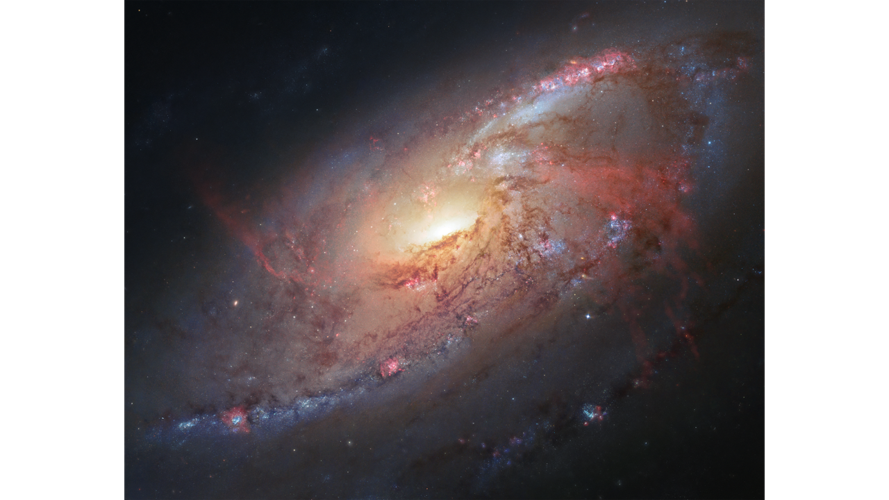
A composite of galaxy M106 using data from the Hubble Space Telescope and ground-based images taken by astrophotographers Robert Gendler and Jay GaBany. Researchers used M106 as their “anchor galaxy” when measuring relative distances and computing the expansion rate of the universe for a recent study.
According to a new paper by the research team, the strange phenomenon known as the Hubble Tension can no longer be dismissed as a statistical or observational mistake, thanks to precise data collected by the $10 billion observatory.
The lead author of the paper, Adam Riess, is a physicist at Johns Hopkins University in Baltimore, where he won the 2011 Nobel Prize in physics for his part in discovering “dark energy” and its role in accelerating cosmic expansion.
“With measurement errors negated, what remains is the real and exciting possibility we have misunderstood the universe,” Riess said in a written statement.
Study co-author Lucas Macri from the Tucson-based National Optical Infrared Astronomy Research Lab put it another way: “The universe still has surprises for us,” he said. “The universe is even more amazing than we thought.”
Named for American astronomer Edwin Hubble, the Hubble Tension is the unexpected difference between the observed expansion rate and what scientific models predict it should be, based on what we know about early conditions in the universe and how it has evolved.

Macri
Scientists have been measuring the expansion of the universe for several decades, using the Hubble Space Telescope and other observatories to chart the relative distances between predictable, milepost stars known as Cephied variables and to study the background microwave radiation left over from the universe’s infancy.
Since 2005, Riess, Macri and company have refined those measurements by sampling about 1,000 Cephieds in more than 40 galaxies, including some as much as 130 million light-years away.
Once the Webb telescope came online, they were able to collect even more precise measurements that confirmed what they had found using Hubble.
The research team’s latest paper represents a triple-check of their results, using coordinated observations from both space telescopes. The findings were published last month in the Astrophysical Journal Letters.
Macri said the measured expansion rate is roughly 10% faster than what our models of the universe predict.
One possible explanation for the discrepancy is that “we have not accounted for all the things that the universe is made of,” he said. There could be some undiscovered or unexplained cosmic component, perhaps something that behaved differently during the universe’s turbulent beginnings or only existed during those first few hundred millennia after the Big Bang.
“We’re running out of words. We already have dark matter. We already have dark energy. What are we going to call this new thing?” Macri said.
So far, the term some scientists have settled on is “early dark energy.”
“We continue to be amazed by the things we didn’t know or didn’t even imagine about the early universe,” he said.
At the moment, Macri works remotely from Texas as a project director for NOIRLab, the National Science Foundation research institution headquartered across the street from Flandrau Planetarium on the University of Arizona campus.
The other local co-author on the new study also has a NOIRLab connection. Andrew Dolphin was a postdoctoral researcher at the lab and then at the U of A, before joining Raytheon in Tucson as a systems engineer.
Macri said Dolphin developed the photometry software used to measure the brightness of Cephieds and other stars. His software package — called DOLPHOT, a combination of his last name and the word photometry — is still widely used in the astronomy field.
The Webb telescope has plenty of Tucson connections of its own.
Several dozen U of A astronomers, engineers and students, led by husband and wife Regents Professors George and Marcia Rieke, helped to develop the spacecraft’s two main scientific devices: the Near Infrared Camera, or NIRCam, and the Mid-Infrared Instrument, or MIRI.
As far as Macri is concerned, Webb is “one of the best things that humans have ever done” — a $10 billion tool of discovery literally coated in gold and sent to orbit the sun a million miles from Earth solely to advance the pursuit of knowledge.
“When you deploy the best telescope ever developed by humans,” he said, “it’s not a terrible surprise” that you would discover new things about the universe.
“Will some of our models be proven wrong? By definition,” Macri said. “That’s how science proceeds.”
When the Hubble Space Telescope launched, one of its main goals was to measure the rate at which our universe is expanding.

