




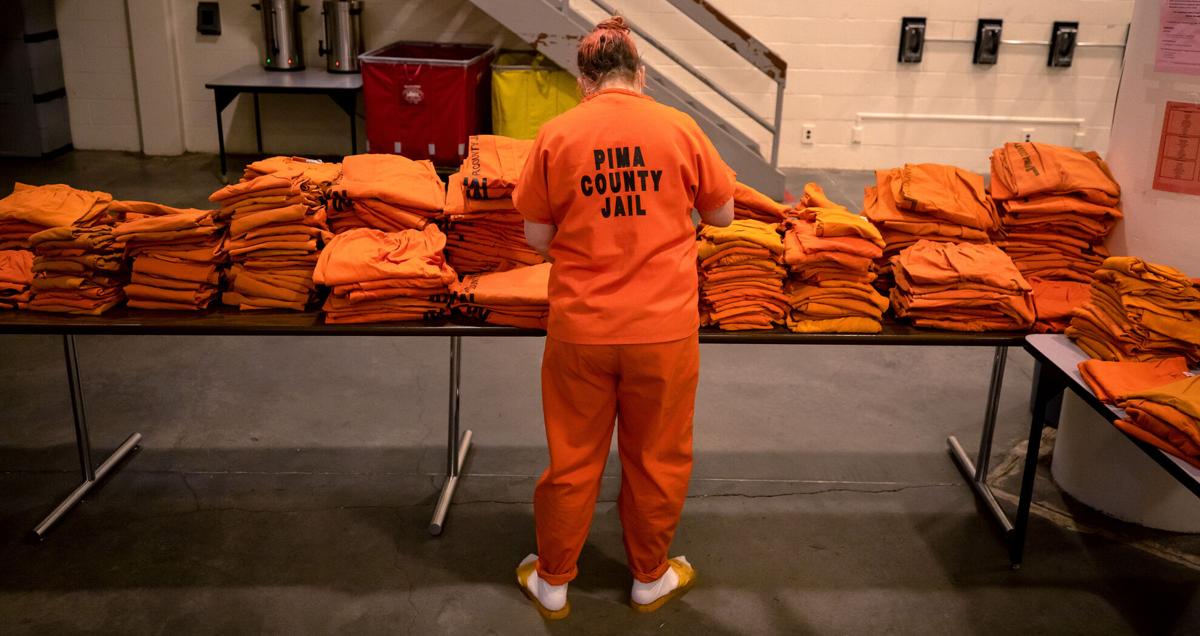
In early December, Pima County Sheriff Chris Nanos stood before the Board of Supervisors pleading for help improving jail conditions that he called a “full-blown crisis.”
The Pima County Adult Detention Center is “unlivable” for inmates, he told supervisors. And a worsening staffing shortage is creating serious safety concerns, he continued. Nanos floated the idea of building an entirely new facility, contending the detention complex at West Silverlake and South Mission roads “beyond repair.”
While the board has discussed the jail’s deteriorating conditions since then, its latest response was approving the creation of a “blue ribbon commission” tasked with assessing the need for a new detention center and determining how to pay for it.
In a 4-1 vote on Tuesday, the board approved the new jail commission’s membership, charter and work timeline. The board gave the 10-member group 180 days to report back with its findings in September.
County Administrator Jan Lesher recommended the formation of the commission to answer the key questions: “How serious is the current problem? And what do we need to do (to address it)?”
“The sheriff has been very clear about believing he needs a new jail … I’m not an expert to understand whether there’s work that can be done on the current jail, or whether we’re better off with a new jail,” she said.
The commission’s members have varying backgrounds in law enforcement, criminal justice, construction and social services. Three vice chairs within the group will lead efforts on assessing the structural status of the facility, operations within it and ways to finance potential changes.
“We need a new jail. How that happens, and whether it’s brand new or remodeled, whatever,” Nanos said. “But somebody’s got to do something here because I can’t do it myself. And I certainly can’t have my staff in that kind of situation.”
Jail ‘literally falling apart’
The detention facility has largely been funded by voter-approved bond packages passed in 1997 and 2004. The 1997 funds were used to construct a new maximum-security adult detention facility, the juvenile detention facility and communication tower. The 2004 dollars funded security enhancements. Initial estimates place the construction of a new jail at about $250 to $380 million.
Now, Nanos claims the jail complex “is literally falling apart” and has frequent flooding issues, mold and deteriorating concrete. While some repairs have been done, the sheriff likened it to “putting lipstick on a pig.”
A third-party contractor conducted structural assessments of certain problem areas on the property in June, July and October 2021. They found issues such as cracking masonry on the exterior of the jail and spalling concrete throughout walkways inside the facility but did not report significant structural issues. According to the assessments, the repairs of the identified issues were completed by the county’s facilities management department.
A full-scale, engineer-based assessment of the entire jail would be a much lengthier, and more costly, process.
While the new commission will look into the jail’s physical conditions, it’ll also be tasked with reviewing the facility’s operations.
In recent years, the Pima County jail has dealt with a growing population of inmates and a dwindling number of corrections officers to oversee them.
Nanos said corrections officers, or COs, are falling asleep on the job, being tasked with supervising more than one section of the jail at a time, and forced to work overtime.
The jail has a 68% vacancy rate of COs, and in the last three months alone, the county spent $1,266,703 in overtime costs at the jail, according to the Sheriff’s Department,
After Nanos brought his concerns to the Board of Supervisors in December, the board granted his request to dole out $1.7 million a year to give 7.5% raises to corrections workers. The sheriff said the raises help get people in the door but don’t address the ongoing need of retaining staff.
Underscoring the need for reform at the jail is an elevated number of inmates dying in it. The jail saw a decade-high number of deaths after 10 deaths were reported at the facility in 2021. In 2022, 12 deaths were reported at the jail, according to the county.
Of those 12 deaths, 5 were related to fentanyl use, 3 were ruled suicides, one was due to medical complications after an inmate consumed a plastic spork and one was ruled a homicide after an inmate was tased repeatedly in an altercation with corrections officers, according to reports from the Pima County Medical Examiner’s office. Two inmates died at a nearby hospital after being granted compassionate release.
While corrections officers are supposed to conduct routine rounds of inmates at least every 15 minutes, Nanos said, the reality is inmate check-ins happen about every 40 minutes.
“They’re locked in the little room, and we walk by and peek in a little, tiny window that’s about four inches wide and maybe two feet tall. We look in there and see, ‘Yeah, he’s there.’ And we walk on by,” Nanos said. “How is that safe and secure?”
According to the sheriff, inmates receive “maybe one to two hours” in the general dayroom area outside their cells every day.
And while the jail has the capacity for about 2,100 people, the actual population the jail can efficiently hold is much smaller than that, as each inmate must be classified based on their alleged offenses. Throughout the last four months, the population has hovered at about 1,800.
“The reality is 90% of those in our jails are still innocent, they haven’t gone to trial,” Nanos said. “I don’t think any of our jails today are designed for any type of compassion, any type of dignity, it’s just designed to lock you up, keep you away from everybody. It’s almost punitive.”
The sheriff has expressed concerns that the alarming lack of officers overseeing the jail population could lead to further deaths or violent outbreaks.
The jail has already seen some close calls, including when corrections officers “faced a very dangerous situation” when 90 inmates refused to lockdown in their cells until an hour-long negotiation deescalated the situation, Nanos said. On Dec. 1, an inmate choked a corrections officer who was rendered unconscious for 24 minutes until medical personnel revived her, according to the sheriff.
One of the responsibilities of the blue ribbon commission is to assess “Best practices and standards and other factors impacting operations given industry changes since the county facility was built.”
According to Lesher, this could be a chance to “develop a more modern jail or detention facility in which case the term ‘new’ describes enhanced programming and/or operational efficiencies.”
A ‘new’ jail
Daniel Sharp, who served as Oro Valley’s police chief for 20 years before retiring in 2020, will lead the commission. While he’s heard Nanos’ concerns about the jail, he said he’ll approach leading the commission “with an open mind.”
The exact timeline of the commission’s meetings has yet to be determined, but Sharp said the group will take public input into consideration and utilize the knowledge of county staff while making recommendations on the fate of the jail, and ultimately, how any changes would be funded.
“I always believe that the public’s money belongs to the public, so we need to make sure that we’re spending it wisely and doing the right thing,” Sharp said.
When addressing the board in December, Nanos asked the county’s supervisors to consider supporting a Jail District Excise Tax, which Lesher has looked into as a possible funding option.
Eight of Arizona’s 15 counties have some sort of tax to fund their jails, but such a tax requires voter approval. If Pima County were to approve a jail tax, it would be capped at a quarter-cent sales tax for residents, non-residents and visitors to the area.
Ultimately, the commission will examine all potential financing options for any changes to the jail and make a recommendation to Lesher, who will pass that recommendation to the board for approval.
“When I talk about a new jail, new is not just new as in we just built it. It’s new in terms of concepts and operations. There are ways to look at how the population is served within a jail, there’s new ways of approaching that service,” Lesher said.

