

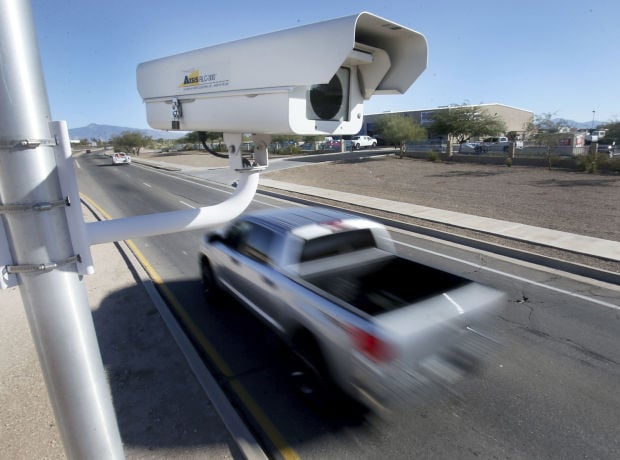
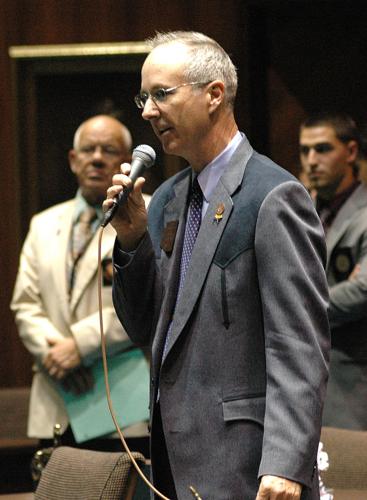

PHOENIX — A proposal to allow photo enforcement of laws governing stopped school buses would force people who get any kind of photo radar tickets to rat out whoever was driving their vehicle at the time.
The proposal by Rep. Bob Thorpe, R-Flagstaff, would eliminate the requirement that photo radar tickets have a picture of the person driving the vehicle that is speeding or goes through a red light. Instead, the only thing that would be needed is a picture of the license plate.
What that does is tie the violation to the vehicle rather than the driver, similar to a parking ticket. Thorpe said that would prevent insurance companies from raising the premiums of drivers who are caught violating the law.
The other side, however, is that vehicle owners who get the citations in the mail would no longer be able to escape a penalty simply by showing they are not the person in the picture. Instead, they would have to either provide the name of who was behind the wheel or pay the ticket themselves.
Thorpe’s legislation, HB 2366, also would allow school districts to put photo radar cameras on their buses, even as pressure builds to ban the technology entirely.
He said schools have told him there is a problem with motorists ignoring the legal requirement to stop when a bus is loading or unloading students. He said mounting cameras on the buses should help catch violators and potentially deter others.
The legislation comes as Sen. Steve Smith, R-Maricopa, has introduced SCR 1010, asking voters to outlaw the use of cameras to enforce traffic laws. And Sen. Debbie Lesko, R-Peoria, is pushing SB 1241, to keep cities and counties from setting up the cameras on state highways.
Thorpe’s proposal also comes on the heels of a vote last year in Tucson to stop the city from using photo radar. Pima County also stopped using photo radar enforcement in 2014. Thorpe’s bill would appear to allow schools within a city to put them on their buses despite that vote.
HB 2366 has provoked an outcry among tea party interests.
“It’s interesting that the whole libertarian Facebook crowd is just crucifying me right now,” said Rep. Mark Finchem, R-Oro Valley, a co-sponsor.
Finchem said he remains opposed to the use of photo enforcement. And he pointed out that he also signed on as a co-sponsor to Smith’s measure for a public vote to outlaw it.
But Finchem said he thinks that the issue with school buses is “a little bit different” and that Thorpe’s bill deserves to be heard.
Arizona law requires motorists to stop when a school bus has its flashing lights on and the stop sign on the left side of the bus extended. A first violation can draw a $250 fine; anyone convicted of three violations within 36 months loses a license for at least six months.
Despite those penalties, Thorpe said people ignore the signs and children get injured.
He said the Center for Innovation in Pediatric Practice says 24 percent of all school bus-related injuries are from kids getting on and off the bus. “These injuries occur in the ‘danger zone’ about 10 feet from each side of the school bus,” Thorpe said. “In these hazardous areas, children are at risk of being injured.”
So he wants to make it optional for schools to take pictures of offenders.
“I have no idea whether any school districts would take advantage of it,” he said.
Stephanie Boe, spokeswoman for Tucson Unified School District, said “isolated cases” of problems at bus stops are handled by police. She also said costs might prevent the district from using the cameras.

