


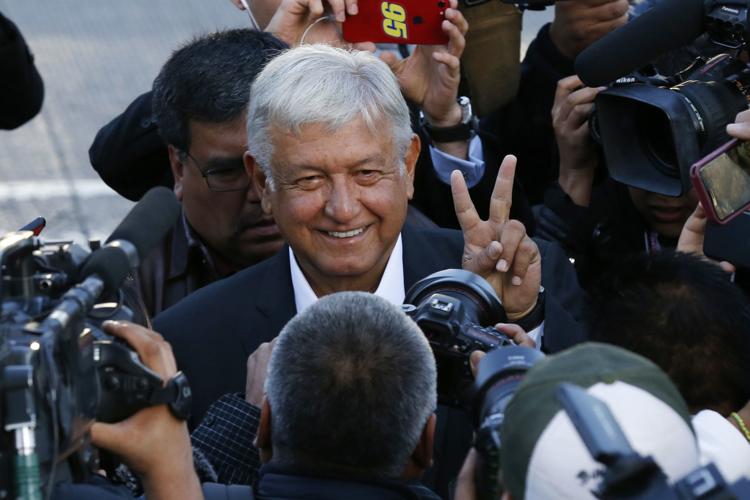


MEXICO CITY — Leftist Andres Manuel Lopez Obrador has claimed victory in Mexico’s presidential election, calling for reconciliation after what he called a “historic day.”
The candidate spoke late Sunday shortly after electoral authorities announced that in a quick count forecast he had won over half the votes, a remarkable mandate not seen in the country for many years.
President Enrique Peña Nieto said in a televised message to the nation that he had congratulated Lopez Obrador.
Lopez Obrador, who vowed to transform Mexico and oust the “mafia of power” ruling the country, rode widespread voter anger and discontent with the governing Institutional Revolution Party, or PRI, of Peña Nieto and had led opinion polls since the beginning of the campaign.
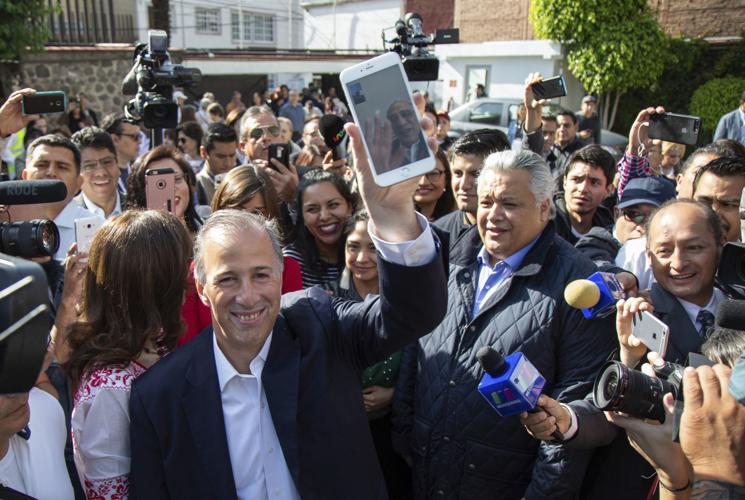
Conservative Ricardo Anaya of a right-left coalition and the PRI’s Jose Antonio Meade acknowledged defeat shortly after polls closed nationwide.
“The tendency favors Andres Manuel Lopez Obrador. … I recognize his triumph,” Anaya said in a speech to supporters.
“For the good of Mexico, I wish him the greatest success,” Meade said minutes earlier.
Lopez Obrador waved to supporters from a balcony of his campaign headquarters and then left in a motorcade for the center of the capital.
Supporters began wild celebrations in Mexico City, cruising up and down the central Paseo de la Reforma boulevard honking horns to the tune of “Viva Mexico!” and waving Mexican flags from car windows and moon roofs.
Thousands poured into the sprawling main square known as the Zocalo, where the 64-year-old former mayor had called on his backers to rally Sunday night. Many danced to the trills of mariachi music.
Retired teacher Susana Zuniga beamed and said the country was experiencing a moment similar to the Mexican Revolution a century ago.
“The people are fed up,” Zuniga said. “That is what brought us to this.”
President Trump tweeted congratulations: “I look very much forward to working with him. There is much to be done that will benefit both the United States and Mexico!”
Lopez Obrador, commonly known by his initials, “AMLO,” was making his third bid for the country’s highest office, having falling short in the 2006 and 2012 elections.
In 2006, rivals convinced voters that his populist message was “a danger for Mexico.” In 2012, voters restored the long-dominant PRI to power in hopes that it could cut back-room deals to tamp down rising violence.
But after six years under Peña Nieto, that hasn’t been the case.
So deep is Mexicans’ discontent with the status quo that not only Lopez Obrador but Anaya, Meade and independent candidate Jaime “El Bronco” Rodriguez all claimed to be the ones representing real change.
In the end, Lopez Obrador’s rants against the “mafia of power” rang most authentic.
“The anger that the average Mexican feels toward the way things are being governed has favored Lopez Obrador,” said Shannon O’Neil, senior fellow for Latin America Studies at the Council on Foreign Relations. “He’s been able to capture the mantle of the person who’s on the outside who wants change.”
After 12 years of near-permanent campaigning, Lopez Obrador moderated his message somewhat in both substance and style. He said he will govern for the poor and fight rampant corruption, and also pulled back from promises to completely scrap energy and education reforms instituted by the Pena Nieto administration.
He also pledged to increase support payments for the elderly and to give scholarships or paid apprenticeships to young people.
“Now that he has won, he cannot fail this new generation that believes in him,” said Mariano Bartolini, a 29-year-old lawyer who voted for Lopez Obrador in the northwestern city of Tijuana, across the border from San Diego. “It is thanks to us young people who are supporting him that he was able to get more votes than he did in past elections.”
Lopez Obrador’s rivals argued he could set the country back decades and lead to disaster with an interventionist economic policy.
“I am concerned that some candidates are making proposals that are impossible, because they’re very expensive to carry out,” said Juan Carlos Limas, 26, an Anaya supporter.
Casting his own vote Sunday, Peña Nieto promised to work on the transition with whoever won.
“The president of the republic and his government will be absolutely respectful and support the authorities that are elected,” the president told reporters.
Sunday was the first time that an independent candidate appeared on the ballot.
It was also the first time Mexicans living abroad were able to vote for down-ballot races like senators. More than 181,000 received ballots and the 97,000 that the National Electoral Institute had gotten back by Friday morning were already double the number received in 2012.

