

Second in a series
The developments that led to El Con Mall and the demise of downtown Tucson date to the late 1930s.
In those years Joseph K. Kivel could be found working long hours at the Market Spot grocery store on East Speedway. Longtime Tucsonans say that Kivel and his older brother Simon dreamed up give away promotions to lure customers, and sacked potatoes potatoes while building up capital for future acquisitions of Tucson real estate.
Gradually, Sy and Joe and their wives Mollie and Esther began buying properties around town. They formed a partnership called Property Investments, the name that a later developer, Lew McGinnis, chose years later for one of his property companies.
After World War II, the Kivels began to make their mark. In August 1945, Sy and Mollie sold a lot on North Campbell Avenue to the developer of the Catalina Theater for $15,000, and the next year the families began development of the ad joining shopping center.
In September 1953, the Kivels made their big move.
With then-President George Amos Sr. of Tucson Realty & Trust Co. and dentist Arch Fee, they bought the 25-year-old El Conquistador Hotel on East Broadway from the United Hotel Co. of Niagara Falls, N.Y. Organized as Western Trust Co., the Kivels, Amos and Fee paid $800,000 and assumed a $250,000 mortgage for the 120-acre property.
In April 1957, Amos, Fee and Simon and Mollie Kivel agreed to sell their interests in the hotel holdings to Gus, John, Spiro and Nicholas Papanikolas of Magna In vestment & Development Corp. of Salt Lake City. The price was said to be slightly more than $.500,000.
Joe and Esther Kivel were left with 33 percent of the property while nearly 17 percent was held by their three nephews and their wives - Victor and Betty Jean Kivel, Alvin and Janice Kivel, and Daniel and Beverley Kivel.
Amos and Fee "saw a few dollars so they grabbed it, which is fine because they bought property and sold it right along," Joseph Kivel recalled. "Amos' company got the brokerage commission (on the purchase), so his portion didn't cost him that much."
From the start, the Kivels and Magna knew what they wanted — a regional shopping center on a scale never known before in Southern Arizona. Its initial cost in 1957 was estimated at $3.5 million.
The late Newsom Holesapple of Tucson Realty was in charge of leasing and financing, but Joe Kivel himself nailed down many of the lease agreements. He turned up repeatedly at downtown shops to persuade the owners to move or expand into his venture.
At the time, downtown was the totally dominant retail center. Its stores included Steinfeld's, Levy's, Sears, J .C. Penney, Jácome's, Myerson's, Dave Bloom & Sons and Grunewald & Adams. Malls were virtually unknown, and moving east to the new shopping center was considered chancy by many of the conservative, risk-fearing merchants.
Joe Kivel was persistent in lining up tenants. Merchants say that at some stores he showed up again and again until the merchants agreed to leases that in those days ran for up to 20 years.
"I lived from time to time in Los Angeles and saw regional shopping centers going up," Kivel recalled.
He said that in Tucson in the 1950s and 1960s, "everybody had some land they wanted to put a mall on," but it wasn't until 1982, when the Tucson Mall opened, that Tucson had a non-Kivel mall.
In November 1959, Valley National Bank extended a $5 million construction loan. Ground was broken Nov. 12 for construction of Montgomery Ward & Co. and other original tenants. Equitable Life Insurance Co. provided the $5.3 million long-term first-phase financing — the equivalent of $17.8 million in today's dollars.
After El Con opened in late 1960, Kivel began to change his ways. Gradually at first, he developed his passion for anonymity.
In 1960, Dan Kivel, Simon's youngest son and a resident then and now of Santa Monica, had been named president of the family-owned Sierra Investment Co., although files in the Pima County Recorder's Office indicate that he has never owned more than a one-eighteenth interest in any of the corporation's purchases.
"I don't know anything about Sierra," Dan said last year, despite the fact that most of its holdings are still listed at his California address. "All that is handled by my Uncle Joe in Tucson. You'll have to talk to him."
Veteran merchants at El Con say Dan was the figurehead who could draw attention away from the elder Kivels in Tucson, especially Joe Kivel. Press clippings f rom the 1960s before Joe finally became head of Sierra in 1975 state that "any further information must be gotten from the president, who is in Santa Monica."
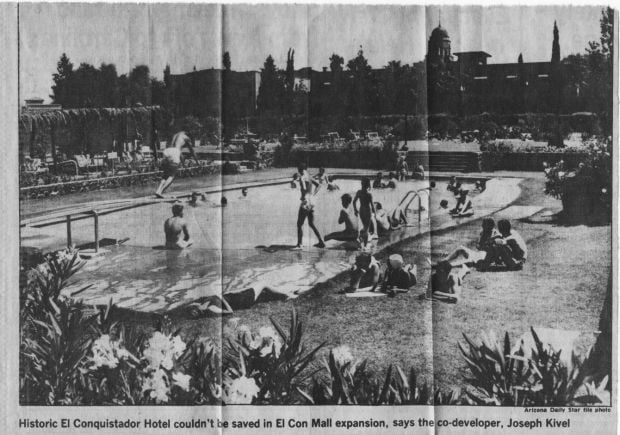
In 1960 and 1961 El Con had taken shape as two long parallel lines of stores running north and south. Aerial photos show the parking lot moving further and further west toward the El Conquistador until, in August 1961, co-developer Gus Papanikolas announced that the fate of the historic hotel was in doubt.
In December 1964, the hotel was closed. In the summer of 1968, nearly 10 years after Kivel had said that the hotel would be integrated into the expanded shopping center, the 70- room landmark was demolished. "We broke our neck to save the old hotel," but it wasn't possible, Kivel said. The new Levy's, Penney's and the collection of stores that connect them together opened in 1969 and 1971.
The 1971 expansion had actually created two malls, one older and open to the air and the other fully enclosed and air-conditioned. Business started to sag in the old mall. The squeeze on profits for the older merchants led to years of bitter squabbles and finally to the 1977 decision to enclose and further expand the mall.
Finally, in early 1978, the finishing touches to the aging El Con Shopping Center were announced. A $6.25 million face lift, including the construction of a Goldwaters department store, at last created the full-fledged El Con Mall.
Tomorrow: War at El Con Mall.

