

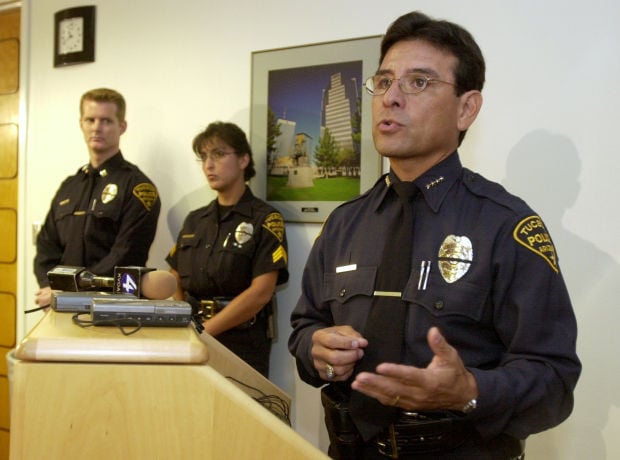
Tucson Police Chief Richard Miranda has emerged virtually unscathed after six months of criticism over his department’s handling of the North Fourth Avenue riot.
Miranda, who was sworn in as chief three years ago Saturday, enjoys wide support from his bosses on the City Council, community groups and the nearly 1,000 officers under his command.
The soft-spoken Tucson native also has weathered a storm of controversy over a series of other recent embarrassments: a longtime homicide detective was indicted for perjury, another detective used his departmentcomputer to keep track of his estranged wife before killing her friend and then himself, and the FBI is investigating the loss of $600,000 from MANTIS, a multi-agency narcotics task force administered by the Tucson Police Department.
But the biggest challenge for Miranda and the department was overcoming intense criticism about its April 2 riot response, during which nearly 500 rounds of less-lethal munitions were fired at citizens, prompting more than a dozen to file formal complaints alleging excessive force.
“The department needs to take a lot of credit for how we came through that situation,” Miranda said during an interview Friday morning. “I told them that if we handled ourselves in a professional manner then the support from the public would be there in the end.’’
Miranda said he survived the riot aftermath largely because of his deep ties to the city.
“Iwas raised here, I went to high school and college here, and I’ve been a police officer for almost 27 years,’’ he said. “There are people in Tucson who have literally known me since the day I was born.’’
The chief said that because of his personal connection to Tucsonans in all walks of life, he was confident that he wouldn’t be judged based on 10-second sound bites on television news or harsh comments in the newspapers.
Oro Valley Police Chief Danny Sharp worked with Miranda at TPD for several years.
“As a police chief, you recognize that your decisions will be scrutinized," he said. “It’s important that the public understand your thought process, and if your decisions are consistent with your own values, and with the Constitution, they will generally support you.’’
Sharp and other observers credit Miranda for his quiet, deliberate approach to decision-making.
“He’s a nice guy, very likable and approachable,’’ Sharp said. “He tends to put people at ease because of his laid-back nature. He doesn’t like to rush things.’’
Sharp agreed with Liana Perez, the city’s independent police auditor, that the chief’s open review process was the key reason why Miranda came through the riot criticism with barely a scratch. The department also released after-action reports and its own board of inquiry’s final report, a commitment to openness that surprised police observers in other cities, she said.
“The chief knows how important it is to listen to the community,’’ Perez said. “If he would have taken a different approach, and not listened to the community, that would have hurt credibility and support.’’
Miranda appointed 12 people to serve as a riot-review panel, and initially he wanted them to meet behind closed doors.
“At first, I had envisioned people on the second floor, rolling up their sleeves and going to work and I couldn’t see television cameras in there,’’ Miranda said. “But I have to give the media credit because they were very critical of that decision and they were right. The criticism benefited the department.’’
Miranda, a 1970 graduate of Sunnyside High School and the city’s first Hispanic police chief, said he has learned a great deal during his three years at the helm.
“I’ve grown into the job, and Ifeel confident that my decision-making is solid and that my team is really together. We’ve been able to achieve some of the goals that we set for ourselves,’’ he said.
One of his first goals was to gain certification from the Commission on Accreditation for Law Enforcement Agencies, or CALEA.
“To meet the national standards as set by CALEA was a goal I set three years ago, and it was difficult. But because it was difficult, it makes it more rewarding,’’ he said.
Miranda expects the department to be officially accredited next month.
Those who worked with Miranda over the years invariably describe him as a good listener who never loses his temper or makes hasty decisions.
His calm demeanor is a marked departure from the management style of his predecessor, Doug Smith, whose brusque manner alienated some officers and community leaders. Smith, who came to Tucson from Ann Arbor, Mich., also failed to overcome criticism over his handling of a drunken-driving investigation involving one of his commanders.
But former Chief Elaine Hedtke holds the recent record for inspiring discontent among the ranks. She resigned under pressure in 1993 after only 20 months as Tucson’s first female chief. Before Hedtke, Peter Ronstadt was chief for 10 years.
Miranda said he’s not likely to match Ronstadt’s longevity.
“I think chiefs have to measure their years in dog years,’’ he said. “The amount of hours you put in is just incredible, and so is the amount of time that the job is on your mind, which is all the time. I don’t see me being here for 10 years. I think that would be physically impossible for me.’’
/////
IN LAST SIX MONTHS
April 2. Tucson police fire nearly 500 rounds of less-lethal munitions after rioting erupts on North Fourth Avenue.
Citizens have filed more than $7 million in claims against the city.
June 12. Homicide Detective Joe Godoy pleads not guilty to nine counts of perjury in connection with two murder trials. Godoy resigned before his indictment.
June 25. Sgt. Jeffrey Wheeler is fired by Miranda after he fired three shots in the direction of two suspects, then claimed that he forgot doing so.
July 29. Detective Kenneth Dillard, assigned to MANTIS, a multi-agency narcotics task force administered by the Tucson Police Department, fatally shoots his estranged wife’s friend and then kills himself at an apartment near North Campbell Avenue and East River Road.
August 16. Authorities confirm that $600,000 in seized drug money is missing from MANTIS coffers. The FBI investigation reportedly centers on a retired Tucson police detective.
/////
Contact M. Scot Skinner at 629-9412 or skinner@azstarnet.com.

