

On Sept. 8, 1893, a meeting was held by local businessmen at the Pima County Courthouse, for the purpose of obtaining grounds near or in the city, where sporting events could be held.
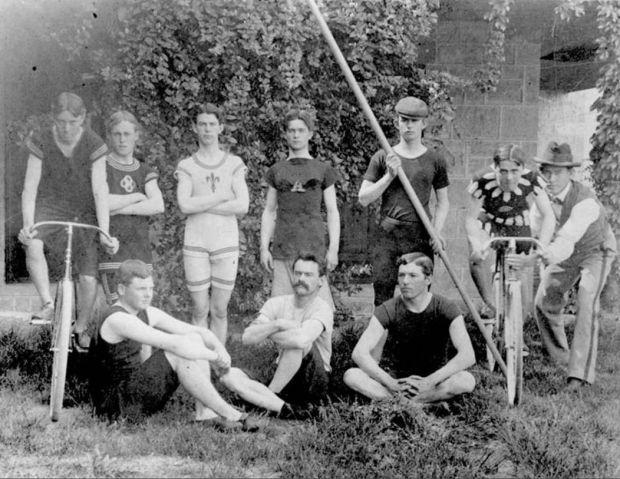
A temporary committee was appointed to bring together Tucson’s different sporting groups, such as the gun club, wheelmen club (bicycle club) and the trotting association (horseback riding club) to form a larger athletic club.

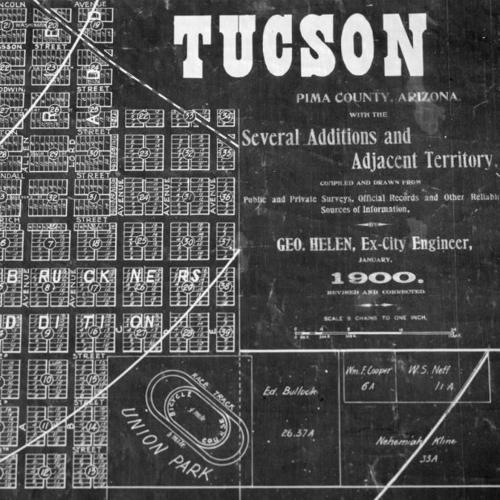
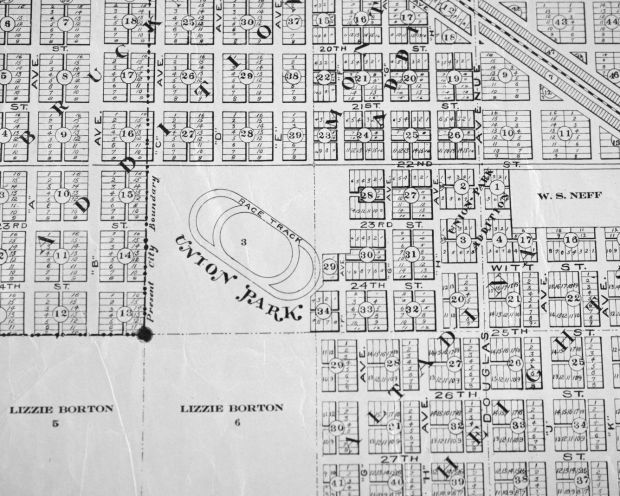
1900 map of Tucson shows Union Park and Ed Bullock’s land. Photo by Paul F. LaFrance.
Ten days later, a meeting was held at the Tucson City Hall, to review the land options for the new athletic grounds and the committee decided on an offer by restaurant owner Joseph Soldini, whose land was about a mile north of town.
On Sept. 29th, a permanent organization was formed with Judge C.W. Wright, as president. The Board of Directors consisted of Tucsonans from the different clubs, E.N. Fish (trotting association), Dr. George Whomes (bicycle club), Joseph Scott (baseball club) and Charles T. Etchells (gun club). The organization also issued 500 shares of stock at $5 a share to raise funds to build the track, grandstand, baseball field and other items.
The board of directors met on Oct. 16, 1893, and decided on a formal name for the organization, The Union Park Association and two days later the articles of incorporation were filed with Pima County.
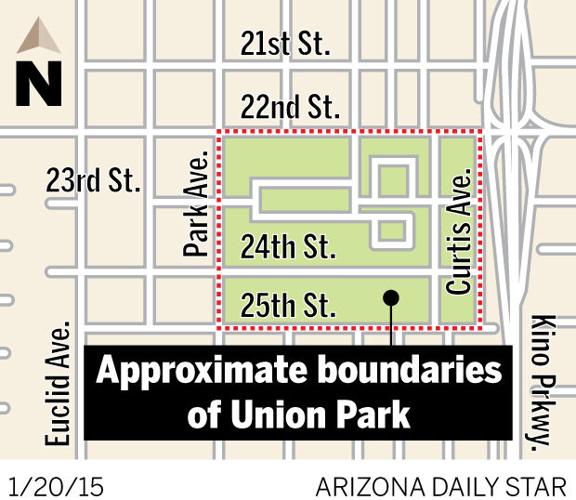
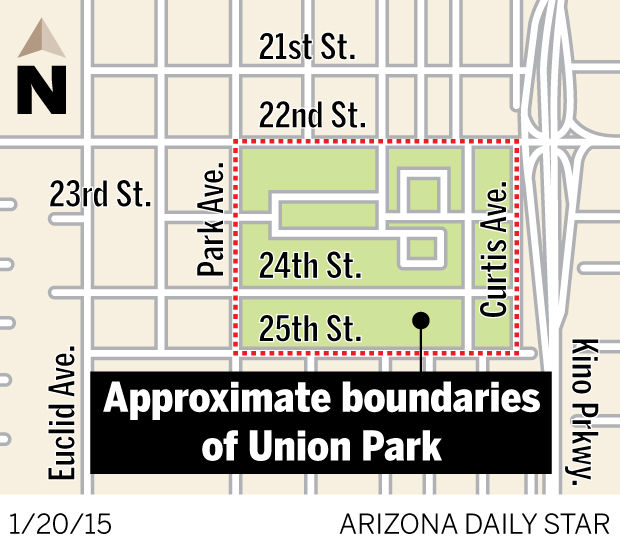
The board then decided not to utilize Soldini’s property, because of the caliche found underneath the soil, and instead purchased forty acres of land, about a mile and a half south of the University of Arizona, on the edge of the city limits, for $100 cash and the same amount in stock.
 |
By mid-December, construction of the new half-mile track and a well was underway. Four additional acres were deeded by Ed Bullock to the park for horse training grounds.
In early 1894 a wooden fence, eight and half feet tall and consisting of 3,200 running feet of wood, was built around the park. A roofed grandstand that was 20 feet by 45 feet that could accommodate 250 people was constructed along with a railing inside the park. In the middle of the park was the baseball diamond.
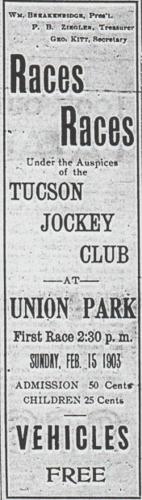
On a windy March 2, 1894, Union Park officially opened. The events for the day included a bicycle race by some of the best wheelmen in the Arizona Territory, a gun shoot with live birds, a horse race between two horses and a practice by a local baseball club to close the day.
Within five months, Union Park was in financial trouble, having a $900 debt. It was announced in the Arizona Weekly Citizen, on August 18th, that the park was under a new board of directors.
The new board appears to have breathed life back into the struggling park, with a successful bicycle racing event on August 31, that featured a half-mile, mile, two-mile, and five-mile races and by enticing “Arizona Charlie” to bring his Wild West show to the park in December of that year. It is believed this was the first time a Wild West show came to Tucson.
The year 1895, saw more write ups about the park in the newspapers, with some of the highlights being an approximately 10-mile race between Albert Schock, long distance champion cyclist of the world and two local horses, with Schock taking the $200 purse in February. In October, surveying started for a new one-third mile bicycle track in the park to be built of a concrete-like material.
But the park continued to be plagued by financial problems, even under the new management.
On March 23, 1895, town councilman James W. Whalley, after an eight-day disappearance, was found dead under the grandstand.
The highlight of an event the following year was a bicycle race in June that attracted cyclist from around the country and also featured trick riding by local rider Seth Orndorff. The attendance wasn’t what management had hoped for.
In 1897 the University of Arizona track & field team held a competition at the venue, which included exhibition bicycle races.
But this was likely one of the last really big events at the park, as the popularity of the track seems to have been on the decline. The Blue Rock Gun Club, a regular at Union Park, found new grounds to hold its events.
Carillo’s Garden, later called Elysian Grove, built a grandstand to go along with its bicycle track, and it appears that some baseball games were being played at the Military Plaza, downtown rather than the Union Park.
The park continued on for several more years but it appears it didn’t have the same prestige as before and fewer events were happening there. The distance from town to Union Park likely played a part in the decline, since other venues offered most of the same sporting events but much closer to town.
 |
In 1902, the Tucson street railway was supposed to be extended to Union Park, offering sports fans easier access, but it appears it was never extended that far south.
It is believed the park survived up until about 1908.
By 1917, the land became known as the Kenrose Park Addition and the land would later be occupied by O’Rielly Chevrolet.
A large apartment complex called The Retreat at Tucson now occupies a large portion of the old track.
While Union Park’s glory days appear to have been short, during its time it was a well-known attraction in Tucson. No known historical markers could be found on the site.
The alignment now known as Park Avenue was originally called “C” Avenue . On June 17, 1897, Park Avenue, which ran from the University of Arizona, south to present-day Broadway Boulevard, was recorded with Pima County, later “C” Avenue was abandoned and the whole alignment became Park Avenue.

