




How do you know if your hobby has gotten out of hand?
For Glenn and Janet Mitchell, it was when they were stressed about preparing their west-side garden railway for the annual tour put on by the Tucson Garden Railway Society.
So they decided to downsize.
What they come up with in order to manage their passion will make its debut at the 2018 Rails in the Garden Tour March 3 and 4.
For several years, the Mitchells fired up their steam engines for the tour. In 2013 the Arizona Daily Star featured their 650 feet of track and some 70 buildings of the Victorian-era town that surrounded plants.
Then they found that as they got older, it was becoming less fun to maintain their backyard Turtle River Railroad. It took days to clear the track of debris, give buildings fresh coats of paint, trim plants to scale and repair dirt mounds that created different elevations.
“It was about two years ago when we were getting ready for Rails in the Garden when we sort of made a decision that we had to change things,” says Glenn, a retired electrical engineer.
“We spent the last minute getting ready and there was just too much to do.”
“I used to have about 15 rosemary bushes,” Janet recalls. “It took 45 minutes to an hour to prune each one.”
After that 2016 event, the couple got rid of about half the track, train cars and buildings.
They had someone haul out more than 20 tons of dirt, just about the amount that they had hauled into the yard over the years to build up hills, elevate tracks and create tunnels.
The track is now on one elevated level in what’s called a dog-bone loop. It gets its name because it has long sides and a knobby shape at each end.
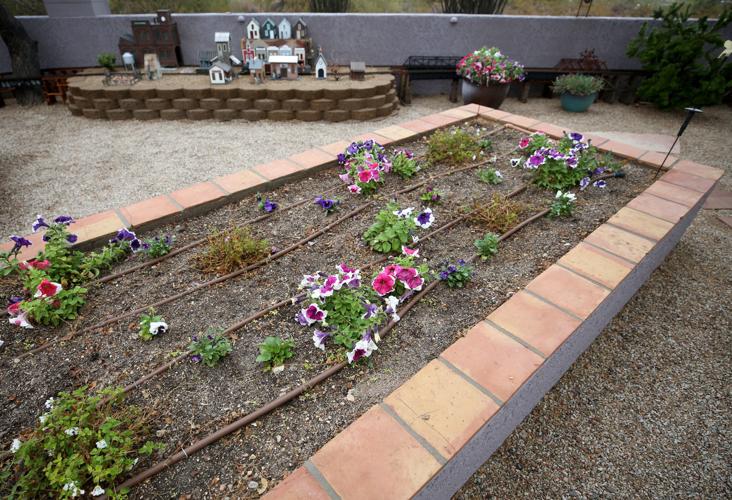
The layout now eliminates the need to step over track, buildings and rocks or clamber up mounds to get access to the entire layout. There are fewer plants to trim, fewer buildings and track to repair.
Both agree that life is a lot easier with the smaller design. “I thought I would miss it more than I did,” says Janet.
“We used to have a backyard that was a garden railroad,” she adds. “We now have a backyard that has a garden railroad.”
AGING and CHANGING
The idea of downsizing and elevating G-gauge (for “garden-sized”) railroad layouts is appealing to long-time hobbyists. Jack Forgues says he has friends in his SaddleBrooke neighborhood who are changing their layouts as they get older and prefer some comfort.
Jack and his wife, Rosalie, whose Quail Ridge Garden Railroad is one of four SaddleBrooke stops on the tour, started building in 2006 by elevating their layout 28 inches off the ground.
The original aim was to make the layout fit with their existing landscape and eliminate the need to walk over tracks to see the mid-20th century trains and the mining operations.
But as the years have gone by, they’ve discovered raising the railroad was the right move for other reasons.
“When I’m painting, it’s easier when it’s aboveground,” says Rosalie.
“I move around fine,” says Jack, “but when I bring a new project onto the train, it gives you a better vantage point if you’re above ground.”
A toy train collector for years, Jack says he now likes the G-gauge better than the small, indoor HO- and O-gauge trains he used to own.
Aging eyesight is making it hard to work with smaller tools and train parts. “Now I really enjoy the larger scale because I can detail it more,” he says.
Ron and Helen Koehler also have a raised railway for their live-steam locomotives that run through a scene that evokes mountainous Colorado. The South Park and Western Railroad runs on top of a 30-inch-tall planter.
Ron needs to constantly monitor his locomotives to make sure they have enough water and fuel to make steam. The elevated track makes that monitoring easier.
But he also appreciates the ease that a higher track affords. “Getting down is easy,” Kohler says. “Getting up, as you get older, is not as easy.”

