

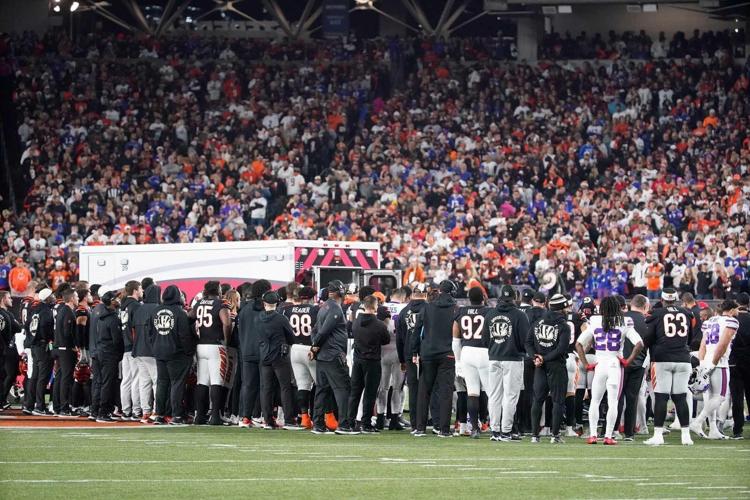
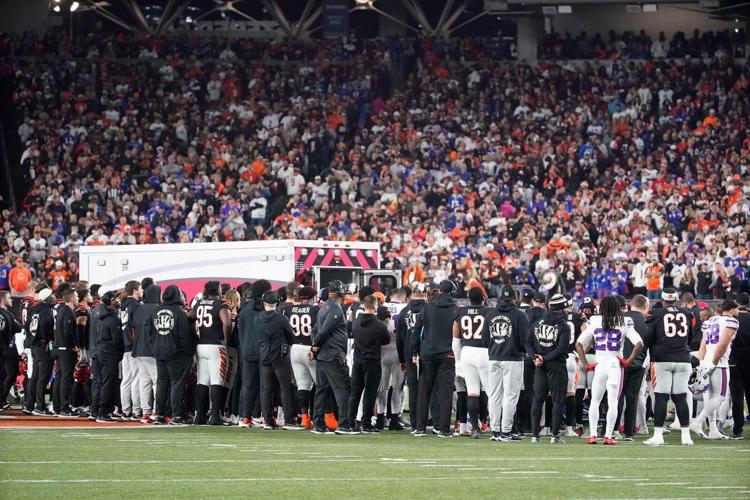
When Troy Vincent, the NFL executive vice president of football operations, recalled Monday night, his voice trembled. His emotions came through clearly on a conference call Wednesday as he spoke about Buffalo Bills safety Damar Hamlin.
“My greatest fear had flashed in front of me at that particular moment,” Vincent said, “but for the goodness and grace of God, Damar is still here, and he's still fighting.”
Hamlin went into cardiac arrest on the field during the Bills’ game against the Cincinnati Bengals on Monday night. His heartbeat was restored on the field, and Dr. Allen Sills, the NFL’s chief medical officer, said the quick reaction was critical.
“It's certainly not an exaggeration to say that the skilled and the immediate response by all of these talented caregivers prevented a very tragic outcome at that moment,” Sills said.
Sills and Vincent joined Jeff Miller, the NFL executive vice president of communications, public affairs & policy, in starting off the call with well wishes for Hamlin, and with immense gratitude for the medical personnel who have helped him since the moment he collapsed.
"You gave our brother Damar another day to live, another chance to fight," Vincent said.
Hamlin remains in critical condition at the University of Cincinnati Medical Center, but an update from the team on Wednesday afternoon said he had "signs of improvement noted yesterday (Tuesday) and overnight."
While Sills acknowledged that there has been “a lot of speculation” on why exactly Hamlin went into cardiac arrest, he said it is too soon to say with certainty.
“I don't really want to address that in too much detail today, because I think there's still a lot of investigation that needs to happen to understand that,” Sills said.
“Many people have discussed this condition commotio cordis, and it certainly is possible, but I think what's more important is, regardless of the cause, the key in any type of sudden cardiac event is the rapid response of trained personnel."
Commotio cordis can occur when a blow to the chest sets the heart into sudden arrhythmia, meaning an irregular heart rhythm.
No matter the cause of cardiac arrest, the response time can be lifesaving.
Sills detailed the “three E’s” that the NFL emphasizes: emergency action plan, equipment and experience. The preparation for potential emergency situations “starts many, many months before game day,” Sills said.
“Certainly, we never want to see events like this occur, but if there were to be a medical emergency, there was absolutely the right team, with the right equipment and the right training on site able to provide care,” Sills said.
Because of that, Sills emphasized “the important lesson” that for “every sport, at level,” there should be AEDs available and people who have training in basic life support, such as CPR.
“That is a very, very key message, and something we can all learn from,” Sills said.

