



Big things are coming at Tucson International Airport, but don’t scan the skies for the latest jumbo jet.
Airport officials have made plans to open up thousands of acres of airport-owned land to commercial development, create new pathways for access to the airport and new commercial centers, and to boost cargo and cross-border freight operations.
The grand plans are laid out in the Tucson Airport Authority’s 2013 master-plan update for TIA, which was approved by the quasi-governmental authority’s board in May and is awaiting Federal Aviation Administration approval.
The 20-year master plan is the first update in nine years and represents the deepest dive yet into land uses around the airport.
“It’s the most in-depth land use planning we’ve ever done,” said Bonnie Allin, president and CEO of the Tucson Airport Authority since 2002.
Airport master plans — required to qualify for Federal Aviation Administration capital-improvement grants — cover every phase of operations including major capital projects such as concourse and airfield improvements.
This time, much of the plan focuses on thousands of acres of unused “reserve land,” acquired over the years for buffer zones and future development.
To the extent that airport improvements are planned to keep up with capacity growth, some of the urgency of long-term expansion has been blunted by operations that have diminished since the Great Recession.
When the last master plan was updated in 2004, TIA was handling 3.8 million air passengers annually, and planners saw steady growth. But in the aftermath of the financial meltdown, fuel costs rose, TIA lost flights and passengers fell to 3.7 million last year.
The airport is still planning long-term to build a new main runway and eventually — in 30 years or so — a whole new terminal.
But there are several parcels adjacent to the airfield ready for development, and the airport is exploring interim uses for land earmarked for future airfield expansion.
“What we’re looking at it, we have a lot of property that is either noise-sensitive and it’s limited in what it can be used for, or it’s reserved for future development, the future terminal and future runway, for the long-term growth of the community, and what we can do with interim uses,” Allin said.
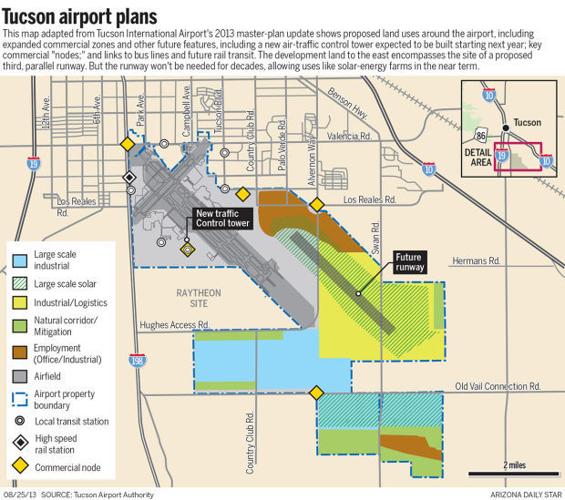
With the airfield operations taking up only about 2,000 of the airport’s 8,000 acres of property, the Airport Authority has slated large swaths of land south and east of the current airfield for aviation, industrial, logistics and office uses.
The airport is already marketing some parcels to the south of the runway for aviation-related use, and plans to put out a request next month for qualifications for one or more real-estate brokers to handle the airport’s emerging portfolio.
“We’ve got several shovel-ready parcels — for cargo, for industrial, aviation and non-aviation related — that we’re out actively trying to market,” Allin said.
Other areas, such as an area east of the current airfield where a third runway is planned beyond the 20-year master plan’s horizon, can be used on an interim basis for things like solar-energy farms, Allin said.
The idea is to rev up TIA as an engine of the region’s economy.
A study last year by the University of Arizona reported that TIA provides an annual economic impact of $3.3 billion and supports nearly 35,000 jobs directly and indirectly throughout the community.
Airport officials are quick to point out that the airport is self-sufficient, without taxpayer funding, relying solely on user fees and rents and other revenue. Even federal grant money for capital improvements comes from user fees.
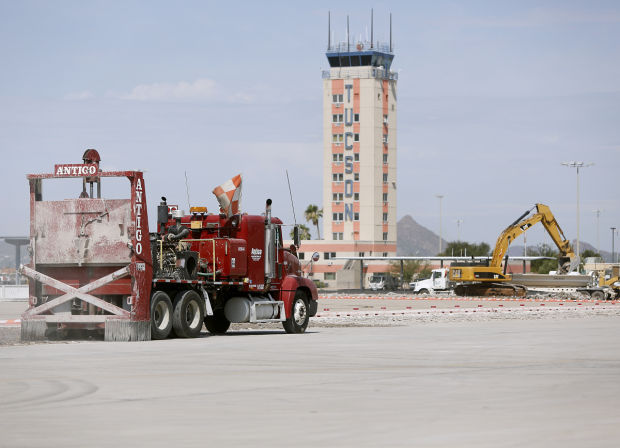
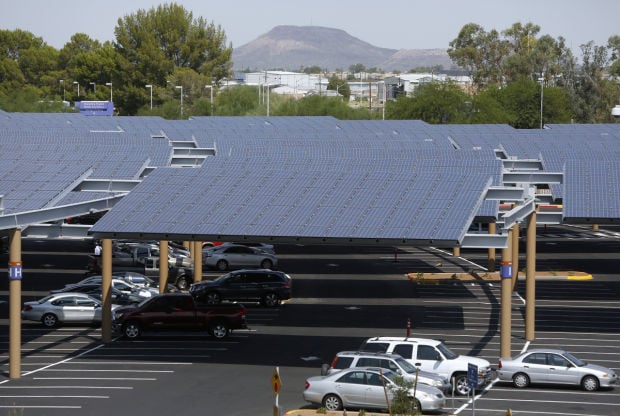
In recent years, such capital-improvement grants have funded a redo of TIA’s concourses and a new solar parking canopy, and grants are paying for a $50 million apron reconstruction project now under way.
Within the next year, design will begin on a grant-funded project to shift and expand a runway parallel to TIA’s main commercial runway, greatly boosting capacity.
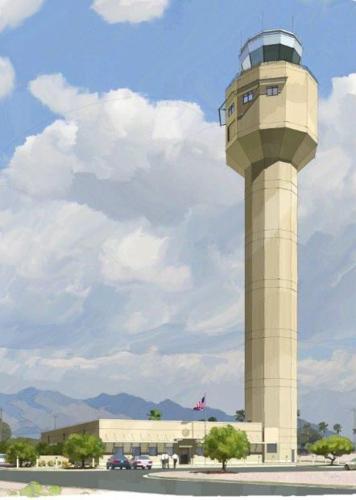
The FAA plans to build a new, $40 million air-traffic control tower at TIA that is in final design stages, with construction expected to start next year. At about 200 feet, the control tower will be about twice as tall as the old 1950s-era tower.
Lisa Israel, chair of the Tucson Airport Authority, said airport management is making the right moves.
While improving air service remains a top priority, the airport’s development moves support that mission and economic development as well, said Israel, president and CEO of the La Posada retirement community in Green Valley.
“The airport invests in the land and development so it can remain viable,” she said.
Another major component of the plan would tie the airport into current and proposed transportation projects, including a proposed Interstate 10 bypass, the proposed high-speed rail between Tucson and Phoenix and a proposed rail link through Nogales to Mexico on the tracks that pass by the airport along Old Nogales Highway.
Plans also are in the works to extend Country Club Road south in a decade or so, to later tie in with other new roadways to give better access to I-10, new commercial developments and eventually the new runway and terminal area.
A related plan would significantly boost air-cargo operations, particularly across the border, said Allin.
With the rail proposal and nearby assets like the Port of Tucson intermodal transportation center, the airport is in a good position to cash in on increased cross-border trade.
Assistant Pima County Administrator Nanette Slusser said the county and the airport are on the same page when it comes to boosting the economy and job growth.
After Tucson missed out on a major plant expansion by Raytheon Missile Systems a few years ago, the county bought land south of Raytheon’s site on the airport’s southwest side.
The Hughes Access Road that now runs to Raytheon’s main plant will be relocated about a half-mile to the south to give Raytheon a buffer zone.
The airport and the county are collaborating on developing access to a possible aerospace-related business park there, Slusser said.
A neighborhood activist said the airport has been largely a responsive and responsible neighbor and welcomed the idea of more commercial development around TIA.
“To put more commercial around the airport is ideal, because you don’t want to put houses there” because of aircraft noise,” said Yolanda Herrera, who lives in the Sunnyside neighborhood.
New tax revenues also will help local schools. But Herrera said she and others will be watching to make sure any new businesses fit the community, citing a strip club that operated for a while just off airport property that is looking to restart under a new owner.

