



Question: The walls of my home are warm despite the air conditioner being set at 73 degrees. Is it possible that I don’t have effective insulation?
Answer: It depends on when your home was built. Home construction building and energy codes now require insulation in all new home construction. Such requirements were not always the case in Arizona. Masonry homes built prior to the 1940s did not have insulation.
The 1950s and 1960s saw the beginning of insulated walls. Products like “rock wool” and “vermiculite” were installed in masonry (and some frame) homes as a nod to thermal control. The settling of these products has since rendered them ineffective.
Codes requiring insulation weren’t introduced to major housing markets until about 1965. They were not the consistent, science-based codes we have currently.
Dennis Rodenburg with Thermal Advantage, a Rosie on the House certified partner, says that many of the older homes in Arizona, particularly masonry homes, are prime candidates to have insulation added. Insulating a home that was built before 1984 is a great way to increase the R-Value of your walls. The R-Value of a wall system measures the system’s resistance to heat infiltrating or exiting a structure.
“We believe masonry homes are preferable to frame as the block construction is a building material that stands the test of time with much less maintenance,” says Rodenburg. “The thermal mass that block provides is both a curse and a blessing as it transfers heat into your home long after the sun goes down.”
During the winter months, we enjoy the additional heat gain block gives as it warms our homes naturally. During the warmer months, heat is transferred from the sun. This process bakes the outer surface of the block. That heat will gravitate to the interior of your home.
Most block has a web-type construction. The hollow spaces conduct heat from outer surfaces to the opposite surface and then into your home. This “wicking’” action across the hollow spaces can be substantially reduced by filling the void with an insulating material. Rodenburg says that by injecting foam into these spaces, the R-Value of a wall can improve from a rating of two or less, to a rating of at least an R-11.
In the winter, we want the heat to stay inside; in the summer, we want it outside. The insulation works to meet both those requirements.
Q: How do I retrofit my home that was built in 1963 with insulation?
A: Insulation needs to be introduced to an existing home without inflicting damage. Damage to block can be difficult, if not downright impossible, to repair as patches do not blend well with the original surface.
Rodenburg says his company installs insulation with minimal damage to the block walls by making an approximately 7/8-inch diameter hole about every 2 feet. These are made at shoulder height around the home and done in the mortar joints exclusively, not in the masonry unit itself.
Typically blocks are laid down in a staggered block pattern. This exposes the internal cells, which are the voids created by the block’s webbing, to be accessible for the insulating product to be introduced.
When existing rudimentary insulation materials are present, such as rock wool or vermiculite, that material is removed through a vacuuming process before the new insulation material is introduced.
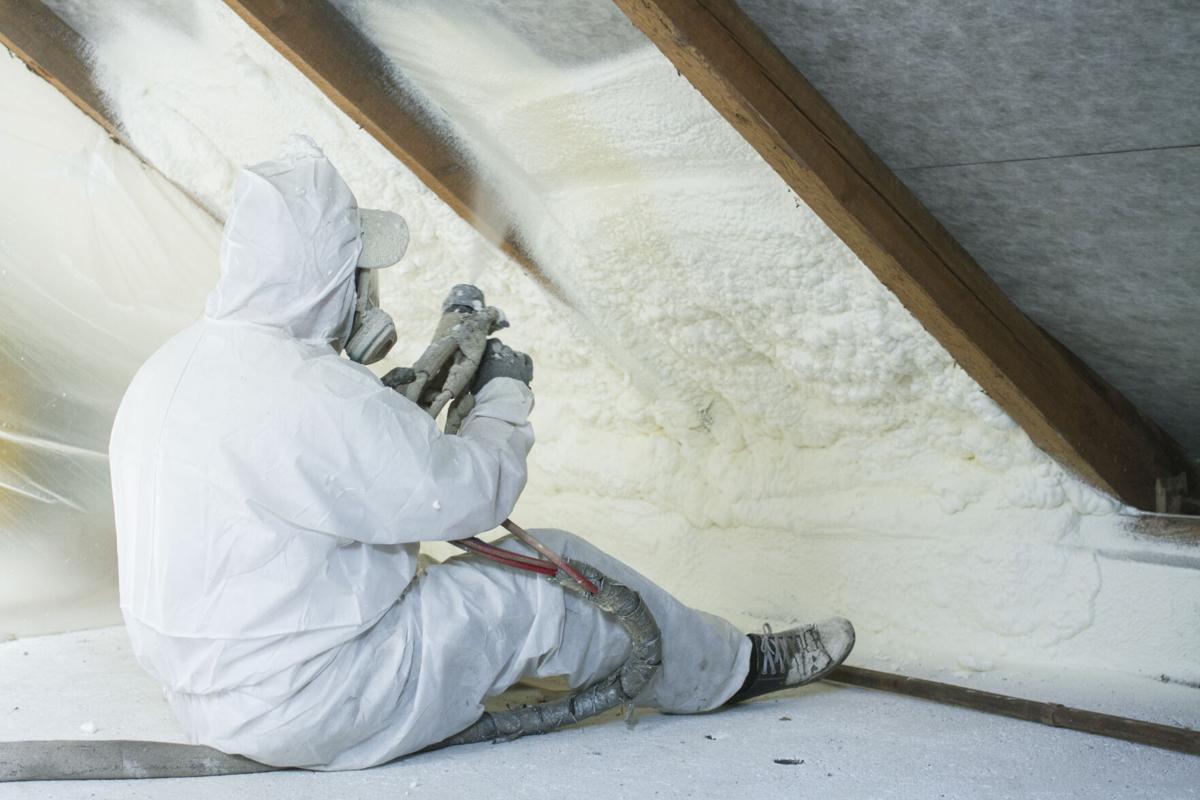
Then a foam insulation product is injected into the block wall as a foam-like liquid. It will find its way, under pressure, into just about every nook and cranny inside that block wall. The foam fills all the voids horizontally and vertically throughout the wall system. The liquid nature of the foam, when first introduced into the space, allows the material to move in any direction, under pressure. The goal is to fill as many of the wall’s voids and any void larger than the foam’s molecules as possible. By maximizing the coverage, an old wall becomes a new barrier to significant thermal fluctuations.
The next step is to repair the small holes around the home that were made to install the insulation foam. Since these openings were made in the mortar joints, patching those joints is the next challenge. Mortar joints are simple to repair.
The challenge is to match the existing mortar’s color of an older home. Compounding this challenge is that weather, sun exposure and landscape vegetation can make the color of the mortar vary. All exterior walls will age differently. This makes matching the color of each orientation the real trick of the trade.
The effectiveness of the process is evidenced in the reduced utility costs, and, most importantly, in the increased comfort inside your home. Processes such as thermal imaging can be used to see how well the installation process went, though those type of tests can be costly. The savings in air conditioning or heat costs, combined with the comfort level speak for themselves. Additional benefits will be a quieter home, less dust and elimination of voids for pests to enter your home.
You could benefit from this expertise if your block home was built before the 1980s. Insulating a block home can add a layer of comfort no matter where you are in our state — high elevations or low desert.
In the face of a recession and economic turmoil, how can you tackle home improvements? Financial planner Eric Maldonado told MarketWatch to start with an emergency fund. Veuer’s Maria Mercedes Galuppo has the story.

