

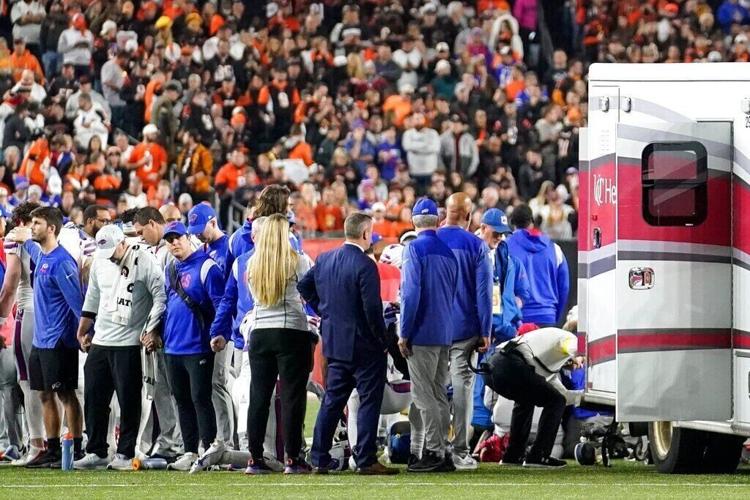
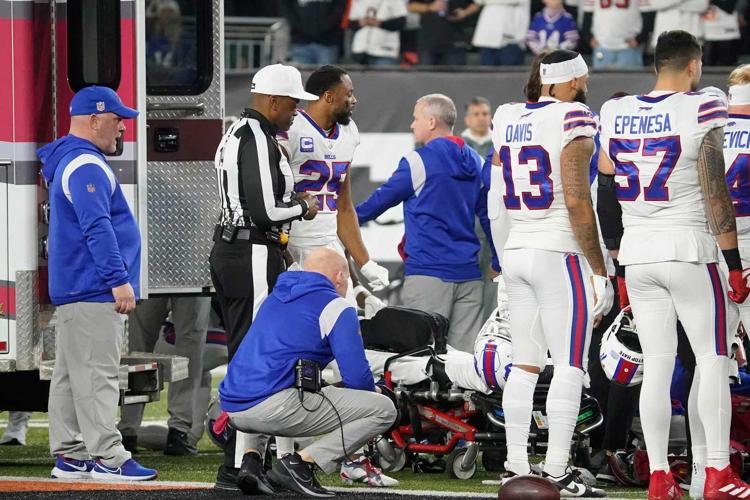
A former NFL trainer with 26 years of sideline experience lauded the Buffalo Bills’ medical staff for their immediate treatment of safety Damar Hamlin early in their game against the Cincinnati Bengals on Monday night.
Hamlin collapsed after tackling Bengals receiver Tee Higgins and went into cardiac arrest. He was transported to the nearby University of Cincinnati Medical Center, the game was suspended and the Bills announced early Tuesday morning Hamlin was in critical condition.
“First and foremost, the Bills’ medical staff did a phenomenal job,” former Jacksonville Jaguars head athletic trainer and physical therapist Mike Ryan said. “It’s a scary situation and you go onto the field and you don’t know if a player has gotten the wind knocked out of him or a player is unconscious and you literally have a life-threatening situation at hand. Kudos to them in a difficult situation. They had to get very aggressive in managing the injury.”
On their website, the Bills list Nate Breske (head athletic trainer), Denny Kellington (assistant athletic trainer), Joe Micca (rehabilitation coordinator/physical therapist) and Tabani Richards (assistant athletic trainer) as their training staff.
Ryan spent six years on the New York Giants’ training staff before running the Jaguars’ training room for 20 years. He is currently sports medicine analyst for Amazon’s “Thursday Night Football,” and NBC’s “Sunday Night Football” broadcasts, watching the games in-person from the sideline.
Watching the Bills-Bengals game on television, Ryan said he quickly noticed Bills team internist Dr. Tom White.
“I could see the sense of urgency in his demeanor so I knew they were locked into the situation and very, very well prepared,” Ryan said.
During a phone interview with The Buffalo News, Ryan and California-based physical Shepal Doshi walked through the steps once Hamlin was injured.
Step 1: Evaluating consciousness.
The first horrifying image was Hamlin rising to his feet before collapsing. How did that happen?
“Let’s say the heart goes into cardiac arrest, for a healthy young person, you can still be functioning for a couple of seconds even if your heart stops or goes into cardiac arrest and then you suddenly pass out, which is what it looked like,” said Doshi, director of cardiac electrophysiology and pacing at Providence Saint John’s in Santa Monica, Calif. “He’s so healthy and conditioned, even a few seconds without the heart pumping well, he doesn’t feel it and then you suddenly you just pass out on the field. He got up out of reflex.”
Once Hamlin was unconscious, Ryan said: “There is an emergency protocol you go through and (consciousness) is one of the steps and how you handle it from there.”
The medical staff administered CPR on the field to restart Hamlin’s heart.
Step 2: Stabilizing Hamlin for transport.
“You want to make sure he’s stable for the ride (to the hospital),” Ryan said. “It’s important to note: Medical staffs, paramedics, team physicians – they’re always practicing these things and you go over all of the scenarios. The preparation of the Bills, of (Breske) and his staff and how often they practice things like this and how often they work with their doctors and paramedics are for this exact situation.”
Ninety minutes before every game, Ryan said the teams’ head athletic trainers and physicians, the on-site paramedics and concussion spotters meet.
“It’s a good way to share notes of, ‘Where is the ambulance going to be parked? What hospital would we use?’ ” Ryan said. “All those things that may have different nuances at one stadium compared to another.”
Step 3: Transport to hospital.
Because UC Medical Center is a Level 1 trauma center, Ryan said the hospital is always prepared to provide immediate treatment.
“They have emergency surgeons, they have vascular surgeons and they have a full staff and here’s the key thing – they are there 24/7,” Ryan said. “You could show up unannounced and their staff is prepared and fully staffed to take care of any traumatic emergency.”
Ryan said he expects the Bills’ medical staff personnel accompanying Hamlin in the ambulance were communicating with the hospital.
“The hospital knew what (type of injury) was exactly coming and they know the history and they know what happened so there is less need for summarizing once the player comes in,” Ryan said. “They’re prepared and ready for him.”
Step 4: Re-stabilizing Hamlin, assisting with his breathing and evaluating other injuries.
Hamlin required intubation to assist his breathing, his marketing representative Jordon Rooney said in a statement early Tuesday morning.
Additionally, Ryan said the likely course is Hamlin’s vital signs were examined (Rooney's statement said Hamlin's vital signs had returned to normal) and personnel began to assess if he sustained any other injuries.
“Let’s say he did have a broken rib. That’s less of a concern on the field than his heart,” Ryan said. “Once he got to the hospital and was stable, they would start looking at those secondary injuries.”
It is unclear who from the Bills’ medical staff stayed with Hamlin while the team flew home to Buffalo. If Ryan had a situation during a Jaguars road game, he said an assistant trainer and one team physician would stay with the player.
A Bills physician isn’t licensed in Ohio so he would not have medical privileges to perform a potential surgery, but Ryan said they could assist the local surgeon.
Ryan said NFL athletic trainers and physicals will “absolutely” debrief each other about the Hamlin situation.
“Everybody wants to win the game, but when it comes down to medical care, you don’t look at the scoreboard and you don’t look at any other thing than taking care of that patient,” Ryan said. “From this situation, just like every other very difficult injury, be it medical or orthopedic, all NFL athletic trainers and athletic trainers at all levels of sports will benefit because they are willing to share what happened, what they did well, what they learned, what they would do better next time. The open communication and the focus on the patient continues to increase the safety and care of the athletes.”

