





Traditional retailers are refining their use of online browsing history and social media to reach customers and personalize their shopping experiences.
But much work remains to be done to put shopper data to best use, and engaging customers with company values is becoming more important in the new era of social activism, speakers said at the 22nd Annual Global Retailing Conference, hosted by the University of Arizona’s Terry J. Lundgren Center for Retailing.
Lundgren, retired CEO of Macy’s and a UA alumnus, said despite the onslaught of online sales, nine out of 10 purchases are still made in a brick-and-mortar store.
“We certainly see a trend toward online shopping, but it’s going to go from 10 percent to 11 or 12 percent, its not going to go to 50 percent overnight,” Lundgren said in an interview.
Some major retailers have driven online sales higher by using online data and channels to drive sales anywhere, anytime.
For most people these days, the shopping experience starts on their smartphones.
“The way consumers are clearly shopping is they’re starting the search for the product they’re interested in with their phone or mobile device and they’re searching, whether they want a shirt or jacket or whatever, they’re seeing what their options are,” Lundgren said, “But the large, large majority of them are then going into a physical store and making the transaction there.”
Leveraging vast amounts of customer data now available from online retail sites and social media, retailers are targeting shoppers like never before.
Wonder why you got that popup ad for shoes?
“When you purchase an item, we can go to our site and find another 500 customers who purchased that item and what they purchased next, and then what they purchased next after that,” said Lundgren, who retired as CEO of Macy’s last year. “So we can kind of get a feeling for what you might like, by the way your purchase pattern looks like others.”

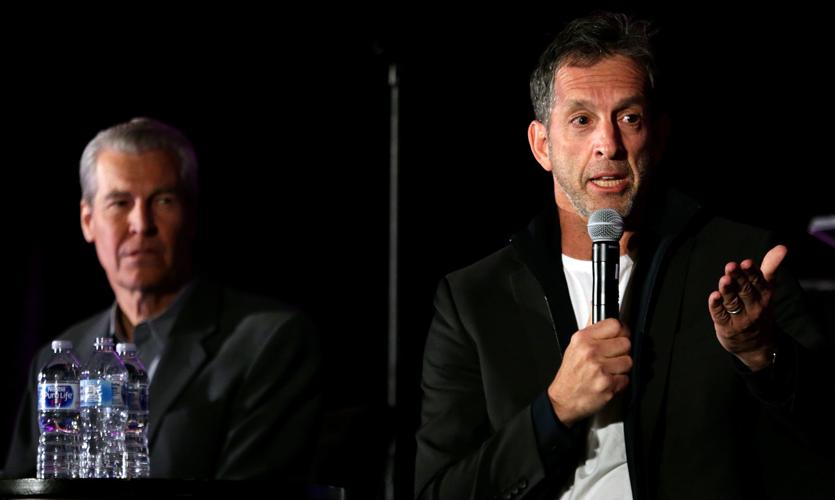
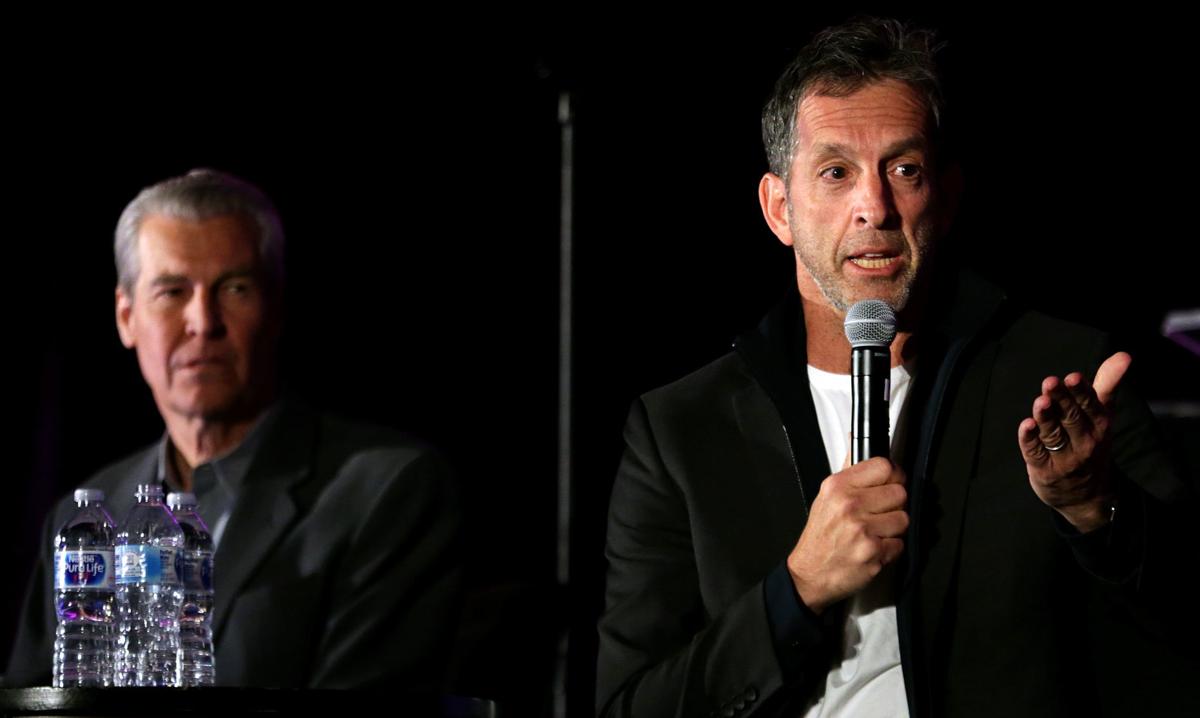
Kenneth Cole, founder of Kenneth Cole Productions, speaks during the 2018 Global Retailing Conference, by the University of Arizona Terry J. Lundgren Center for Retailing, at the Westin La Paloma Resort and Spa, 3800 E. Sunrise Dr., on April 20, 2018, in Tucson, Ariz. The two-day conference concluded with a talk and discussion with fashion mogul Kenneth Cole.
SELLING SOCIAL
Prominent American designer Kenneth Cole said his company recently revised its business model, closing its outlet stores to focus on its online and third-party sales through department stores like Macy’s, Dillard’s and Nordstrom. Kenneth Cole Productions still has a full-price retail store in New York City.
“In this new sharing economy you ride in other people’s cars, stay in other people’s homes, but the good news is, you’re still buying your own shoes,” Cole said.
But online, Cole said, “You have to have the ability to react overnight, and it has to be a dialogue, not a monologue.”
To stay relevant either online or as a store, it’s now more important than ever for retailers to engage customers at a social level, he said.
“We’re talking to people about not only what’s on their body but also what’s on their minds,” said Cole, whose longtime social activism has included advocacy for AIDS sufferers and the homeless.
Cole encouraged the more than 300 conference attendees, including about 80 UA retailing students, to participate in the “unprecedented” wave of social activism, pushing back against racism and sexism.
“Business should engage in this new activism,” he said. “Sitting on the sideline is no longer an option — today, you either have the courage to take a stand or you have to step aside.”

“We’re talking to people about not only what’s on their body but also what’s on their minds,” Kenneth Cole says.
FROM WEB TO STORE
Several other speakers at the two-day conference said they are deep into efforts to leverage online consumer data and create new ways to reach customers at every step of the shopping process.
Tony Rogers, chief marketing officer for Walmart U.S., said the world’s biggest retailer is trying to link online shopping with the in-store experience and is essentially turning each of its stores into distribution centers for its online business, recognizing that for many customers, shopping starts with a smartphone.
“We are tied to our phones — it’s just 24/7,” Rogers said.
Walmart’s new in-store pickup service, which allows customers to buy online and pick up within seconds via a growing number of self-service, automated “pickup towers” at their local stores, has been a tremendous success, he said.
The company plans to expand the pickup-tower concept to 2,200 of its 4,700 stores this year, in the name of customer convenience, Rogers said, citing the growing number of households where every member works and many have second jobs.
“You can see where people need to save time and save money, and we’re focused on both,” he said.
Walmart is expanding its online-based grocery delivery service from six pilot stores to 100 nationwide this year.
“It’s a process of ‘test and learn’ — we’re trying all kinds of stuff,” Rogers said.
Meanwhile, Macy’s has been refining its marketing strategy to use customer data to “narrowcast” its message to “digitally retarget” consumers, said Rich Lennox, chief marketing officer for the retail giant.
That refinement eventually creates a “pull” effect to attract sales, as opposed to ubiquitous and sometimes obnoxious “push” advertising, Lennox said, adding, “No one is waiting for our marketing to interrupt their lives.”
While Macy’s has been closing stores after suffering declining sales, Lennox has worked to build on its longstanding brand loyalty with a new marketing push targeting fashion-minded consumers and its top customers.
Lennox credited a long-term ad campaign launched last October and a new fashion-focused site, Macy’s Presents The Edit, along with new perks for Macy’s Star Rewards customers with turning around 11 straight quarters of falling sales at the end of 2017.
CRUNCHING NUMBERS
Meanwhile, luxury retailer Neiman Marcus has embraced online sales, which now comprise about 35 percent of the company’s total revenues, said Karen Katz, who recently retired as Neiman’s CEO.
Already focused on personalized service for its affluent customers, Neiman has launched a new system that gives salespeople on the floor instant access to customers’ shopping and personal preferences.
Neiman Marcus, which launched a mobile-payment app with Capital One in 2015, is looking to expand mobile-payment options to make purchases “frictionless,” she said.
“That’s the wave of the future, those kinds of things that make shopping easier but really resonate with customers when they come into the store,” Katz said.
Several speakers expressed the growing need for data-analytics experts to help refine retailers’ marketing strategies.
Lundberg noted that Macy’s and other retailers are busy hiring computer scientists, including Ph.D.s, to help them make better use of mounting volumes of customer data.
“Consumers today have much higher expectations, they’ve risen dramatically,” Neiman’s Katz said.
“I think we can use data to be better merchants, to be forward-thinking about what we’re going to buy.”

