


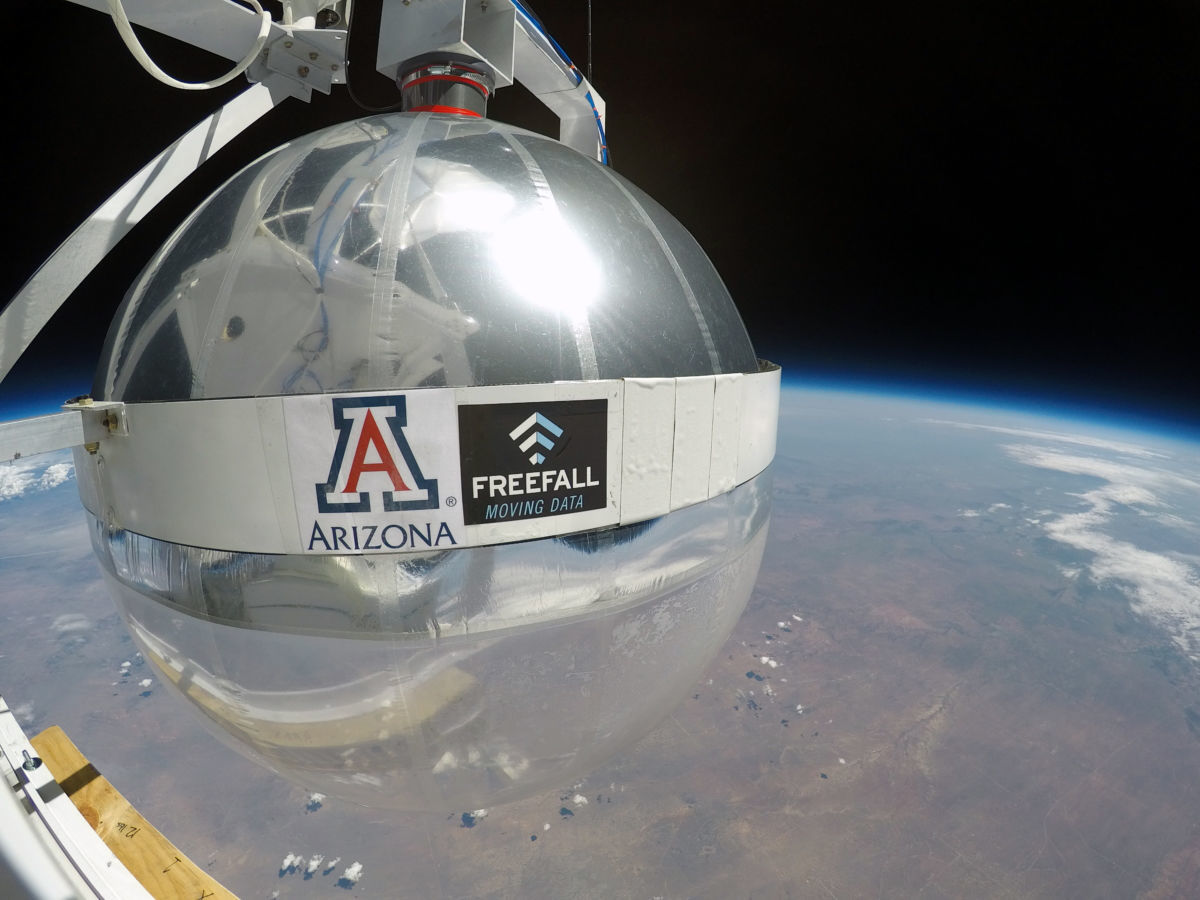

One of Tucson’s latest New Space industry startups took a big step forward recently when a prototype of its spherical antenna hitched a ride on NASA’s newest and biggest research balloon.
Freefall Aerospace, a University of Arizona technology spinoff founded by UA astronomy professor Chris Walker and NASA veteran Doug Stetson, demonstrated its high-efficiency antennas for small satellites in a test flight Aug. 17 from Fort Sumner, New Mexico.
The flight test, a first for Freefall’s antenna, was conducted with other experiments aboard NASA’s new, football-stadium-size, 60-million-cubic-foot stratospheric balloon at a record-breaking sustainable altitude of 159,000 feet.
Stetson, Freefall’s president and CEO, said the antenna’s spherical reflector design offers a 360-degree field of view for reception and can be electronically “steered” around the reflector surface to track signals through computer algorithms — with no moving parts.
In contrast, common shallow-dished parabolic antennas focus incoming signals on a single point and must be physically pointed in the direction of a signal, making them tricky and costly to deploy on small satellites.
“A parabolic antenna is fine, but it must be pointed very precisely at its target or else it loses signal strength rapidly,” said Stetson, who spent 35 years as an engineer and manager in NASA’s Joint Propulsion Laboratory and later worked with Walker on astrophysics projects at the UA. “This allows a way to steer an antenna from space without any moving parts.”
Freefall’s antennas are designed to handle high data-transfer rates, such as those afforded by emerging 5G data networks, and Freefall’s inflatable spherical reflectors are compact, lightweight and relatively inexpensive to make.
Besides antennas for space, the company is developing antennas that can be used as ground stations or as antennas aboard moving vehicles or ships.
The antenna’s inaugural flight was a success in confirming the performance of the antenna’s electronic beam-steering technology at long-distance, Stetson said, noting that the company was able to gather data for eight hours during the test.
“The balloon was a step toward testing the antenna in space, and the balloon gives us a good sort of a near-space environment in which to make that test,” he said.
Through Tech Launch Arizona, Walker’s patent-pending antenna technology was licensed to Freefall by the UA, which could benefit from future license revenue under the deal.
Freefall has six employees, including four full-timers, as well as part-time help from Walker and other UA faculty and students.
The privately held company has been self-funded so far but is in the process of raising funds from investors for further development, Stetson said.
Freefall was recently awarded a Small Business Innovation Research grant to further develop its antenna technology, he said.
The Office of Naval Research, which funded the original antenna research at the UA, is also interested in pursuing the technology, Stetson said.
Walker, who also holds UA professorships in optical sciences and electrical and computer engineering, has longtime ties with NASA’s balloon programs.
He is principal investigator for numerous NASA missions including GUSTO, the Galactic/Extragalactic Ultra Long Duration Balloon Spectroscopic Terahertz Observatory, a $35 million project that includes a planned long-duration balloon mission to be launched from Antarctica in 2021.
“We’re hopeful there will be an opportunity for a test flight on a spacecraft in the next year or two,” Stetson said, adding that the company is also pursuing ground-based applications for the antenna with a couple of interested companies.
“We have a number of different applications for this that we’re pretty excited about, and this balloon flight was a big step toward validating the approach,” he said.
For more information, visit Freefall online at freefallmovingdata.com.

