


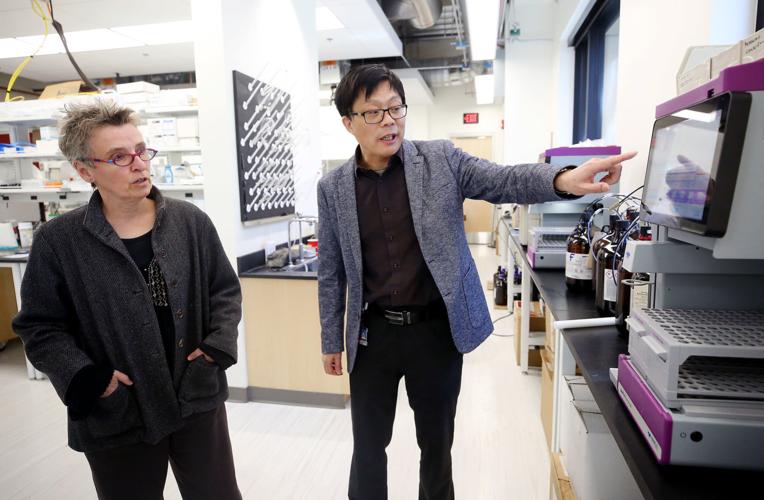
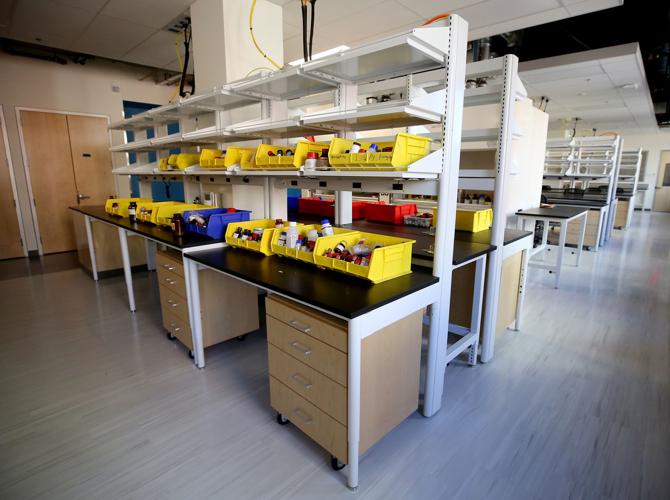

The big, unopened boxes of lab equipment that crowd one room at the recently expanded Skaggs Pharmaceutical Sciences Center are a sign of things to come for drug research at the University of Arizona.
The UA College of Pharmacy’s new Arizona Center for Drug Discovery promises to energize the drug discovery process across campus and help push innovative technologies developed in Tucson from the lab to the patient’s bedside.
The center aims to do that by helping UA drug researchers with drug discovery — early-stage efforts to narrow down candidate drug compounds — and connecting them with partners in the pharmaceutical industry, said the center’s co-directors, Jutta Wanner and Wei Wang.
Wanner, who joined the UA last August after a long career in the pharmaceutical industry, said part of the center’s mission is to unify the school’s drug-discovery efforts, which are ongoing in campus facilities including the various Health Sciences colleges, the BIO5 Institute and in the Department of Chemistry.
“A lot of drug discovery was ongoing, but it wasn’t unified,” said Wanner. “I think our role is to put this under one umbrella.”
Wang, who has a Ph.D. in chemistry and joined the UA faculty as a professor of pharmacology and toxicology about two years ago after a 15-year stint at the University of New Mexico, said the timing is good for universities to step up their early-stage drug development efforts.
“The timing’s great, and there is huge demand across campus for drug discovery,” said Wang, who did postdoctoral chemistry work at the UA in 2000 and 2001 under now-retired UA Regents professor Victor Hruby.
As part of the initiative, the UA’s main genomics facility, the ACDD is partnering with the Functional Genomics Core at the BIO5 Institute to coordinate efforts and avoid duplicative services.
The center is also in the process of installing a chemical screening facility with state-of-the-art equipment to rapidly purify and screen candidate drug compounds, after recently moving into new spaces at Skaggs built as part of a $26 million expansion and renovation project.
Those tools will help drug researchers move rapidly through the discovery process, identifying the most promising drug compounds before moving into extensive and costly preclinical studies and, later, clinical trials.
“It’s a long process and along this pathway, each step and assay (test) you do is really to de-risk the waste of money and de-risk your product and so you get a good safety profile the desired efficacy,” Wanner said, noting that it typically takes more than a decade to bring a new drug to market.
As an example, she cited UA tech spinoff Reglagene, which has identified a compound to “turn off” cancer cells but still has much development and preclinical work to do before preparing for clinical trials.
Wang noted that most UA faculty members involved in drug research have their own labs, many supported by ongoing grants, but they often don’t have the advanced and rapid chemistry screening tools needed to move forward with a product.
“They don’t have the capacity to do the drug discovery, because on their side they work on the biological component, they don’t have the chemistry component,” said Wang, who has his own chemistry lab at Skaggs.
After a compound is identified to treat a disease — for example, to inhibit the growth of cancer tumors — medicinal chemists typically must optimize the compound for safety and efficacy, Wang said. Since taking the helm of the new center last year, Wang and Wanner have been scouring the greater UA campus to find promising drug research and help move it forward.
Wanner, who is also an associate professor in the College of Pharmacy, said the new center already has begun working with about 40 UA scientists, in some cases encouraging them to take new approaches for broader impact.
“Somebody might be working on a biomarker assay,” she said, referring to a test for a marker of biological activity used for diagnostics. “For that investigator, that biomarker assay is exactly that, but for a drug discovery scientist, that biomarker could become a drug target.”
To help connect with research partners, Wanner said, the ACDD has prompted UA scientists to write non-confidential summaries of their work to shop among potential collaborators including major pharmaceutical companies, biotech startups and research institutes.
The ACDD will work with existing drug-discovery initiatives at the UA including BIO5, the Arizona Cancer Center and the Sarver Heart Center and the UA’s Phoenix medical campus, and longer-term, plans to widen its reach statewide.
The center will host its second symposium on drug discovery in Phoenix in September and is planning a spring symposium in Tucson, Wanner said.
The head of the UA’s technology commercialization arm said he expects the ACDD to amp up tech licensing and startup activity.
“This creates a focus for the whole university, that is doing different stages of a drug discovery project to actually utilize resources in a centralized way,” said Doug Hockstad, UA assistant vice president of Tech Launch Arizona. “Drug discovery is really hard, and this potentially speeds up the process, gets quicker to potential drug candidates, and provides things for TLA to invest in.”

