

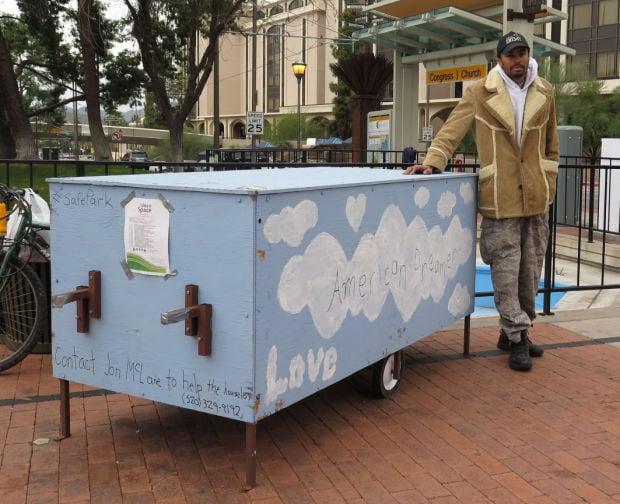
People living in boxes and tents on downtown sidewalks, saying they are protesting the lack of jobs and housing, mostly rebuffed city, county and social-service-agency efforts in the last week to help them find jobs and housing.
This comes as city officials have been under increased pressure from the community and business leaders to find a solution to the influx of homeless people who have set up camp in areas around Veinte de Agosto Park.
Business owners are angry about aggressive panhandling, crimes, and urination and defecation in public spaces.
A Feb. 25 report from Steven Nelson, program coordinator at Pima County’s Sullivan Jackson Employment Center, noted that some of the homeless group gathered around Veinte de Agosto Park, at Church Avenue and Congress Street, rebuffed service providers.
Nelson wrote that occupants of the area fronting the County Administration Building were “outspoken in refusing services and any assistance at this time.”
Peggy Hutchison, CEO of the Primavera Foundation of Southern Arizona, said representatives of her organization had a similar response when they tried to offer services to homeless-camp occupants.
“People have told my staff, ‘I don’t need any resources,’ ” Hutchison said.
An organizer of the movement, which participants call Safe Park, said he’s aware some people have turned down offers of assistance.
“Some people just don’t want the services,” said Jon McLane, one of the protest organizers, who lives in a wooden “dream pod” box on Congress Street. “People want their own private space.”
At least 36 coffinlike boxes that organizers call dream pods have been set up along downtown sidewalks. Along with a dozen tents and various other shelters and furniture, they occupy an area that now extends extend south on Church Avenue across the front of the Tucson Convention Center.
McLane, 31, said many of the agency shelters provide only communal sleeping quarters that often are unclean and unsafe, and most limit the number of days a person can stay per month. Such shelters are “really more of a holding place,” he said.
Another problem, McLane said, lies with what he sees as a lack of services for people once they arrive at shelters.
“It’s hard to be transitioned when they don’t provide jobs for people or advanced training,” he said.
McLane also said many of the homeless lack basic life skills such as budgeting, which he said aren’t provided. Pima County’s One-Stop Career Centers provide numerous employment, job-training and other community services, many tailored specifically to the homeless.
But program’s requirements include that the participants show a willingness to work to qualify for the services.
“There are a lot of resources, but at the same time, we have to turn people away,” Hutchison said.
And some, she said, simply aren’t interested, an attitude she attributed somewhat to misinformation and wrong perceptions.
For instance, many homeless people with dogs or other animals assume they won’t qualify. Hutchison said that’s not the case, and Primavera can provide people who have pets with housing.
Others think that if they are married or living on the streets with a spouse or partner they also won’t qualify or will be separated. But Hutchison said family shelters are available, as well as rental assistance programs. Primavera has offered rental assistance to at least one couple now living in a dream pod at the park, but the pair have not yet accepted the offer.
The Downtown Tucson Merchants, which represents about 150 businesses in and around downtown, recently sent a letter to the City Council asking that more be done to keep the area clean and safe.
“The inhumane living conditions; waste and excrement; incidents of assault, violence, aggression, animal attacks, illegal drug possession; use and distribution of narcotics in this area have created a dangerous and unacceptable environment for everyone, including the protesters, our community and guests,” the letter reads.
The merchants asked for round-the-clock police presence in the park and more police patrols at the Ronstadt Transit Center, which merchants say has also been impacted.
“They keep regurgitating these same complaints,” McLane said, adding that he doesn’t think Safe Park protesters are responsible for criminal activity.
McLane has said he’d be amenable to moving the protest to an alternative site as long as it’s within about a mile and half of downtown.
Tucson City Councilman Steve Kozachik has backed moving the protest to another location, possibly with some sanitary services like portable toilets, which he said would serve two purposes.
First, it would remove the nuisance factor of people living on downtown sidewalks, he said, and second, it would prevent the city from having to go back to court.
McLane and others have a pending lawsuit against the city, accusing police of violating their free-speech rights and harassing people.
A federal judge ruled that participants can remain on the sidewalks as long as pedestrians were given 5 feet of clearance.
“Here we are trying to win this thing in court, and this is a nonlitigious solution,” Kozachik said of his proposal.
Earlier this week, the city filed a motion in U.S. District Court in Tucson asking the judge to clarify his order. Since the judge restricted the city’s enforcement abilities, between 70 and 100 people have effectively established residence on the sidewalks.
The judge agreed to hear oral arguments on March 10.
City attorneys also recently filed an appeal of the District Court’s ruling with the 9th U.S. Circuit Court of Appeals.

