




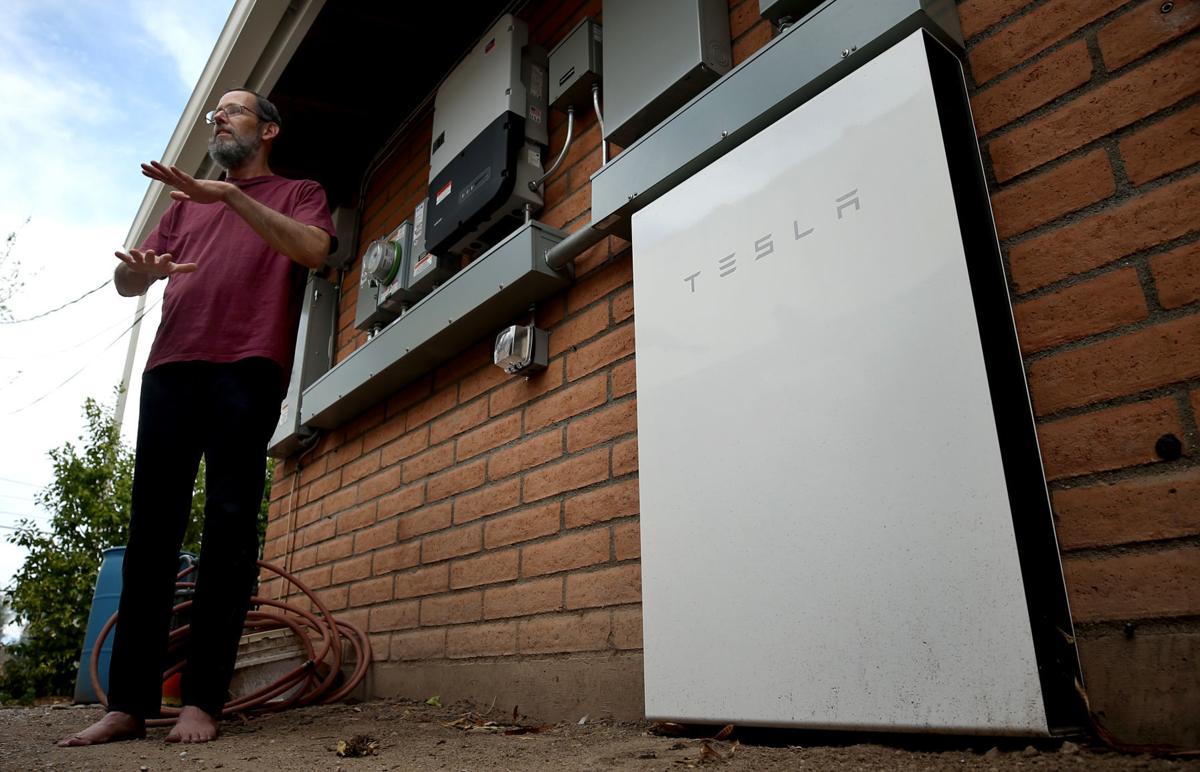
When Duane Ediger and Carol Rose installed a Tesla Powerwall 2 battery on their Barrio Hollywood home last January, they knew it wouldn’t pencil out financially.
“Though there’s a slight financial benefit, it’s definitely not enough to pay for the battery,” he said. “We got the battery out of a commitment to kind of blazing the trail to where we’re headed.”
But rooftop-solar customers of Tucson Electric Power Co. may soon have a new incentive to install home battery systems that store excess energy generated by the panels for use when the sun isn’t shining, under a proposal being considered by state regulators.
As part of the companies’ solar rate case pending before the Arizona Corporation Commission, an administrative law judge has recommended that TEP and sister utility UNS Electric propose special rate plans for solar customers who install battery storage systems.
The Corporation Commission in late 2016 decided to end net metering as a matter of policy and shift to a system where rooftop-solar customers are paid a lower “solar export rate” set for each utility for their excess power.
Lower solar export rates will make energy-storage systems more attractive, but local experts say such systems likely still won’t pay for themselves quickly enough to lure most customers.
Though prices are falling, battery storage systems are expensive, costing about $10,000 to $15,000 installed for typical home systems like Tesla’s Powerwall and batteries from LG and Sonnen.
Originally proposed by solar-industry groups, the TEP/UNS program would be modeled after a pilot rate plan offered by Arizona Public Service Co., which includes batteries and other “behind the meter” technologies such as load controllers that can turn off large appliances during demand peaks, and electric cars.
The APS “R-tech” rate plan has three parts: a basic service charge, a charge for the amount of demand averaged in a one-hour period for the month and a charge for the total energy used for the month.
The idea is to give customers a way to shift their power demands.
TEP and UNS have not taken a position on the R-tech rate proposal but the companies have said customers with battery systems could take advantage of existing time-of-use rates, which charge lower rates during off-peak periods, or demand rates, which include time-of-use rates with a charge based on a customer’s peak usage.
TEP spokesman Joe Barrios said the companies generally support the idea of a storage rate but it’s too soon to discuss specifics. He noted that once the solar rate order is approved, the utilities will have four months to come up with the rate plan.
“Our goal would be to design rates and requirements that would make battery systems accessible and beneficial to customers,” Barrios said. “We’re certainly in support of new opportunities to work directly with customers, and battery systems have the potential to afford those opportunities.”
Barrios said most existing customers install batteries for backup emergency power, noting that those systems can only run some home systems for a few hours and lack the oomph to start up an air conditioner.
“We encourage customers to understand what they’re purchasing and what services the battery system provides,” he said. “In the future, customers might be able to help with reducing peak load by charging their systems during off-peak hours, then deploying during on-peak hours.”
LONG-TERM OUTLOOK
Solar supporters say battery storage can help rooftop solar homeowners save money by allowing them to store and use their own energy rather than tapping the utility grid, and help reduce peak power demand.
There are some caveats, however.
Aside from the cost, adding batteries doesn’t make financial sense for existing solar customers, who already get a full billing offset for excess energy their panels produce under the current system of net metering in TEP and UNS territories.
“With where the cost of storage is right now, it’s hard to justify economically,” said Louis Woofenden, engineering director and co-owner of Tucson-based Net Zero Solar.
Net Zero has installed a handful of battery systems, including some in off-grid applications where customers have no local electric service, but Woofenden said he doesn’t expect the storage rate to be highly attractive, even if regulators approve a low solar export rate for TEP and UNS, noting that it takes some discipline and effort to avoid large peak demand charges.
“It will be an option, but I wouldn’t guess it will be attractive for most people on a strictly economic basis,” he said, adding that such rates are more beneficial to customers in places where usage-based rates are very high, like Hawaii and California.
Then there’s the relative complexity of the making the rates work.
“The challenge there is you’ve got to be 100 percent of the time avoiding the peak — a lot of homeowners don’t want to dig that deep,” Woofenden said.
Kevin Koch, co-owner of the Tucson-based solar installation firm Technicians for Sustainability, said energy storage may not be financially attractive now, but a pilot program is a good idea to help figure out how customer-sited energy storage can help shave peak demand and otherwise benefit the grid.
“I certainly support pilot programs to encourage storage adoption and to identify where storage makes sense, sort of where the low-hanging fruit are,” said Koch, who is a formal intervenor in the TEP/UNS solar rate case.
He said adoption of storage rates may be driven by the solar export rates the commission sets, and the eventual design of the storage rates will be critical to creating benefits to the grid.
“It’s not going to pay itself off, so there has to be some value provided to the grid,” Koch said. “The impact of a single resident isn’t going to drive the needle, but there’s value of setting this up en masse.”
He likened it to incentives offered as state regulators tried to boost the adoption of rooftop solar through the state’s renewable-energy standard.
GETTING ON BOARD
Some consumers are installing storage systems despite the cost, to avoid using grid power or to provide backup emergency power.
Ediger, a solar installer for Technicians for Sustainability, says the combination of a 5.44-kW rooftop solar array installed last year and a Powerwall lithium-ion battery system provides most of the couple’s power needs, including running an energy-saving two-stage heat pump designed to start up without a surge of power.
“It keeps us cool and lit in the evening and overnight,” Ediger said. “We use very little utility power.”
Ediger and Rose are among about 30 to 40 customers who have applied to install battery systems with solar, according to TEP, which has received about 50 applications overall, Barrios said. Solar and battery systems must be inspected and approved by the utility.
Ediger said he was aware that battery storage would be an extra expense, since the couple gets full credit for excess power production under net metering.
He said the battery installation also benefits the utility by lessening the effect of the so-called “duck curve,” a phenomenon where in some cases grid-tied solar systems produce more power than needed during the middle of the day but production wanes as demand soars in the evening.
“We’re not feeding back into the grid when that power isn’t particularly needed, and then by the time the battery is full, cooling and other loads in Tucson are coming on in the late afternoon,” he said, adding that the battery also can be configured to send power to the grid during peak evening demand periods.
The Salt River Project, serving the Phoenix area, started offering an incentive of up to $1,800 for customers who install lithium-ion batteries either with solar panels or to store grid power, under a settlement of a lawsuit filed by Solar City in 2015 over solar rates.
Elon Musk’s Tesla acquired Solar City in 2016.
SRP also offers a special rate for customers who own electric vehicles with a low rate of 6 cents per kWh during “super off-peak hours” between 11 p.m. and 5 a.m.
About 160 APS customers have installed lithium-ion batteries, APS spokeswoman Anne DeGraw said.
Since APS began offering energy-storage last spring, 14 customers have signed up for the rate, and 11 of those own electric cars, she said.
“This rate is a fantastic opportunity for technology-savvy customers to go on a plan that not only helps to utilize more mid-day solar but can also save them money on their energy bill,” she said, adding that APS has not actively marketed the rate but plans to ramp up marketing this fall.

