

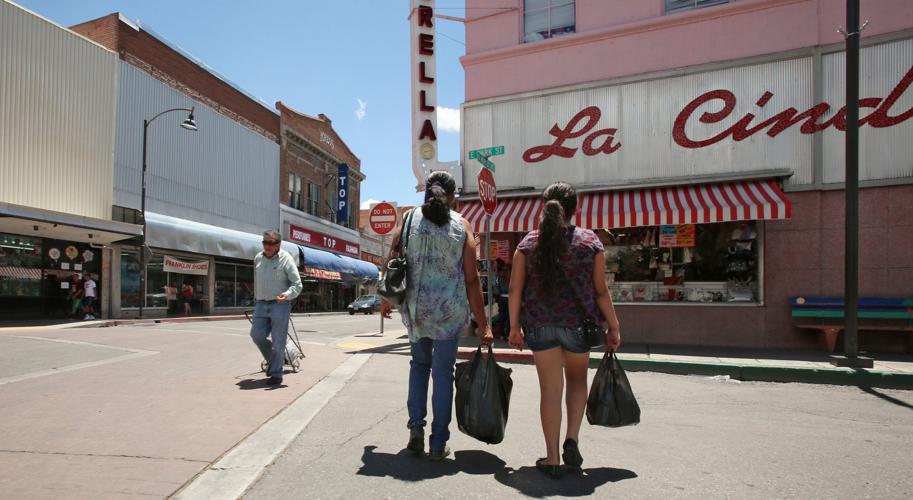
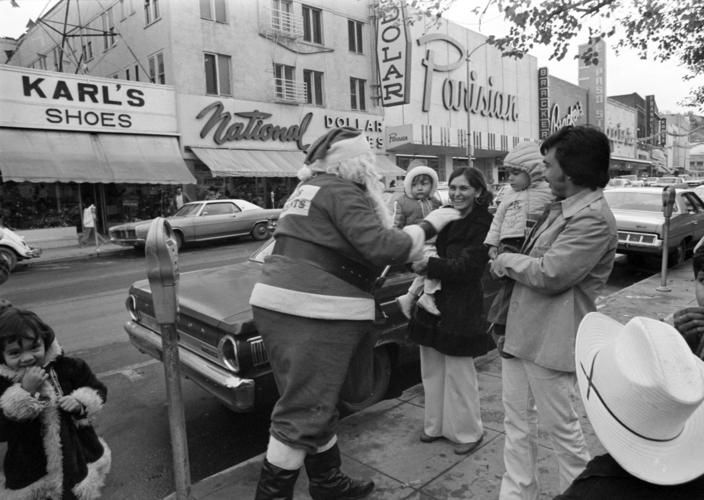
NOGALES, Ariz. — Walking into Bracker’s department store in Nogales, Ariz., is like going back in time. Murals depicting scenes of a very different border, with horse-drawn carriages and women in long dresses, run along the walls. Elegant hats, sparkling with sequins and jewels, line the glass shelves. Silk gowns and dark blazers sway gently on their silver racks.
Now, half of that merchandise is gone. Mannequins stand naked in the front windows, and what remains is stuffed into boxes or plastered with neon sale tags.
“Listen to that,” said Debbie Bracker-Senday, who co-owns the store with her cousin Bruce Bracker, as the decades-old cash register rung brightly behind her, announcing one of its final sales. “I’ll never forget that sound.”
It is one of the many memories that will stick with her after the department store she grew up in closes. This month, Bracker’s — once known as a “destination” for well-to-do shoppers from Sonora and Sinaloa, according to Bracker-Senday — will shut its doors after 93 years. It’s one of the latest casualties of a declining economy, a devalued peso, changing shopping trends and anti-immigrant rhetoric, business owners and officials said.
The 91-year-old JC Penney’s closed in 2012. The decades-old Robinson’s True Hardware shut down in August. A walk through downtown shows vacant storefronts and chain-locked doors.
It’s a trend city officials and the community are trying to reverse, although they acknowledge it won’t be easy. They want to attract customers from other parts of Arizona and revitalize downtown by bringing in more activities and nightlife.
But some business owners feel that their stores will be unable to rebound after years of struggling to turn a profit.
“Once you start having problems, it’s hard to bring it back,” said Bracker-Senday.
While a myriad of reasons contributed to the store’s decision to close, including a general preference for online shopping over retail, the closure really came down to a declining number of shoppers from Mexico, which made up about 85 percent of Bracker’s customers, she said.
Mexican shoppers contribute about 60 percent of the annual sales tax revenue for Nogales, according to a 2014 report from the city’s mayor John Doyle. The sales tax income for 2016 was about $8.5 million, slightly down from the previous year, and it will likely continue to decline, said Nogales City Manager Carlos Rivera.
He also cites the devaluation of the peso as a major catalyst.
“That’s what initially started this whole mess,” he said. “For a long time it was 11-12 (pesos) per dollar, and at one point in shot up to 20-22 per dollar, which really hurt business a lot. ”
For Bracker-Senday another factor for the drop in Mexican shoppers is the anti-immigrant rhetoric coming from the new presidential administration.
“Our government didn’t respect our nice people across the border,” she said. “They really didn’t realize that the reason there was so much revenue here, and in Tucson, was because of our friends in Mexico.”
Rivera thinks that the best solution to help Nogales businesses is to attract more shoppers from within Arizona, following the model of Tucson’s downtown revitalization, including food trucks, artisan markets and musical events.
But it will require cooperation from the entire community to make it happen, including local businesses whose core clientele has come from Mexico for decades.
“No matter what we do, we can’t fix the overall problem. We can spruce up the amenities, the streets, the lighting, we can possibly get some grant money to assist,” he said, “but we can’t do their advertising, we can’t change their product.”
City Council members are working on several projects to bring more businesses, including building a small amphitheater downtown and applying for preservation funds to improve the facades of some of the older buildings.
But those initiatives will take time and for businesses like Bracker’s, the issues and costs associated with revitalization — including the store’s location of Morley Avenue on a flood plain — aren’t worth it financially.
“I wish more had been done (by the city) when we were here,” Bracker-Senday said.
On their last visits to their favorite store, customers talk about the memories they’ve made inside those four walls.
About the times when their parents and grandparents made trips in horse-drawn carriages down muddy roads to buy a season’s worth of clothes at the most elegant store in the region, and marveling at the glittering evening gowns that Pearl and Charlie Bracker, Debbie’s grandparents and the store’s founders, had brought back from shopping trips to New York.
“There’s no other like Bracker’s,” said Maria Maytorena, who came up from Hermosillo with her daughter to shop at the store one last time. Her arms weighted down with creamy silk communion dresses and navy blazers, gifts for her grandchildren. “I bought my wedding dress here. The attention, the quality — only at Bracker’s.”
As Maytorena approached the register, Bracker-Senday said that she had probably purchased her wedding dress from her grandmother, Pearl.
While the thought of turning off the neon Bracker’s sign for the last time is emotional for Bracker-Senday, hearing what the store and her family has meant for so many people gives her comfort.
“To know that they won’t forget us, even after we’re gone,” Bracker-Senday said.

