



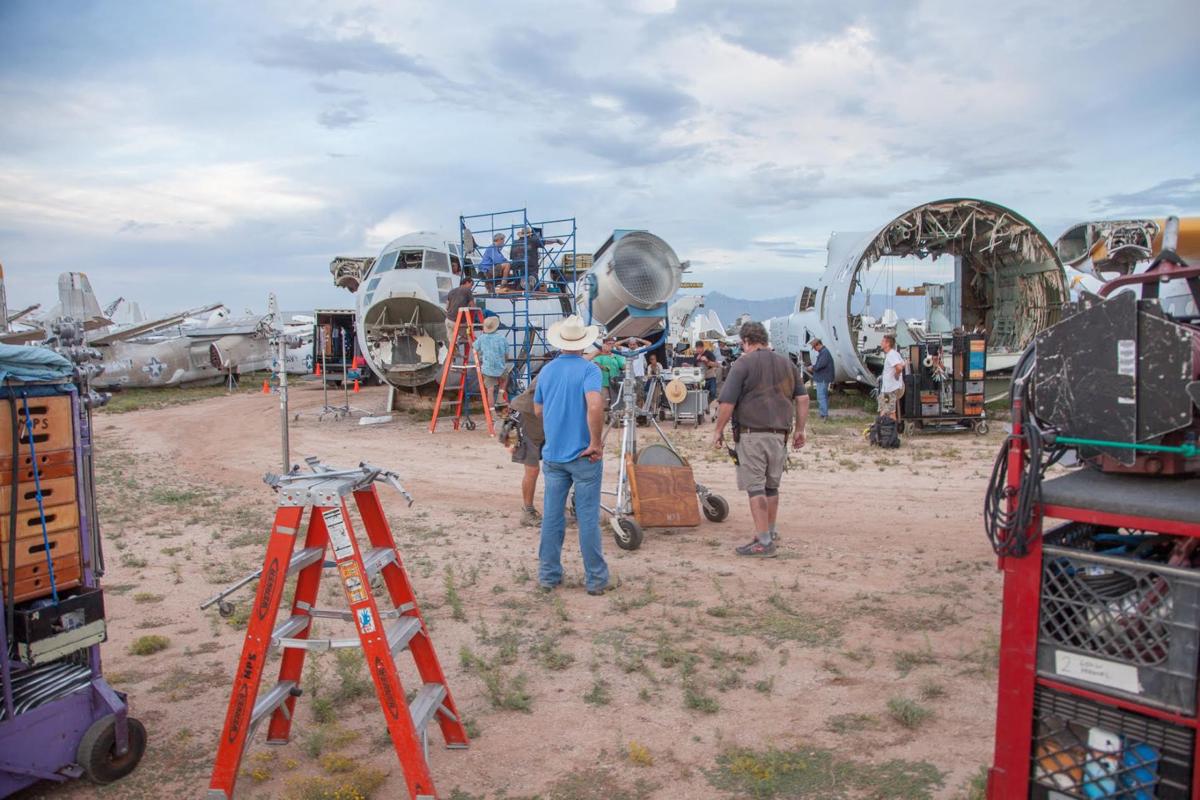
Once a powerhouse for filming western flicks, a lack of tax incentives for filmmakers has forced Tucson to adapt.
With large productions often bypassing Arizona to film in states that offer more tax incentives, Tucson has shifted its focus to independent films, reality television shows, and magazine photo shoots, said Shelli Hall, director of the Tucson film office.
“Run Coyote Run,” a show for FOX’s Latin America market, was shot here, and just renewed for a second season. Complex TV, a streaming network from Complex Magazine, is currently shooting in Tucson.
Last year, a film company with offices in Paris and Los Angeles came to Tucson to shoot four music videos for French artists. The Discovery Network often films here for segments that include University of Arizona faculty; and Neiman Marcus, Williams-Sonoma, West Elm, Calvin Klein and Macy’s book photo shoots in the region.
While many of the film projects that come to Tucson are small, the local film industry still generates dozens of jobs and millions of dollars. The Complex TV shoot generated $800,000 for the local economy when the crew came here for 46 production days.
“Last year we facilitated $11 million in direct spending,” Hall said. “We are on track to beat that number this fiscal year.” She added that through 2015 and 2016, about $9 million was spent in Tucson.
Hall also said that “Run Coyote Run” was filmed partly in Sonora, bolstering Tucson’s partnership with the region. “We have a great relationship we’ve developed over the years because of these cross-border projects,” she said.
Another advantage: Tucson is only an eight-hour drive from Los Angeles, in addition to having a dozen flights to and from Los Angeles daily.
Despite the money that is generated by film projects in Tucson, the lack of tax incentives offered by Arizona keep larger productions away.
“We don’t have the tax incentives 40 other states are offering to Hollywood,” Hall said, adding that production companies would rather take their business elsewhere, to a state like New Mexico. “That’s the most important thing they want.”
Councilman Steve Kozachik expressed frustration at the lack of incentives offered to production companies, calling it “a big loss to the state economically.”
“It’s a big loss to Southern Arizona especially,” he said.
Tucson no longer gets big-name films or TV series, and TV series that were looking at Tucson as a place to film have passed on it, according to Kozachik.
He added that Arizona has turned itself into “flyover country” for the film industry. “We’re losing opportunity, so we’re losing revenue,” he said.
When production companies choose to film in Tucson, the money doesn’t come from the film itself, but from all of the economic activity generated by the film crew, Kozachik said.
“Crews come here and rent hotel rooms, eat at our restaurants, rent cars, build sets,” he said.
Kozachik said he is working with Hall to push the state legislature to begin offering film incentives.
Gov. Doug Ducey reopened the state film office in Phoenix last year after it was closed in 2010, offering hope that the film industry in Arizona will grow.
Ornella Jaramillo, a line producer for “Run Coyote Run,” said that while tax incentives aren’t offered, Tucson officials make up for it with their helpfulness, making the filming process easier for the crew.
“It was perfect, not only as a location, but as a base camp,” Jaramillo said.
“They gave us a lot of options.” She also noted that filming in Tucson actually saves money.
“The permits are free; locations are more accessible,” she said, saying that in other cities, obtaining permits to film is a lengthy and expensive process.

