




Solar and wind farms are supplying a growing portion of the nation’s electric power, but the looming question is how to best put all that power to work when it’s needed most.
Utilities including Tucson Electric Power Co., researchers and renewable-energy companies are scrambling to find answers in new energy-storage technologies and grid-management strategies, experts said at a solar symposium this week at the University of Arizona Tech Park.
TEP has added significant solar and wind resources in recent years and is adding larger projects as it works toward a goal of generating a third of its power from renewable sources by 2030, Ted Burhans, TEP’s director of renewable resources, said during a panel discussion on the future of solar.
But the intermittent nature of solar power plants, which produce power only when the sun shines, creates challenges for power-grid operators, Burhans said.
Not only does solar power production start petering out in the late afternoon — when extra power is needed the most in Arizona — but output from big solar arrays can jump up and down as clouds pass over on a summer day.
“We’ll see up to an 80 percent production dropoff in minutes, and that’s not good for the system,” Burhans said.
TEP is working to better handle those peaks with data tracking systems developed at the University of Arizona, new battery projects to store solar and to smooth out voltage and frequency fluctuations that solar and wind resources can cause.
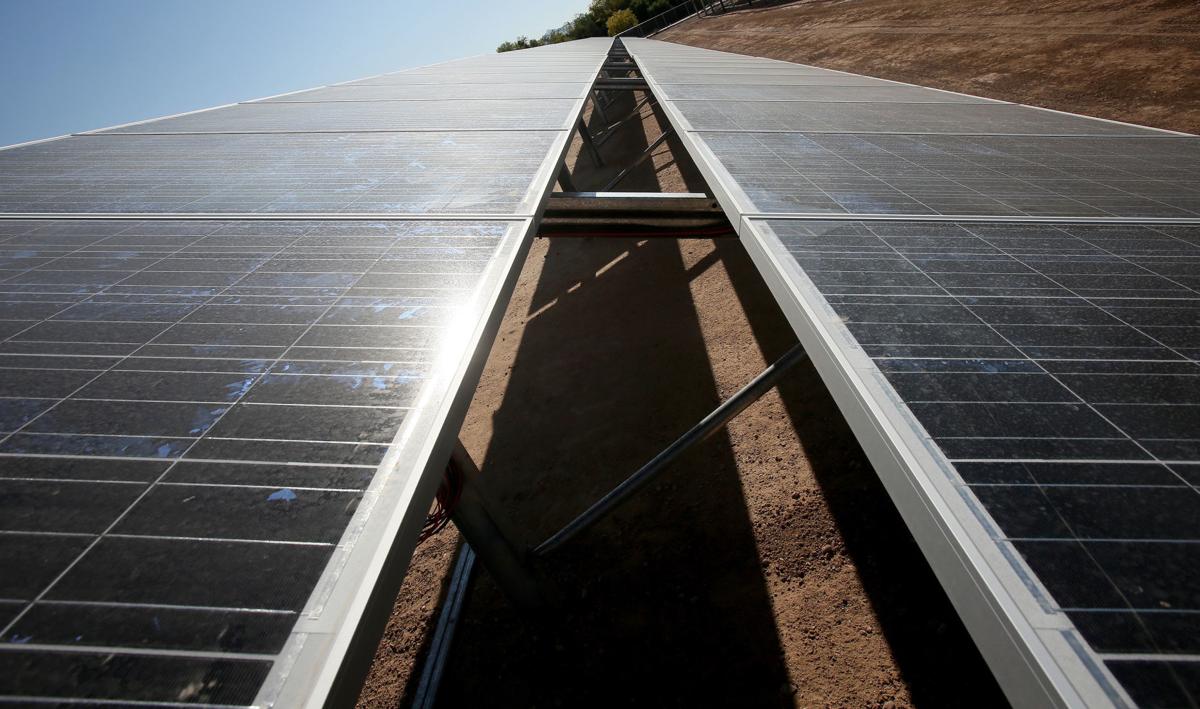
Such technologies are the focus of the second phase of the Solar Zone, a 225-acre research area at the UA Tech Park, created through a partnership of the UA and TEP in 2010. The Solar Zone hosts nine different solar technology projects that pump 25 megawatts of power onto TEP’s grid.
The solar symposium included a preproposal conference on requested bids for solar storage and grid-management technology projects for the second phase of the Solar Zone, a tour of the existing first-phase projects and a panel discussion.
Burhans said TEP already has partnered with the UA on grid-management technologies such as solar production data collection and real-time “solar-power forecasting” to warn operators ahead of time when clouds are expected to cause a sudden drop in production.
In the not-too-distant future, TEP may have to worry about another issue: solar power overproduction.
Burhans noted that California has added so much solar energy to its grid that it sometimes has had to unload solar power at a loss by selling it in places like Arizona, rather than overload the system or curtail operations of large fossil-fuel power plants.
TEP hasn’t reached that point but is studying the issue as it looks to add more large solar farms, Burhans said, noting that starting and stopping large coal plants is time-consuming and costly.
“Those plants don’t take long to turn off, but they can take two or three days to turn on again,” Burhans said.
A representative of First Solar, a Tempe-based manufacturer of thin-film photovoltaic panels and a major solar farm developer, said the company is increasingly designing solar arrays with storage systems to help shift power availability to when it is most needed.
For example, First Solar uses system controllers that can decide when to send power to the grid and when to charge a battery storage system, said Austin Quig-Hartman, First Solar senior technical manager for business development.
The battery system adds to the overall project cost, but it boosts grid reliability and allows users to use power in the evening when photovoltaic panel production drops, Quig-Hartman said.
Properly managed, solar farms can help system operators balance power supply with demand when the sun isn’t shining, he said.
“This is the perfect case where solar plus storage can help,” Quig-Hartman said.
The UA is increasingly studying storage and advanced grid-management technologies as part of its work in solar, said Kim Ogden, director of the UA’s Institute for Energy Solutions.
The institute, founded in 2016, is a cross-campus collaborative hub for research in areas including advanced photovoltaic materials, data collection and forecasting, energy-storage technologies and energy-efficient water and building systems.
Ogden noted that the UA is in the process of upgrading its full-scale “accelerated degradation chamber” which was designed to mimic the effects of long-term environmental exposure on solar panels, to test battery systems.
“Solar (generation) is ahead of storage — we really need integrated systems,” said Ogden, who also is a UA professor of engineering.
UA researchers also are working on an array of other energy technologies, including advanced battery formulas, energy-storage media such as heat-holding molten salts, and integrated energy and water-purification systems for remote areas.
TEP is keeping an eye on technology advancements as it works to add 800 megawatts of new renewable capacity by the end of 2030, boosting its total renewable energy portfolio to about 1,200MW.
The utility is planning 100 megawatts worth of new utility-scale solar and 150MW of wind power, and it is encouraging bids that include energy-storage components.
Meanwhile, First Solar’s Quig-Hartman said the industry expects to take a hit as the Trump administration’s new 30 percent tariff on solar panels made in China takes effect.
“Across the industry, it’s expected that we’ll see about a 10 percent contraction in the market,” he said.
TEP’s Burhans said he expects the tariff, which steps down to 15 percent by 2022, will depress demand for rooftop solar installations though the exact impact is hard to predict.
“There will be a reduction, because the margins are thin especially for the local installers, so there probably will be a dropoff,” he said.

