


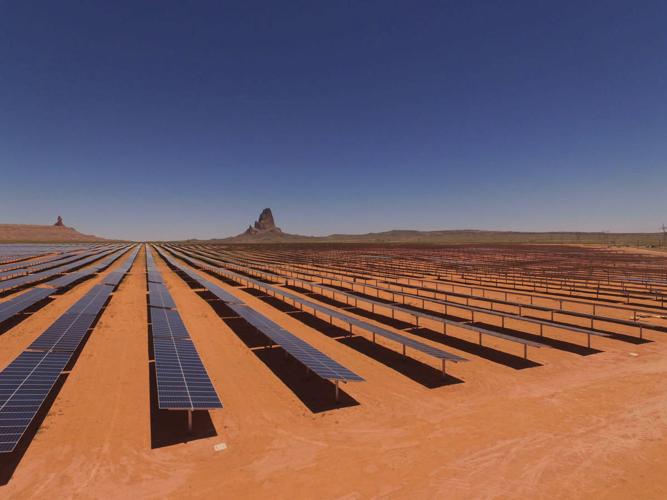
In May of this year, in the shadows of sandstone towers near Monument Valley, an array of 120,000 photovoltaic solar panels fired up for the first time.
In doing so, the Kayenta Solar Facility became the first utility-scale solar project to go operational on the Navajo Nation, producing enough electricity to power about 13,000 Navajo homes.
The Navajo Tribal Utility Authority, which owns the solar plant, touted the project as a major clean energy advancement on a reservation long known for fossil fuel development.
Before the solar plant, “the green economy didn’t exist” on the Navajo Nation, said Walter Haase, general manager of NTUA, which is a tribal enterprise. After years of empty promises on renewable energy projects, Haase said the array that spans 200 acres shows that such projects can, in fact, be completed on Navajo land.
“This is a game changer,” he said.
It’s the type of glowing assessment one would expect from a person in Haase’s position. But analysis from energy experts familiar with the solar plant, as well as the examples provided by Haase himself, suggests the array is in fact a significant advancement for renewable energy development on the Navajo Nation and, more broadly, tribal land.
“It is a big deal because you always have to make that first step. If they had not been able to do anything like this, then I would say all bets are off. But this takes them to the next level of conversation,” said David Hurlbut, senior analyst with the National Renewable Energy Laboratory.
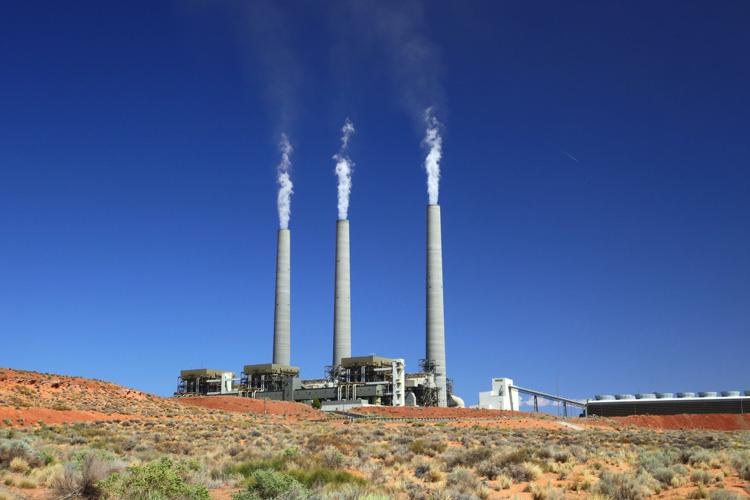
Hurlbut and others also noted that the solar plant’s completion comes at a time when the area’s energy landscape is shifting. The countdown has begun for the December 2019 closure of the coal-fired Navajo Generating Station, which will leave a site that both tribal and private entities say is rife with potential for renewable energy development.
CHANGING A REPUTATION
Perhaps most important about the solar plant’s completion is it proves to investors, developers and other tribal communities that a renewable project is possible despite hurdles like complicated land ownership structures and sometimes confusing government processes that come with working on the Navajo reservation, Haase said.
Before the solar facility, “we had a reputation in the industry of not being able to get something built or brought online,” Haase said.
Now that has changed.
Another advantage is the plant’s 27.3-megawatt size, which is big enough that the utility was forced to learn a lot of lessons should it choose to pursue an even bigger project, said Karin Wadsack, a project director with Northern Arizona University who works with northern Arizona tribes on clean energy projects. That learning curve includes figuring out how to increase efficiency and bring the cost down for future developments, she said.
The Kayenta community benefited as well, as the project contractor hired and trained about 200 Navajo workers to construct the solar plant, said Deenise Becenti, a spokeswoman with NTUA. And in the event of future projects in the region, there is already a nearby workforce ready for the job.
NTUA also worked out a financing model that avoided putting the $60 million cost of the solar project onto its ratepayers, said Glenn Steiger, project manager for the solar farm. That included creating a for-profit taxable entity to take advantage of federal solar investor tax credits and working out a two-year power purchase and renewable energy credit agreement with Salt River Project that covers the loan repayments for the plant’s construction, Steiger said. NTUA is now working on potentially extending the agreement beyond two years.
He said there are a number of parties interested in similar power purchase agreements if the Kayenta Solar Facility were to expand.
SCALING UP
Scaling up is indeed the plan for the solar plant, Haase said.
There is space on the Kayenta site to double the array’s capacity and, in the longer term, NTUA is looking at developing another 500 megawatts of renewable power on the reservation, Steiger said.
The closure of the Navajo Generating Station could help advance those plans. As part of the power plant shutdown agreement, the Navajo Nation was granted transmission capacity on power lines that snake out from the facility. That access to transmission is a major advantage, and one of the only ways to make renewable projects economically feasible, Haase and others said.
That being the case, the utility is already looking at a 4,000-acre site near the power plant for wind, solar and battery storage, Haase and Steiger said.
In terms of the timing for pursuing such a project, “it’s not too early at all,” Haase said.
STILL CHALLENGES
While the Kayenta plant marks a significant accomplishment for clean energy on the Navajo Nation, major challenges remain for future projects on tribal lands, Wadsack said.
“It’s a great step in some kind of right direction, but it’s also a very small step,” she said, pointing out that the solar plant represents 1 percent of the generating capacity of the Navajo Generating Station.
Price is one place where NTUA may have a long way to go. Though Steiger said he could not confirm contract details, Wadsack said she heard from numerous sources that the price for power from the solar plant comes out to $53 per megawatt hour. That’s well above the going rate for utility-scale solar, which has dropped to as low as $30 per megawatt hour.
Both Wadsack and Hurlbut emphasized that for future renewable energy projects to succeed on tribal land, they need to be competitive with the rest of the market.
In general, Wadsack didn’t think NTUA’s goal of developing and finding demand for 500 megawatts of renewables was overshooting.
“I think it can be done and I think a lot of people are chipping away at it,” she said. “There is still appetite for huge amounts of renewables. At this point it’s almost a question of areas where it could get built making themselves open for business.”
For his part, Hurlbut also made sure to temper any lofty expectations.
“I think everybody on the Navajo Nation realizes that they may have this success under their belt but there is still whole lot of work left to do,” he said.

