

and Alia Beard Rau
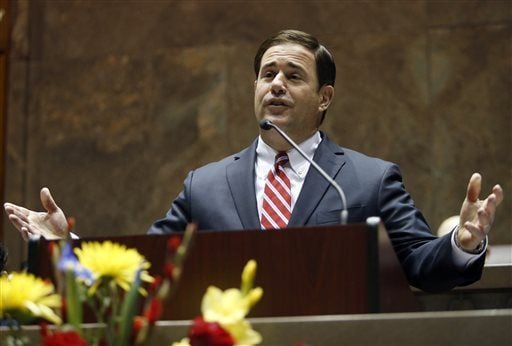
PHOENIX — Gov. Doug Ducey’s threat to withhold revenue from cities and towns that enact their own wage and employment laws got big applause during his State of the State address, but some local officials suggested it was an overly aggressive attempt to exert control over them while others said the threat was unnecessary.
Ducey called on cities “to put the brakes on ill-advised plans to create a patchwork of different wage and employment laws,” saying doing so would harm the Arizona economy.
The governor then vowed to “use every constitutional power of the executive branch and leverage every legislative relationship to protect small businesses and the working men and women they employ — up to and including changing the distribution of state–shared revenue.”
Arizona shares 15 percent of collected taxes on income, sales and transportation with cities, towns and counties. That money is critical to local governments and funds significant portions of their budgets.
The move opens the governor to criticism about his commitment to local control, a theme he frequently preaches when it comes to perceived federal overreach on state issues.
“You so frequently have the Republican Party complaining about the federal government, but they want to stamp out any kind of local control by municipalities,” said Flagstaff attorney Mik Jordahl, who represented a group pushing to raise that city’s minimum wage in a lawsuit against the state.
But Senate President Andy Biggs, R-Gilbert, argued the comparison between federal and state control is faulty. While states give the federal government its authority, Biggs said, “local jurisdictions are subdivisions of the state.”
Ducey doesn’t yet have the power to make good on his threat. The Legislature would have to approve a bill changing state statute to grant state leaders the authority to adjust a complicated funding formula to deny disobedient cities and towns state revenue. Biggs said he might file such a bill.
Ducey staffers have said the governor’s concern is focused on efforts to increase the state’s $8.05-an-hour minimum wage, or expand paid time off. No Arizona city or town has passed such an ordinance. And some called Ducey’s statement a solution in search of a problem.
A Tempe City Council subcommittee is looking at requiring earned sick leave. The subcommittee has held public and stakeholder meetings, but has not yet determined if or when it will ask the City Council to vote on an ordinance.
The Tucson City Council is also looking at mandatory paid time off for illnesses.
While Ducey’s staffers said the governor was taking aim at wage and employment benefits, Phoenix officials viewed Ducey’s speech as an attack on cities’ attempts to protect LGBT workers and people with disabilities from discrimination. In 2013, Phoenix adopted a broad non-discrimination ordinance that expanded protections for gay and transgender residents.
“Far from being a job killer, this has been tremendously positive for our economy and for other leading cities that have adopted similar ordinances,” said Robbie Sherwood, a spokesman for Mayor Greg Stanton.
Flagstaff, Tucson and Tempe have similar anti-discrimination ordinances. Other cities, including Mesa and Scottsdale, are considering similar measures.
In Flagstaff, residents last year began pushing to raise the minimum wage. The group filed a lawsuit against the state asserting cities’ rights to set their own minimum wage. The Flagstaff City Council voted 4-3 not to get involved. The group is working to take the issue directly to Flagstaff voters in November.
Flagstaff Mayor Jerry Nabours, who said his city received $8 million in state-shared revenue last year, said he sympathizes with the governor but disagrees with him.
The Flagstaff City Council is not talking about raising the minimum wage, “and I don’t see the voters doing that either,” Nabours said. But, he added, “if the voters did ... the courts have said that’s up to the cities to decide and so I don’t think it’s actually fair to use the state-shared revenue as some kind of leverage on that.”
Last year, Attorney General Mark Brnovich agreed to a Maricopa County Superior Court judgment tied to the Flagstaff dispute. It confirmed cities and towns have the right to raise their minimum wage.
According to the judgment, a 2013 law limiting minimum-wage increases conflicts with Proposition 202, a measure Arizona voters approved in 2006 allowing cities to regulate wages and benefits via ordinance.
Chandler Mayor Jay Tibshraeny, a former Republican state lawmaker and current vice president of the Arizona League of Cities and Towns, said he believes the minimum wage should be set at the state level.
He said he was concerned Ducey’s statement gave the public the impression cities across the state are moving ahead with changes to employment laws. He said no city has voted to change wage regulations.
Tom Rex, associate director of the Center for Competitiveness and Prosperity Research at the W.P. Carey School of Business at Arizona State University, said if Ducey follows through with his threat, it would be “just one more action on top of others” that state leaders have taken against municipalities since the recession.
Cuts to state-shared revenues “just put the burden on, instead of one government body — the Legislature — you’re putting it on the counties and incorporated areas in the state,” Rex said.
The Arizona Restaurant Association applauded Ducey. “It is crucial for the restaurant and hospitality industry to have consistency across the state on matters of employment and wage laws, and we are proud and energized to have a governor willing to stand up for the best interest of our industry,” association President and CEO Steve Chucri said.

