


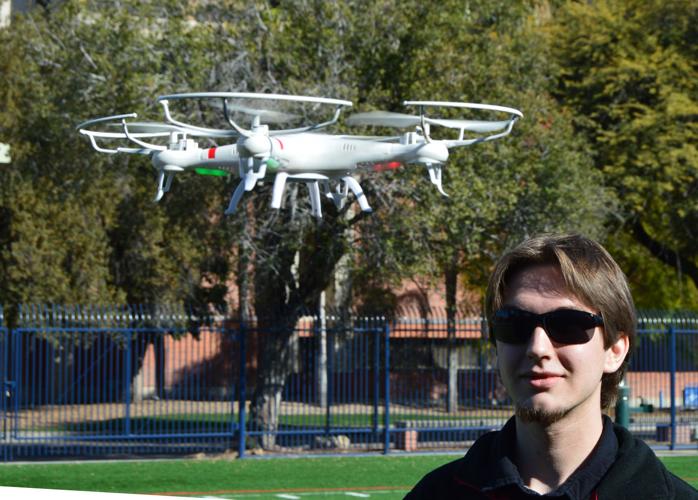
Our rogue drone wouldn’t stop flying toward a UA student running with her dog.
We ran after it, but we had just spent 26 hours programming a drone that couldn’t even hover correctly. We were over-caffeinated, demoralized, and not too confident we could catch it.
Our team had come to Hack Arizona with a plan to build a website or an app. A drone wasn’t in the plans, but it looked so cool.
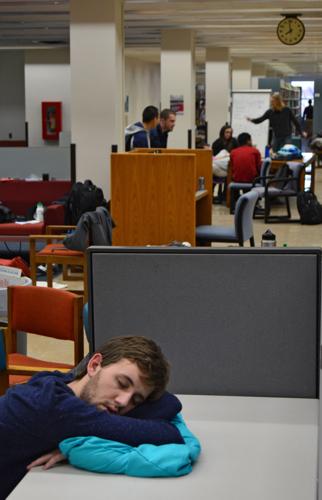
We were among more than 500 hackers from across the globe who descended upon the University of Arizona Science and Engineering Library for Hack Arizona last month. We were given 36 hours to make something elegant from scraps of technology.
When you think hack, don’t think scary computer criminals trying to get your credit-card information. Think about your friend’s car from high school that was “hacked” together from spare parts and required a prayer to start.
Hacking is about coming together with friends or total strangers and making something with your hands. Hack Arizona provided lots of tools.
Thanks to partnerships with sponsors like Raytheon and Major League Hacking, a league sponsored by Dell and Intel that gives support to hackathons across the world, Hack Arizona had drones, smart watches, virtual-reality headsets, cameras, sensors and computers available for anyone to check out.
Our team grabbed a random assortment of hardware and then started brainstorming what to do for the remaining 35.5 hours.
We were immediately drawn to an armband called a Myo, which is able to control a computer with arm movements and hand gestures.
Our ideas for it ranged from a silent communication device using Morse code to a robotic living room.
We wanted to work with a drone, though, and use the Myo to control it like a Jedi knight using the force. How often do you get to play with something as expensive and fun as a drone?
Most of the hackers were in teams of four that formed within the first few hours. Hackers ranged from graduate computer science students to beginners like me with no formal programming experience.
Some people came to Hack Arizona with teams in mind while others flew across the country to meet some random people and start hacking.
“It doesn’t matter if you are a Sun Devil or a Wildcat, or a Lumberjack; everyone is helping each other and joining teams with each other,” said Nick Morin, marketing director of Hack Arizona and one of a group of UA students who organized the event.
Luckily, after we had worked with the Myo for about two hours, a drone opened up for us to check out. We quickly tried to hack together a rudimentary control scheme for the drone and headed to the football practice field to have our first test flight at 3 a.m.
Surprisingly, we were not alone. Mikhail Rudinskiy, a software engineer at Raytheon, was out there debugging our code with us as the temperature dipped to 40 degrees. Rudinskiy was one of the many representatives from companies ranging from the local Tucson startup and UA spinoff Metropia to large multinational tech companies like Amazon.
“One of the benefits of recruiting at the Hackathon is that all of the students are doing something applied,” said Brian Biswell, senior department manager at Raytheon, “Really that’s what our work is about, using what you learned in college and applying it to our products and services.”
UA student Ian Tracey, founder and chief organizer of Hack Arizona, said sponsors donated more than $100,000 in funding and prizes to the event. Many of these companies are scouting the event for their next intern or employee or to have people build products and tools using their company’s technology. Some have fond memories about participating in hackathons themselves.
“My first hackathon was the most positive experience I ever had,” said Shy Ruparal, deputy commissioner of Major League Hacking, “I got to hang out with amazing engineers from all the best startups. ... I went to a hackathon every weekend of my senior year.”
Our team was riding the infectious enthusiasm of Ruparal and the other hackers until we had to crash for the night at 3:45 a.m. Later that morning, we returned to the library to encounter another bunch of problems.
We got the drone flying, accidentally, while still in the library. It blew everything else off our work table. That was a minor setback.
We were quickly able to create a program to use the Myo armband to control the drone. Nothing makes you feel more like an all-powerful computer wizard than tapping your fingers together and watching a stationary drone turn on and start hovering at your eye level.
All the problems started after that.
We originally wrote the program so that when you made small hand gestures, the drone would fly in different ways. A wave of the hand to the right made it go forward and a wave to the left would make it come back.
We soon realized that the hand gestures had a high failure rate, so we changed the control scheme so the drone moved with the position of your hand. Roll your hand to the left and the drone would move left. Tilt your hand down and the drone would fly forward. The problem was that the drone wouldn’t listen after takeoff and would usually crash spectacularly into the ground.
We spent the next 10-14 hours trying to debug our code to stop it from crashing. We would go outside and flail our arms around for about 20 minutes trying to control the drone while recording information about what is happening with our code and what the hardware is telling us. We would then go back inside to warm up and recharge everything and make changes. We repeated that until we ran out of hope.
“I think our biggest problem right now is that we don’t know what our biggest problem is,” said Nate Hattersley, one of my teammates, “We can’t really figure out what’s wrong in our project and we don’t have the impetus to scrap it.”
“I feel hopeless,” said Ruby Abrams. “Abstract mathematical models are letting me down.”
Eventually we discovered the problem was in hardware, not software. The drone had a mechanical problem that caused it to repeatedly crash.
Around 1 a.m. on that Sunday, we were able to get our hands on a new drone but for some reason, still unknown to us today, none of our software was compatible with it.
That was the last straw for our team. With seven hours until deadline we decided to scrap the entire project. In the crushing sadness, some of us went home and some of us started to pivot to another project. We started to make an educational game with the Myo armband and we almost finished it by deadline, but one small technical problem held us up.
Although we didn’t present our project at the closing ceremony, we still had a blast. We didn’t take out any campus joggers with our drone.
Judges at the closing ceremony handed out thousands of dollars in prizes but every hacker at the event took even more valuable experience away:
“Coding is fun and any time you do it, you get better at it,” said Jose Celaya, my other teammate. “Even though we didn’t get it to work, it was awesome that we did it, and it was fun.”

