


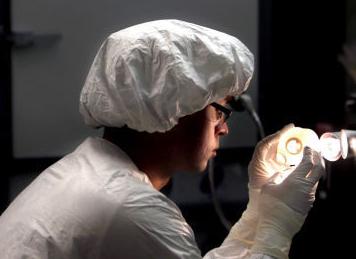

Tucson-based artificial heart maker SynCardia Systems Inc. could go public as soon as next week with an initial stock offering it expects will raise up to $34.5 million.
No date has been set for SynCardia’s planned initial public offering on the mid-cap Nasdaq Global Market, where it has applied to be traded under the ticker symbol “TAHT” after the acronym for its main product, the Total Artificial Heart-Temporary.
In a registration filing with the U.S. Securities and Exchange Commission in September, SynCardia said it plans to issue 2.5 million shares of common stock at an initial offering price of $10 to $12 per share, for total proceeds of up to $30 million, minus an expected $2.1 million in expenses.
The offering’s underwriting investment banks, led by Roth Capital, will have the option to buy 375,000 additional shares for proceeds of $4.5 million.
SynCardia’s Total Artificial Heart is the only artificial heart approved by the U.S. Food and Drug Administration as a temporary bridge to transplant.
The FDA approved SynCardia’s artificial heart as a bridge to transplant in 2004, and more than 1,475 of the devices have been implanted worldwide. Last year, the FDA approved a small pneumatic driver for the heart that greatly increases patient mobility.
The company has attracted millions of dollars in private-equity investments but notes in its IPO filing that it has posted continual losses.
SynCardia reported a net loss of $19.6 million on $8.7 million in revenues in the first six months of this year, after losing $23 million on revenues of $15.4 million in all of 2014.
While no date for SynCardia’s IPO has been announced, it could happen as soon as next week, according to Greenwich, Connecticut-based Renaissance Capital, which closely tracks IPOs.
Company officials declined to comment on the IPO filing, citing the mandated “quiet period” that lasts until the offering becomes effective.
SynCardia would be the second Tucson-based company to go public on a major exchange this year, after HTG Molecular Diagnostics Inc. joined the Nasdaq in May.
Both companies won early private-equity investments from members of the Desert Angels, a group of individual “angel” investors who provide startup funds to early-stage companies, often attracting larger investments from private-equity firms.
Larry Hecker, a longtime local corporate attorney and Desert Angels member, says it’s a good sign for Tucson whenever a homegrown company goes public.
Hecker, who has been deeply involved in local economic development, cited past examples such as Burr-Brown Corp., a pioneering electronics company that went public in 1983 and was acquired by Texas Instruments for $7.6 billion in 2000. Though Texas Instruments has cut back operations here over the years, former Burr-Brown employees went on to found new companies, he noted.
Other examples include Ventana Medical Systems, a University of Arizona technology spinoff that went public in 1996 and has steadily expanded in Oro Valley since it was bought by Swiss drug giant Roche in 2008 for $3.4 billion.
A public stock issue means entrepeneurs and private investors can get a return on their money that they can then reinvest in new ventures, said Hecker, who doesn’t individually own stock in SynCardia.
And that helps entrepreneurs raise money and attract the best talent, “which feeds on itself,” he said.
“In many ways it shows that the strategy of building a knowledge-based, high-wage economy is working,” said Hecker.
The leader of a statewide biosciences industry group said SynCardia’s move to the public stock exchanges is good news for the state as a whole.
“When a company gets to the stage where it can go public, it’s validation that it’s reached a certain maturity, which is good for our reputation as a state,” said Joan Koerber-Walker, president and CEO of the Arizona BioIndustry Association.
“Where local people have invested in those companies, it starts to create momentum where hopefully some of that money will get reinvested in other biotech companies,” she added.
Going public is no sure sign of future success, however. Another UA technology spinoff, ImaRx Therapeutics, raised about $15 million in an initial public stock offering in 2007 but folded after some patients suffered negative results in a clinical trial of a technology to treat stroke-related blood clots.
SynCardia is looking to widen its markets, seeking regulatory approval for use of its heart as a “destination therapy” to extend the lives of heart patients who aren’t transplant candidates. It’s also developing a smaller version of its Total Artificial Heart for smaller patients, including women and adolescents.
In January, SynCardia won FDA approval to conduct clinical studies of its artificial heart as a destination therapy in 19 patients.
SynCardia employs 113 people at its offices and manufacturing facility at 1992 E. Silverlake Road.

