

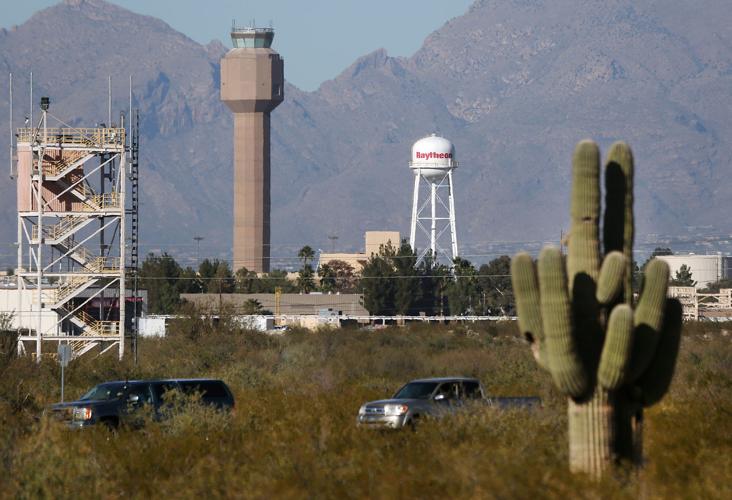
The Tucson Airport Authority board has tentatively approved the sale of a key tract of airport-owned land to create a wider buffer zone for Raytheon Missile Systems.
The proposed sale of more than 300 acres south of Raytheon’s operations at Tucson International Airport would add new buffer space the company says it needs to operate and potentially expand.
The Airport Authority formalized the land sale Wednesday by unanimously approving a memorandum of understanding with the city, Pima County and Raytheon. The City Council and county Board of Supervisors are each expected to consider the agreement at meetings on Dec. 15.
Under the pact, the city or county would buy the land, keep it undeveloped and possibly lease or sell it to Raytheon in the future, said David Goldstein, president of Diamond Ventures and an Airport Authority board member who helped negotiate the deal.
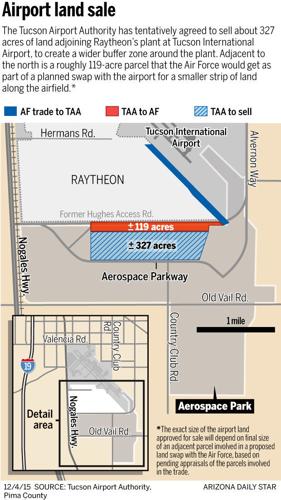
Abutting the land to be sold, to the north, is a parcel of about 119 acres that the airport would get as part of a planned swap with the Air Force for a strip of land along the southwest side of TIA’s airfield.
The size of the sale parcel is estimated at 327 acres for planning purposes, but its final size will depend on the area of the adjacent land that will be traded to the Air Force, which in turn depends on pending appraisals of the land-swap parcels. The land sale also is subject to approval by the Federal Aviation Administration.
Raytheon has requested that the parcel be left undeveloped as buffer space or for future company expansion, according to the agreement and airport officials. A Raytheon spokesman would not comment.
The land sale is a key part of a years-long effort to give a wider berth to Raytheon to support existing operations and future expansion. In 2010, the company passed over Tucson as the site for a new missile plant in favor of Huntsville, Alabama, largely because of a lack of adequate space here. Raytheon needs a generous buffer zone for security and safe handling of explosives.
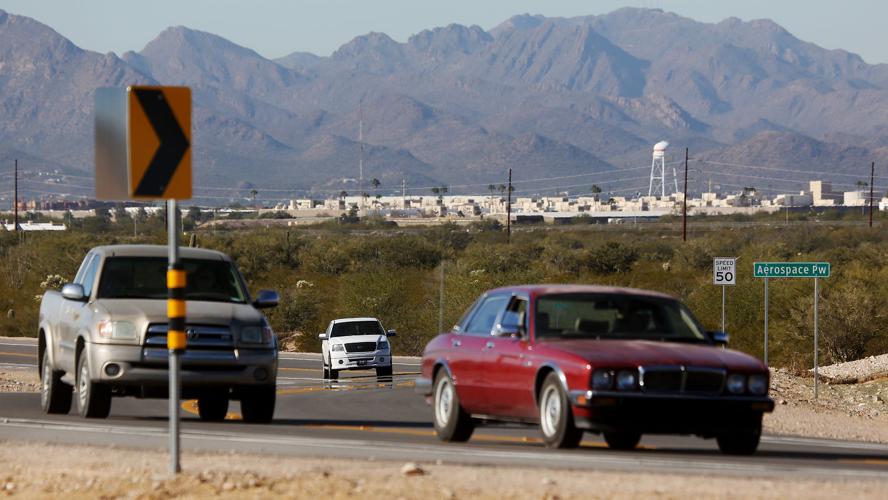
The sale parcel is bounded on the south by the new Aerospace Parkway, a southern realignment of the former Hughes Access Road created to free up buffer space and foster development of a future aerospace business park. Several other small land acquisitions and swaps are in process or planned to create new buffer space and the aerospace park.
Airport Authority Chairman Steve Cole said the deal is an important step in supporting Raytheon and its possible future expansion.
“With Raytheon as our largest employer, this is a true public-private partnership to make sure they stay here and also have room to expand,” said Cole, who is president of Southwest Appraisal Associates.
Who buys the land the airport has agreed to sell, exactly how much it will cost and the funding source have yet to be determined.
Assistant City Manager Albert Elias said whether the city or the county buys the property has not been finalized.
But Elias acknowledged that among the options, the city could buy the land with money set aside through a 2009 annexation agreement with Raytheon.
When the city annexed the Raytheon plant site, it agreed to put half of the use taxes the company pays into a fund to pay for buffer land and other improvements. That fund was initially expected to grow by about $500,000 each year.
Pima County Administrator Chuck Huckelberry said it’s likely the city will buy the airport property through the annexation fund, calling the sale a keystone to the plan to protect Raytheon.
“The key element here is that Raytheon has an absolute assurance that they will have a buffer for their existing property as well as a buffer for expansion,” he said.
Though the parcel to be sold must still be appraised, Huckelberry said the expected selling price is in the range of $16,000 to $17,000 per acre. At the midpoint of that range, purchasing 327 acres would cost about $5.4 million.
In 2012, Pima County purchased 382 acres straddling Old Nogales Highway south of Raytheon from Diamond Ventures and an investment group for about $6 million.
Pima County Supervisor Sharon Bronson said whether the city or the county buys the airport property, it’s vital to protect Raytheon from urban encroachment.
“Bottom line, somebody’s got to do it, or we’re not going to have Raytheon here and expanding.”

