

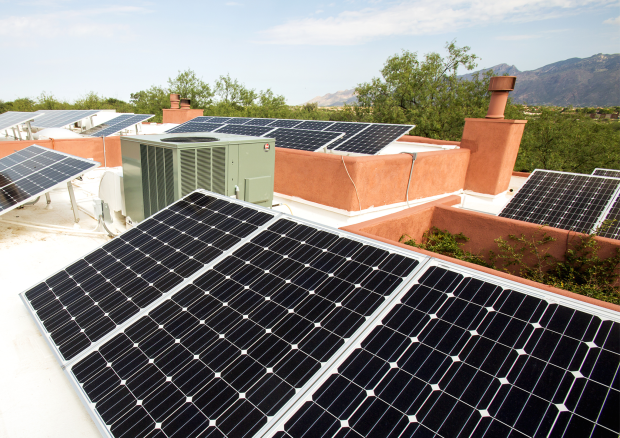

State regulators want to move ahead with Tucson Electric Power Co.’s renewable-energy plan for 2016 — after separating out two controversial proposals to expand TEP-owned solar installations.
The Arizona Corporation Commission is scheduled to consider the plan Tuesday at its regular open meeting in Phoenix.
TEP filed its required annual renewables plan last July, seeking a program budget of $56.6 million, including $9.4 million for company-owned renewable-energy projects and expansion of an energy-storage pilot project.
Under TEP’s request, a monthly surcharge that pays for renewable-energy programs would increase to an average of $4.02 per month for the typical TEP residential customer, up from $3.22 per month.
But controversy soon arose over two provisions of TEP’s renewables plan.
One would expand a program launched last year in which TEP installs utility-owned solar photovoltaic systems on customers’ rooftops in exchange for fixed energy charges for 25 years — something many solar companies vehemently oppose.
The other proposal would allow TEP to launch a new community-based solar program, by which customers would essentially buy energy from an offsite, TEP-owned solar installation with an energy charge fixed for 10 years.
The commission’s staff recommended against expansion of the TEP-owned rooftop solar program on the grounds it may not be cost-effective. The staff recommended that the community solar program be considered as part of TEP’s pending rate case.
In April, a commission hearing judge ordered the Corporation Commission’s utilities staff to file a plan to separate the two TEP-owned solar proposals from the annual renewables plan and present the remaining budget and plan for consideration by the full commission.
TEP spokesman Joe Barrios said the company plans to push ahead with the new rooftop and community-solar programs in its larger rate case, which is schedule for initial hearings in Tucson in late August.
“We’re still supportive of these programs and are very excited about offering them to our customers,” Barrios said.
TEP’s pilot rooftop-solar program, approved as part of its 2015 renewables plan, cost $10 million and filled quickly, with 600 customers signed up and thousands on a waiting list, according to TEP.
The solar industry and some of its supporters object to TEP providing rooftop systems to customers, arguing that it allows a state-regulated monopoly to compete unfairly with private-sector providers.
TEP wants to count company-owned installations under a new community-based solar program toward its mandatory goals for distributed generation — systems sited at a customer’s premises like rooftop photovoltaics.
As part of the larger renewables plan, the utility is seeking to double the size of a proposed energy-storage demonstration project at no additional cost. After receiving bids for a 10-megawatt storage project, TEP found it could do two projects that size for less than the initial budget of about $15 million over 10 years.
TEP also has applied for a waiver to the state requirement that distributed generation must make up at least 30 percent of the renewable energy the utility counts toward its state-mandated renewable-energy goals.
TEP says it can no longer obtain enough renewable-energy credits for rooftop solar installations to reach its goals, since the up-front customer incentives it had traded for such credits were phased out several years ago.
In its pending rate case, TEP is asking for a 7 percent increase in revenues in a rate case that would boost the average home customer’s bill by $12 a month by 2017.
The utility also is seeking a change in its so-called net metering policy that will significantly reduce credits to solar customers for excess energy they generate and add charges for customers with new rooftop solar arrays.

