

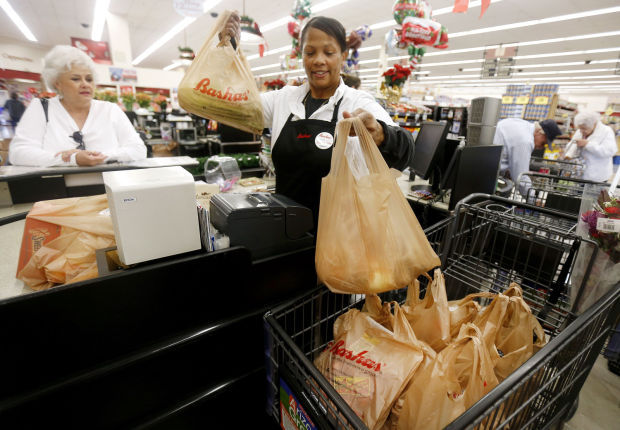
PHOENIX — Arizona grocers, retailers and restaurants are moving to help preserve their right to send customers home with plastic bags, no matter what local governments want.
The groups have hired attorney Kory Langhofer to make their case to a Maricopa County Superior Court judge that there’s nothing legally wrong with a law the Legislature adopted earlier this year that blocks cities from regulating plastic bags.
Attorney General Mark Brnovich is already defending the law against a challenge filed last month by a Tempe City Council member. His office has asked that the case be dismissed.
But the groups that would be most affected have decided to mount their own defense of the law.
Michelle Ahlmer, executive director of the Arizona Retailers Association, said intervening in the case gives the group’s attorney a chance to make legal arguments.
At issue is a measure making it illegal for any community to impose fees or deposits on the use of “auxiliary containers,” which include everything from soda bottles and cups to disposable bags “used for transporting merchandise or food.”
Rep. Warren Petersen, R-Gilbert, who sponsored the provision, said he was acting in the name of individual freedom.
“I understand that some people want to make the decision of ‘paper or plastic’ for other people,” he said. “And I understand some people have an ideology of collectivism. For me, I support individual rights and people making their own decisions.”
Ahlmer, whose organization was one of the groups that asked Petersen for the law, sees the issue in more basic terms.
She said it’s a matter of consistency for chains that operate statewide. Differing rules in various cities are “really had to administer from a corporate level,” she said.
Ahlmer said the same is true from a consumer perspective, with shoppers facing different requirements depending on where they make their purchases.
Petersen’s legislation came in the wake of Bisbee imposing a nickel-a-bag tax on disposable bags. The retailers get to keep 2 cents for the cost of bags and administering the fee, with the balance going to a fund that can be used to provide reusable carryout bags and to promote conservation and recycling programs.
Flagstaff, Tucson and Tempe have been looking at their own ordinances as well.
But Ahlmer called the state law unnecessary because, she said, plastic bags amount to less than 1 percent of what goes into landfills.
Lauren Kuby, a member of the Tempe City Council, disagreed.
Before the ban, she was crafting an ordinance that would have banned single-use plastic bags at groceries and retail outlets. It also would have allowed merchants to charge at least a dime for a paper bag for their customers who did not bring a reusable sack.
Kuby got the Arizona Center for Law in the Public Interest to file suit to have the state law declared unconstitutional.
At least part of the legal question surrounds what the Legislature can tell certain cities to do.
The Arizona Constitution permits cities to establish themselves as “charter cities.” A total of 18, including Tucson, Bisbee, Tempe and Flagstaff, have chosen that status.
Attorney Tim Hogan said that gives them “certain rights and privileges in local matters to legislate freely from interference by the Legislature.” Issues of recycling fall into that category, he said, because cities operate their own trash pickup and landfills.
But Hogan also is arguing to Judge Douglas Gerlach that the state can’t ban recycling laws enacted by non-charter cities or counties, either. That’s because the ban was tacked on to an unrelated legislative measure, he said, violating constitutional provisions that require legislation to deal with only one subject.
Ahlmer, however, contends that having a single statewide rule makes the most sense. She sidestepped questions of whether her organization would be willing to support having a Bisbee- or Tempe-style ordinance made mandatory for all merchants throughout the state.
“So far, there hasn’t been enough support from the full Legislature to do that,” Ahlmer said. Her group, along with the Arizona Restaurant Association and the Arizona Food Marketing Alliance representing grocers, has not asked for such a statewide law, either.
For some cities, the issue goes beyond plastic bags winding up in landfills.
In a letter earlier this year to Brnovich, Bisbee City Attorney Britt Hanson said one reason his council adopted its ordinance was that the bags don’t always make it to the landfill. The result is “unsightly litter ... that resulted from plastic bags blown and caught on trees.”
Ahlmer acknowledged the problem. But she said there’s a better solution: public education.
First, she said, encourage people to reuse the bags, whether it’s to pack a sack lunch or pick up after dogs. Or, “If you take them back to a grocery store, they get put into a recycling bin ... and they’re made into playground equipment, they’re made into decking material, there is a use for them,” Ahlmer said. “So a lot of it is education, just making sure that the consumer understands that there’s really good uses for these and they should take advantage of that.”
No date for a court hearing has been set.

