

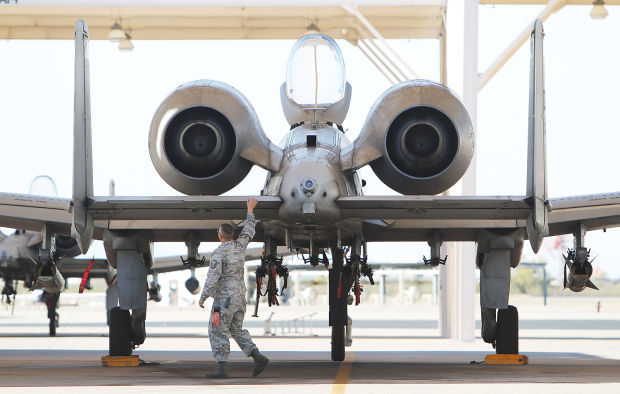

As Congress takes up the fiscal year 2016 defense budget, supporters of the A-10 Thunderbolt II jet say world events show the combat-proven “Warthog” is needed now more than ever.
There’s no telling whether that argument helps save the A-10 — a mainstay mission of Tucson’s Davis-Monthan Air Force Base — from its proposed retirement amid an expected pitched battle over the Pentagon budget.
A dozen Warthogs from D-M’s 354th Fighter Squadron, a veteran of numerous deployments to Iraq and Afghanistan, were sent last week to Germany as part of a NATO show of force amid the conflict in Ukraine. An A-10 unit from the Indiana National Guard deployed to the Middle East in November to help battle Islamic State militants.
Even so, the Air Force’s fiscal 2016 budget request again proposes retiring the A-10 fleet — including mothballing 55 Warthogs based at D-M during the next fiscal year. The Air Force says other aircraft can perform the same close-air-support role as the A-10, and cutting the A-10s can save some $4 billion.
Backers including freshman Rep. Martha McSally — a Tucson Republican and former A-10 combat pilot — say the A-10 deployments show that the plane is still much needed for close air support and its related missions of airborne forward air control and search-and-rescue support.
This year, A-10 supporters are counting on the backing of a more powerful ally with the ascension of Arizona Sen. John McCain, a Republican, to the chairmanship of the Senate Armed Services Committee.
The venerable A-10 also will have the passionate and expert support of McSally, who as a freshman has been assigned seats on the Tactical Air and Land Forces and Oversight and Investigations subcommittees of the House Armed Services Committee. Her predecessor, Tucson Democrat Ron Barber, also served on the tactical-forces panel and led efforts in the House to save the A-10.
“I see a similar fight to last year, and I intend to lead that fight,” McSally said in an interview.
McSally, the first American woman to fly in combat and the first to command an Air Force combat squadron, said she brings a unique degree of expertise and credibility to the debate.
“It’s going to be a fight because of the fiscal realities,” she said. “Right now, we have a budget-based strategy instead of a strategy-based budget, essentially as the threats are growing and the world is becoming much more dangerous.”
MAKING THE CASE
New House Armed Services Committee Chairman Mac Thornberry, R-Texas, indicated in a speech in late January that his panel won’t be a rubber stamp for the Pentagon on issues including the A-10. But McSally said much work remains to be done.
“We need a solution and the case needs to be made, so it’s my responsibility to make the case to Thornberry,” she said.
McSally said she’s already been strategizing with McCain and other A-10 supporters, including Sen. Kelly Ayotte, R-N.H.; Rep. Buddy Carter, R-Georgia; and Rep. Candice Miller, R-Mich.
As a nonleadership member of the Senate Armed Services Committee last year, McCain didn’t have a seat at the table when the “big four” — the Armed Services chairs and ranking members — reached a defense budget agreement that allowed sidelining part of the A-10 fleet. (McCain gave up his seat as ranking Armed Services member last year due to term limits.)
This time around, McCain wields much greater influence.
“I don’t believe he will allow the Air Force to give up the capability the A-10 offers, if it’s at all within his power, until other actions are taken to replace that capability,” said Ron Shoopman, president of the Southern Arizona Leadership Council and a retired Air Force brigadier general.
McCain could not be reached for comment, but last week he and McSally issued a joint statement saying they’re proud of the D-M contingent of A-10s that recently deployed to Germany in support of NATO. They vow to keep fighting to save the Warthog.
“In a time of great tension in Europe, the fact that the Air Force is deploying this contingent of A-10 Thunderbolts and the airmen who support them reflects once again the A-10’s continued role as the finest close-air-support platform in the U.S. inventory,” the lawmakers said. “It is also a vivid reminder of the great folly of this Administration’s attempts to retire the A-10 fleet without fielding a suitable replacement — efforts we will do everything in our power to oppose.”
While the A-10 and its accurate and lethal cannon are usually lauded for their critical role in close air support of ground troops, McSally said it also is effective in airborne forward air control and combat search and rescue support — capabilities she said are badly needed in the fight against Islamic State militants.
CRUCIAL CAPABILITY
The A-10 was thrown into the fray months after U.S. and coalition aircraft began pounding Islamic State targets last August. It had flown about 11 percent of sorties in the operation as of mid-January, the Air Force said.
The A-10s ability to fly low and slow and loiter overhead makes it an invaluable tool to locate and protect downed pilots, McSally said.
“I think it should be more on Americans’ minds right now because of what we’ve seen happen with the Jordanian pilot,” she said. A downed Jordanian F-16 pilot was burned to death early this month at the hands of Islamic State terrorists.
As most observers focus on the fiscal 2016 budget and the A-10’s long-term future, McSally said she’s watching the fallout from the fiscal 2015 deal, which saved most of the A-10 fleet for a year but allows the Air Force to put up to 36 Warthogs on “backup inventory status.”
McSally noted that the backup status means there will be no manning or resources for those planes, potentially reducing the readiness of some A-10 squadrons, which normally have several backup planes.
The Air Force plans to shift A-10 maintenance resources to the nation’s troubled next-generation fighter jet, the F-35, which is supposed to take over close air support and other roles but isn’t yet operational.
McSally said that she hopes the Air Force will take a “peanut butter” approach and spread around the number of A-10s it puts on backup status — shelving a plane or two from each of the current stateside A-10 bases, including D-M.
But she said the Air Force could try and take big chunks out of one or two bases’ A-10 fleets. Beside the active-duty 354th Fighter Squadron, D-M is home to two A-10 training squadrons, comprising more than 80 planes overall.
“I still have great concerns over the fiscal year 2015 compromise deal and how that’s going to impact the A-10 fleet,” McSally said.
RHETORIC ESCALATES
The rhetoric in the battle over the A-10’s future has ramped up as the new budget season begins.
In mid-January, Air Force Maj. Gen. James Post prompted sharp criticism after being quoted saying that service members who gave Congress information about the A-10’s capabilities are “committing treason.”
That remark enraged A-10 advocates, who call the Air Force disingenuous in downplaying the need for the Warthog. The Air Force has distanced itself from Post’s remarks and launched an investigation.
More recently, a story in USA Today last week saying the A-10 had the worst rate of friendly-fire casualties among U.S. aircraft elicited howls from Warthog backers. They said the story used selectively declassified information released by the Air Force to discredit the A-10.
Mandy Smithberger, a director at the Project on Government Oversight, wrote an extensive analysis of the story showing that over a longer period and more sorties, the A-10 actually had one of the lowest rates of civilian and friendly-fire fatalities.
Tom Norris, a retired A-10 pilot and instructor, said commanders overseas asked for A-10s despite the Air Force’s reluctance to use them.
“I believe the Air Force is doing anything it can to prevent the A-10s from operating in these theaters, and the combatant commanders on the ground have overruled them,” Norris said. By law, commanders have access to any resources they need, and their request was eventually fulfilled, Norris said.
SEQUESTRATION BLUES
Under the Budget Control Act passed by Congress in 2011, defense spending is scheduled to be cut by about $40 billion in fiscal year 2016 unless lawmakers amend the 2011 act.
Hearings on the defense budget started in the House last week as the Armed Services Committee hosted several think-tank experts who unanimously decried those automatic cuts, called sequestration.
“If we’re able to adjust or change or eliminate sequestration, the Air Force might be in a position to take a different approach to the aircraft,” said the Southern Arizona Leadership Council’s Shoopman, who formerly commanded the Arizona National Guard 162nd Fighter Wing.
“In the short term, I think it’s safe because of Senator McCain, primarily, and world events — the A-10 can operate with impunity in many places over there,” he said.
“The truth is, though, until we get to the root cause of sequestration, the A-10 is always going to be in jeopardy, and it’s going to be a long struggle.”

