

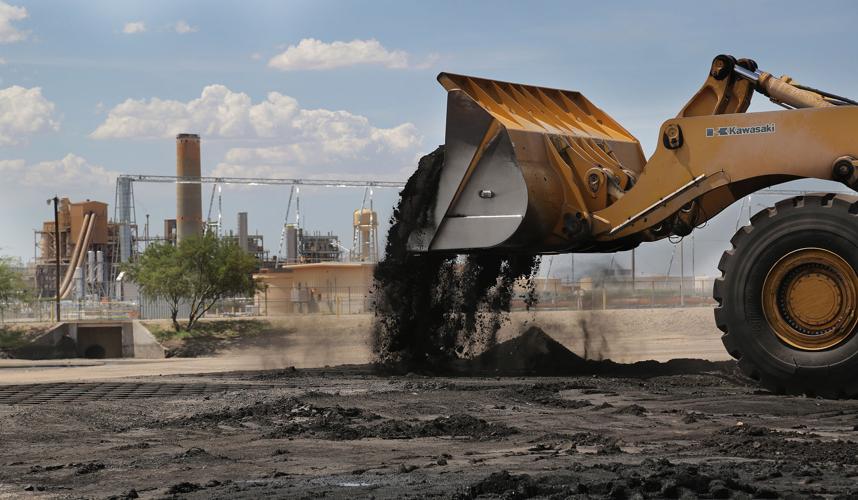
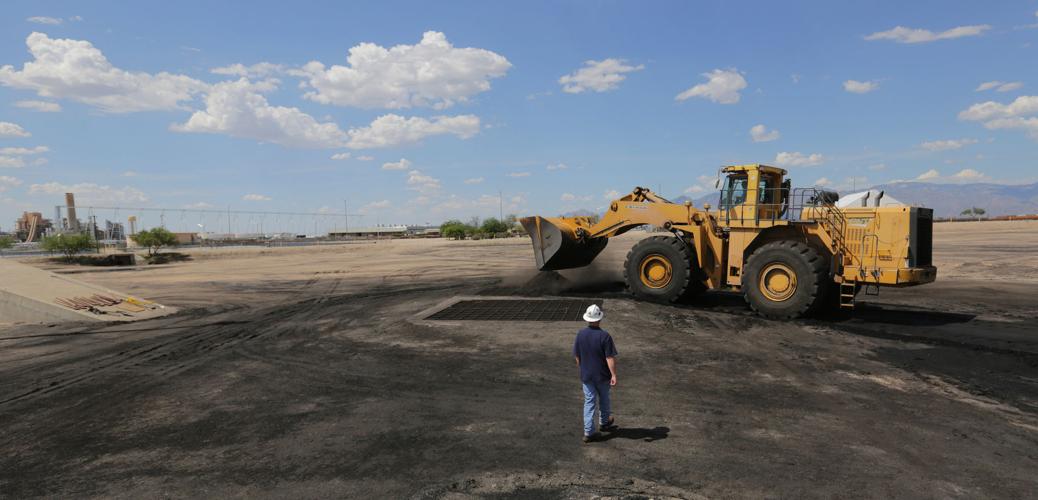
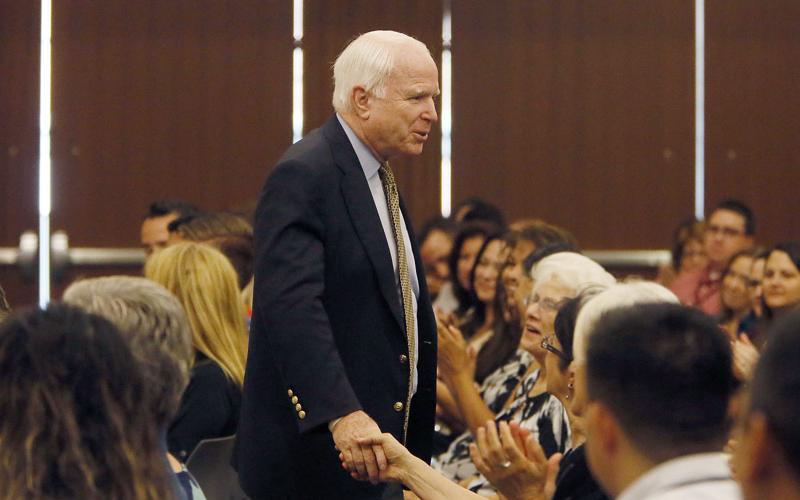

As Tucson Electric Power got its south-side power plant out of the coal-burning business Thursday, Sen. John McCain told a group of its employees why he opposes a federal plan that would require the utility to use still less coal.
TEP drew cheers from environmentalists with its announcement Thursday morning of an early halt to coal burning at the H. Wilson Sundt Generating Station.
The utility had entered into an agreement with the U.S. Environmental Protection Agency to stop burning coal at the plant by the end of 2017. It decided to stop this week after concluding that natural gas is a cheaper fuel. TEP had originally decided to switch to gas also because it wanted to build what it called a cleaner, more diverse energy portfolio, utility officials said Thursday.
"With the current low cost of natural gas, ending our use of coal at the Sundt Generating Station is a cost-effective way to improve our environmental performance while preserving the reliability of our local electric service,” said David Hutchens, TEP's president and chief executive officer.
The utility fed the last 5 tons of coal it knows are at the plant onto conveyor belts that supply the generators. It’s enough to last until Saturday, TEP spokesman Joe Barrios said. It’s possible that some coal remains may be found at the plant as it’s cleaned out over the coming weeks, but it would be less than a ton, he said.
But shortly after TEP’s announcement, McCain drew criticism from environmentalists after telling a group of at least 150 TEP employees that the EPA’s Clean Power Plan is “an abuse of power,” represents “regulation without representation” and will raise consumers’ electric bills. The plan will force Arizona to cut its power plants’ greenhouse gas emissions by about one-third by 2030 as a way of limiting climate change.
McCain said it’s likely that both houses of the Republican Congess will act in September or October to vote down the new rule, “but can we override a presidential veto? I’m not sure.”
TEP has been under pressure for years from environmentalists to stop all coal-burning at Sundt, on the grounds that coal produces heat-trapping greenhouse gases and can harm public health.
Only one of four Sundt generators, unit 4, ever burned coal. TEP agreed more than a year ago to stop burning it by the end of 2017 as an alternative to installing costly emission controls to limit regional haze.
“We haven’t had a coal supply contract at the plant for a while,” TEP spokesman Joe Salkowski said Thursday. “Natural-gas prices have been low and we were not motivated to purchase additional coal. It didn’t make sense.”
“This is a great deal for public health and visibility,” was the reaction to TEP’s announcement from Dan Millis, the Sierra Club’s Beyond Coal coordinator in Tucson.
“The coal affects the visibility of Saguaro National Park and is harming the lungs of people, not only on the south side, but all over the community,” Millis said. “But TEP is still 61 percent dependent on coal. They can do better.”
The EPA Clean Power Plan, adopted Aug. 3, requires Arizona to reduce its greenhouse-gas emissions from utilities by 34 percent by 2030. While less strict than the 52 percent cut the EPA proposed a year ago, that’s still too much, McCain told TEP employees.
“When the president issues executive orders without the approval of Congress, it’s not the right way to go. It sets a precedent,” he said. “I don’t think there’s any doubt this will raise rates for consumers — not just your consumers but all consumers.
“This is the longest recovery from a recession in history. In the meantime, I’m not sure that many low-income citizens of our state and the Old Pueblo need an increase in their electricity rates.”
The Sierra Club’s Sandy Bahr criticized McCain for fighting the plan when the Arizona Department of Environmental Quality and the state’s big utilities including TEP haven’t said how much it will cost them to meet it. Bahr pointed to a new report from the advocacy group the Union of Concerned Scientists that said Arizona is already 75 percent of the way to meeting the initial deadline for compliance with the plan by 2022.
“Why Sen. McCain can’t look up in the sky and see what a great resource we have there is beyond me,” said Bahr, director of the club’s Grand Canyon chapter.
Later, McCain’s staff pointed to a section of the new Clean Power Plan in which the EPA acknowledges the plan will cause electricity cost increases, although the EPA also said it expects the benefits to exceed costs.
McCain’s stance on the power plan is part of the senator’s switch from his earlier, outspoken advocacy for combating climate change. On Wednesday, McCain told the Star’s editorial board, “As long as my friends who are draconian climate-change advocates leave nuclear power out of the equation, leave me out. How much is the cost of energy by solar panels and wind turbines? It’s about 10 times the same cost as nuclear power.”
Actually, the Energy Information’s latest annual energy cost outlook, issued in April, said that wind energy is less costly to produce than nuclear energy. While the report showed solar power is still more expensive to produce than nuclear, it wasn’t anywhere near 10 times as expensive.
McCain press secretary Julie Tarallo said: “Increasing the use of nuclear power is essential in reducing our nation’s use of fossil-fuel-generated power and reducing carbon emissions. In addition to being cost-competitive, nuclear power is reliable, available day and night, and important to the diversity of our nation’s power portfolio. Renewables are important to that mix as well but cannot replace fossil fuels alone.”

