

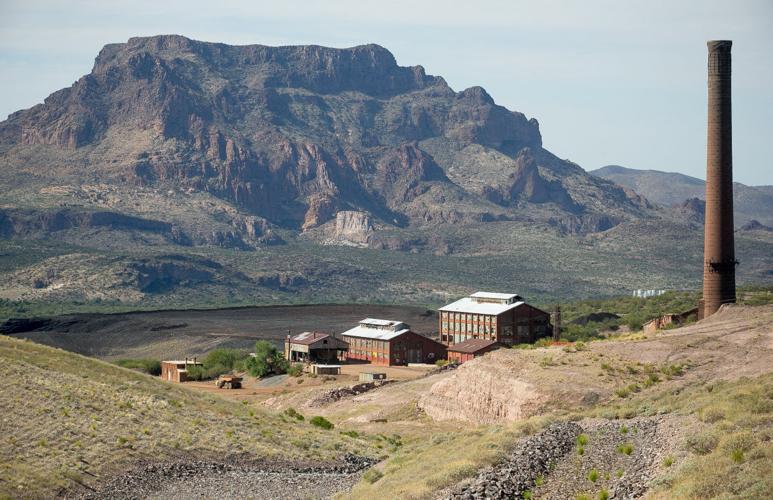
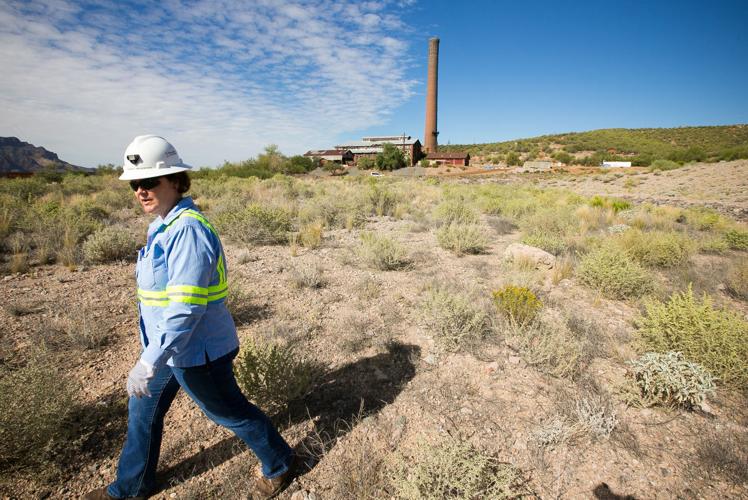

Resolution Copper Mining has spent about $30 million since 2005 cleaning up historic mine sites around Superior as it prepares to open a massive new mine. Now it faces a towering decision over a historic smelter stack.
The 300-foot smelter towering over the town, 110 miles north of Tucson, could be part of the reclamation project. But rather than demolish the structure, many residents would like to see it preserved.
Cleaning up and stabilizing the structure promises to be much more expensive than simply knocking it down, and it’s unclear who would pay the additional cost.
The stack is no longer in use, but residents appreciate the mining heritage it represents, said Casey McKeon, Resolution’s environmental manager, who has spent more than a decade with the company.
“We are working with the community to determine whether the stack stays or goes,” McKeon said.
The smelter has become unstable, presenting a threat to people, and because it is lined with hazardous toxins from its operating days, it presents a unique clean-up challenge, she said.
It could cost about $12 million to preserve the smelter, according to a preliminary estimate by Resolution, including the cost to rebuild or brace it to make it safe again.
Demolishing it would cost $2 million, McKeon said.
“The smelter is very important to us,” resident Lynn Martin said. “We hate to see anything like that destroyed.”
Martin and her husband, George, run the JF Ranch cattle operation outside near Superior, which has been in George’s family for three generations. His father and grandfather also occasionally worked at the mine, she said.
Both Martins are on the Community Working Group formed by Resolution to incorporate residents’ opinions into the company’s decision making. Both would like to see the smelter preserved.
“I think a majority of the townsfolk feel that way,” she said.
Pam Rabago, who represents the Superior Chamber of Commerce on the Community Working Group, said it is likely the community will have to pay for part of the additional cost of preserving the smelter.
“I don’t think we can ask (Resolution) to do that,” she said. “I don’t think that would be right.”
She said discussions about the smelter are only beginning.
The Resolution Copper Project faced years of delay because a portion of the ore body lies below a parcel of federally protected land, but Congress passed, and the president signed in December, a piece of legislation that will transfer the nearby Oak Flat campground land to Resolution.
The company agreed to transfer multiple pieces of private land to the federal government in exchange. Resolution is a joint venture between Rio Tinto of London and BHP-Billiton of Australia.
The mine remains controversial, with many Native Americans protesting its development on the grounds that Oak Flat is a sacred site for them. Many outdoor enthusiasts also lament the eventual loss of rock climbing, hiking and camping opportunities in the area once mining begins and the area becomes unsafe because of the underground blasting, which will create a massive depression where ore is removed.
When Resolution acquired the private land for the mine, it took on the responsibility of cleaning up mining activity on the site. Magma Copper Co. began mining the site in 1911 and built the smelter in 1924.
Magma closed the Superior smelter in July 1971 and began shipping copper concentrates to another smelter in Arizona.
Magma stopped mining in 1982 amid low copper prices and resumed in 1990 under a new Magma Copper Co. formed by Newmont Mining Corp.
BHP acquired the property when it merged with Magma in 1996, and operations at Superior stopped that year.
Resolution has been preparing to mine a much larger and significantly deeper copper ore deposit than those historic operations.
A meeting in late October or November will gather feedback from the community, McKeon said.
“I would like to see it stay but at the same time, I’m being realistic,” she said. “There is arsenic in there. It is pretty, but is it worth it?”
Most of Resolution’s $30 million spent since 2005 on reclamation has focused on capping historic waste rock piles with soil to contain the dangerous material and planting them over with native bushes and shrubs.
The company has about $20 million more in reclamation work to do on slag piles, tailings, historical buildings and other features left by the Magma Mining Co. and other operators.
Resolution officials said they hope the clean-up work they are accomplishing today around the town serves as a the company’s résumé for those who worry the new mining facilities won’t be properly cleaned up once the company begins digging for copper.
“We have to have a plan for closure,” McKeon said of the Resolution Copper Project, which could operate for 40 years once the actual mining begins. “We are proving the company is good at reclamation before we start to dig.”
The company has posted about $20 million in bonds for reclamation with the state, she said.

