

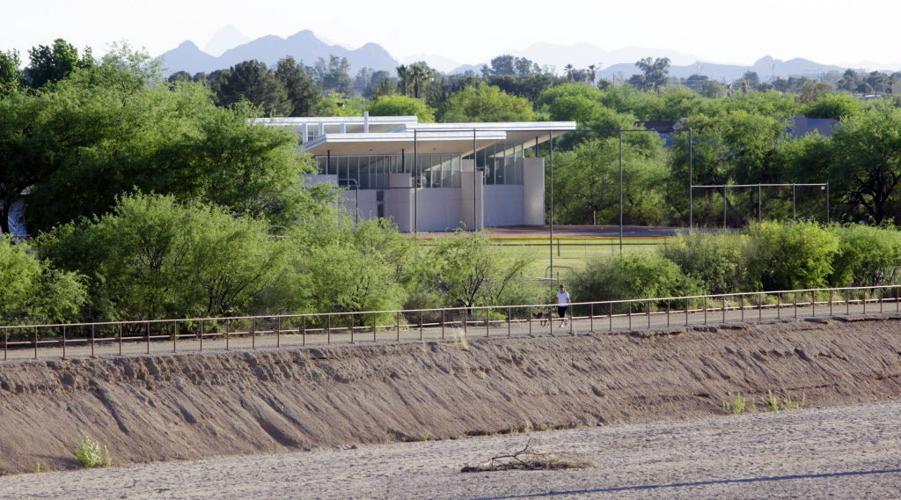
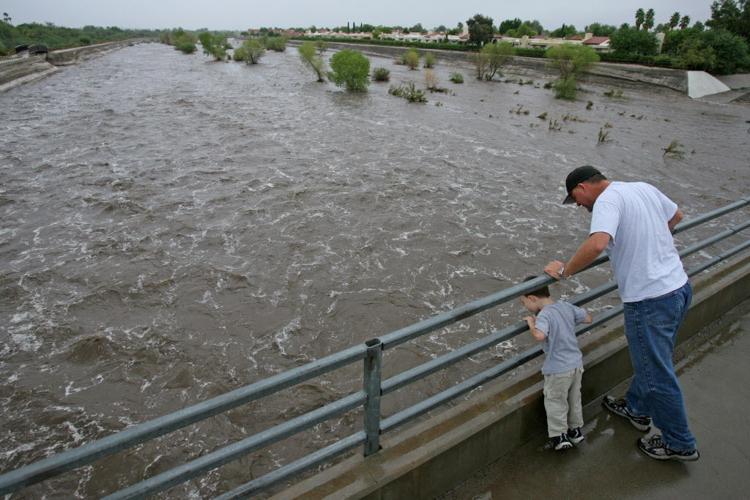

Dozens if not hundreds of tributaries of major rivers and streams in Southern Arizona and across the Southwest remain regulated and protected from damage by development under the federal Clean Water Act.
That is probably the most important regional impact of new federal rules, approved last week, governing how the government will manage watersheds. Just the fact that “no change” is an important development demonstrates how controversial and hard-fought these new rules have been.
Under the rules, developers of land near washes as big and well-known as the Pantano Wash and Tanque Verde Creek and as little-known as the Hardy, Big and Highlands washes across the region will need federal permits to dredge, fill or otherwise alter watercourses.
Such permits will still be required to build houses, shopping centers and bigger projects such as the proposed Rosemont Mine that would impact several washes in the Santa Rita Mountains foothills.
The permits are required even though many of these tributaries only carry water part of the year, and even more carry water only after storms.
Approved Wednesday by the Environmental Protection Agency and the Army Corps of Engineers, the new rules have been touted by federal officials as a simple clarification of what streams and wetlands are covered under the Clean Water Act. The feds’ authority over clean-water protection has been in doubt since two U.S. Supreme Court rulings in the early to mid-2000s limited that authority’s scope. These new rules put on paper government procedures that had been carried out informally since those court decisions came down.
Developers, ranchers, farmers and congressional critics such as Rep. Martha McSally, a Tucson Republican, say the new rules expand federal authority too much and infringe on local control of land use. They’re trying to overturn them in Congress, and are almost certain to sue to throw them out in court.
EPA, environmentalists and congressional allies such as Rep. Raúl Grijalva, a Tucson Democrat, say the rules are essential to protect clean water and washes that furnish drinking water supplies to millions of people nationwide. EPA has said that without these rules, drinking water supplies for 1 in 3 U.S. residents are unprotected from contamination.
Here’s what some of the new rules mean:
- Tributaries with significant connections to rivers such as the Santa Cruz, Gila and others classified as navigable by the feds are called “waters of the U.S.” Under the Clean Water Act, any landowner altering such watercourses needs a permit, which can take many months if not years and cost big bucks to get — but often add major environmental protections.
- The rules define a tributary as a water feature with a bed, riverbanks and an ordinary high water mark, and EPA Administrator
- Gina McCarthy
- has been quoted by Bloomberg News as saying this streamlines the definition of tributaries. A McSally spokesman said the new rule broadens the definition.
- The new rules expand protection for wetlands near washes — wetlands long prized by biologists and environmentalists as important wildlife habitat. Previously, the rules only regulated development of wetlands next to navigable streams. Now, the rules cover wetlands lying within 100 feet of washes that are tributaries to navigable streams.
Of these and a myriad of other issues covered under the new rules, the fate of washes and streams that run part time or hardly ever — known as intermittent and ephemeral washes, respectively — has dominated the debate in the Southwest.
These watercourses are almost invisible to many people except when flooded. Some look scraggly and barren to those who aren’t scientists or desert lovers. But normally dry washes support much of the desert’s wildlife. Also, runoff that seeps into the aquifer through the washes after storms provides drinking water.
The fact that most washes are intermittent and ephemeral makes the new rules critically important, said Sandy Bahr, head of the Sierra Club’s Grand Canyon chapter.
“A mining operation that can just obliterate a stream or water that is flowing into it . . . without going through the process of getting permits, that means there’s no opportunity to say no,” said Bahr, who heads the club’s state chapter based in Phoenix. “Sometimes these activities should be denied because the impact is so significant.”
Yet, often, development can be allowed but changed to limit impacts, and there should be opportunities for such changes, Bahr added.
“If a developer wants to move forward like with a massive development of the type proposed for Benson, or a mining company wants to build a mine, they should have to be accountable to the public,” she said. “These are public resources.”
She was referring to a planned 28,000-home project in the Whetstone Mountains, called Villages of Vigneto, that the Benson City Council gave its first approval to in April.
The two Canadian companies that have proposed building the Rosemont Mine — Augusta Resource Corp. and its successor Hudbay Minerals Inc. — have not fought federal Clean Water Act regulation of the project’s impacts on washes.
Developers, however, have fought to limit regulation of their projects near washes, saying complying takes too much time, and time is money.
“We have general concerns about federal intervention in what we see are local land use decisions,” said David Godlewski, president of the Southern Arizona Home Builders Association. “An attempt to do so by this rule or otherwise is an overreach of federal authority.”
The new rules offer a one-size-fits-all approach to governing watercourses that differ nationally, he said. Also, in Southern Arizona, local governments led by Pima County already have policies and plans such as the Sonoran Desert Conservation Plan that help address these issues, he said.
“We have different land use concerns in Southern Arizona than they do in the Midwest or East,” Godlewski said.
Patrick Ptak, McSally’s communications director, said the new rules expand the definition of an arcane legal term known as “significant nexus” that regulators use to define if a tributary to a navigable stream will come under the Clean Water Act’s protections. That definition has been broadened regardless of a wash’s distance to a larger stream, its size or how often it flows, he said.
The new rules say a significant nexus exists if a tributary carries out a wide range of ecological functions: trapping of sediments, filtering of water pollutants, retention of floodwaters or provision of important habitat for foraging, feeding, nesting or breeding of fish and other wildlife.
“Our top focus needs to be on growing our economy and creating more opportunity for Southern Arizonans, and there’s no doubt that a safe, abundant water supply is critical to that,” McSally said in a written statement. “However, I’m concerned that this rule … would hurt growth while doing nothing to protect our water supply.”
Tucson Audubon Society’s conservation chairwoman Christina McVie, however, said the new rules are needed to protect washes from being damaged by floods and to keep washes and underlying aquifers from contamination.
“When washes flood, and there are contaminants in them, the contaminants will be distributed into the system,” added McVie, who said she lived through groundwater pollution from toxic waste dumping into pits and washes on Tucson’s south side as a resident there from the late 1970s to the late 1980s.
“The tributaries have a physical connection to a larger water body — they feed it, like capillaries and small blood vessels feed into larger blood vessels,” McVie said. “You have to understand that the watershed is like a human body. Protecting watersheds is the same principle as protecting the body.”

