



The trend of craft beers in cans is rising like the head on a pint, and some Tucson brewers are catching the foamy wave.
Looking to get its brews in stores, Dragoon Brewing Co. is expanding production and will become the second Tucson-area brewery to add an in-house canning line.
The brewery and taproom at 859 W. Grant Road is easing into the cans, however.
Dragoon recently bought a low-volume manual canning station and plans to install a larger, semiautomated canning line next year, co-founder and manager Tristan White said.
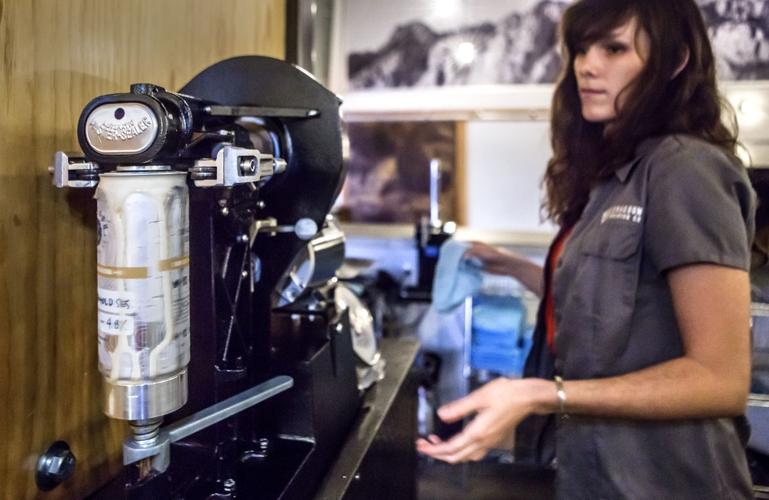
In the meantime, Dragoon fans can get 32-ounce cans at the taproom bar with a new can-filling station unveiled in July. (See accompanying story, Page D4.)
Across town, longtime local brewer Barrio Brewing Co., 800 E. 16th St. — the first Tucson brewer to start canning with its launch of Tucson Blonde in 2013 — has expanded its line of canned beers and is refining its packaging for bigger markets.
And, though Borderlands Brewing Co. doesn’t have space for a permanent canning line, it’s been contracting with a mobile canning company that cans its beers on-site once a month.
Like other craft brewers, Dragoon was attracted by the advantages of cans, which are cheaper to store and ship while shielding the brew from harmful light and oxygen better than glass, Dragoon’s White said, adding that bottle caps can let minute amounts of air in over time.
The stigma of cheap beer in a can seems to have passed, as the craft-brewing industry has embraced the can as a way to bring better brew to a thirsty market.
Since the Colorado-based Oskar Blues Brewery was credited with putting the first craft beer in a can in 2002, the number of craft canners has risen to more than 200 in 2012 and more than 500 today, according to the can-tracking website Craftcans.com.
Big craft brewers like Sierra Nevada and Boston Beer Co. (Samuel Adams) and larger Arizona crafters like Tempe-based Four Peaks Brewing and Chandler’s San Tan Brewing have been canning their beers for several years.
Besides the cost advantages of cans, the lightweight containers are a natural fit for Arizona’s outdoors lifestyle, White said.
“It’s a better product and it really fits with the market in Arizona,” he said. “Everyone likes drinking beer in the park or by the pool, but glass is a no-no.”
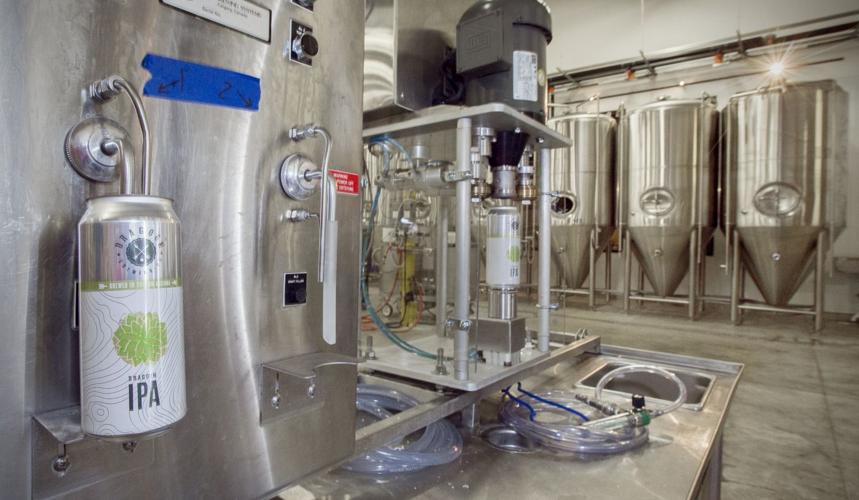
Dragoon plans to release its first packaged canned beer, Dragoon IPA, in stores by late September or early October, White said.
The company recently bought a used two-station manual canning system from Lumberyard Brewing in Flagstaff. That setup initially will be used to can Dragoon IPA at a rate of about 70 cases of 16-ounce cans per day, White said.
The brewery plans to expand into cans slowly, supplying small local retail outlets first. Sometime next year, Dragoon plans to install a larger semiautomated canning line, and the company recently added two new fermenters to handle the extra volume. Dragoon currently sells its kegs to bars and taprooms.
The new fermenters will eventually raise Dragoon’s current brewing capacity of about 2,700 barrels by more than 50 percent, White said. A U.S. barrel is 31 gallons, or the equivalent of about 14 cases of 24 twelve-ounce beers.
White declined to say how much the company spent on the new equipment but noted that it’s a significant investment.
Dragoon plans to sell its initial canned production to local liquor stores and smaller outlets, but in the long term the company hopes to crack the mass market through supermarket shelves, White said.
“The big market of the future for us is the groceries,” White said, adding that Dragoon will let the market response largely dictate the pace of its rollout.
“We don’t know what the response will be. This is a big undertaking, and we have a lot to learn,” he said.
Barrio Brewing owner Dennis Arnold, who has helped Dragoon by supplying some empty Barrio cans for testing, said he’s still trying to crack the grocery market in a big way.
Since Barrio started canning, it’s added two more brews — its Rojo Scottish ale and its Blanco white IPA — to the canning line. That should help Barrio stand out in a seemingly ever-expanding beer aisle and help penetrate the big Phoenix market, Arnold said.
Arnold — who still recalls typing up his original business plan in the late 1980s on a Selectric typewriter — said he’s learned some lessons on retail packaging the hard way.
He had to add a printer to his canning line to put production dates on each can for supermarket sales. Arnold later arranged for a Universal Product Code, or barcode, for his products only to find they weren’t acceptable to the supermarket he was courting.
“It really just picks you apart, but you have to invest in it to do it right,” Arnold said.
Meanwhile, Borderlands has taken a different tack.
Last year, the brewery began canning its Noche Dulce Vanilla Porter, but instead of opening its own canning line, it hired a mobile canning company.
Since last year, about once a month, San Diego-based Mobile West Canning has set up a portable line in Borderlands’ taproom on an off day and cans about 400 cases of brew, co-owner Mike Mallozzi said.
“Most of the beer purchased in the U.S. is purchased in supermarkets — it’s a huge market to tap into,” Mallozzi said. “But it’s pretty expensive to get your own (canning) line.”
Borderlands, 119 E. Toole Ave., plans to can some other beers, starting with its Citrana Wild Ale, by year’s end, he said.

