




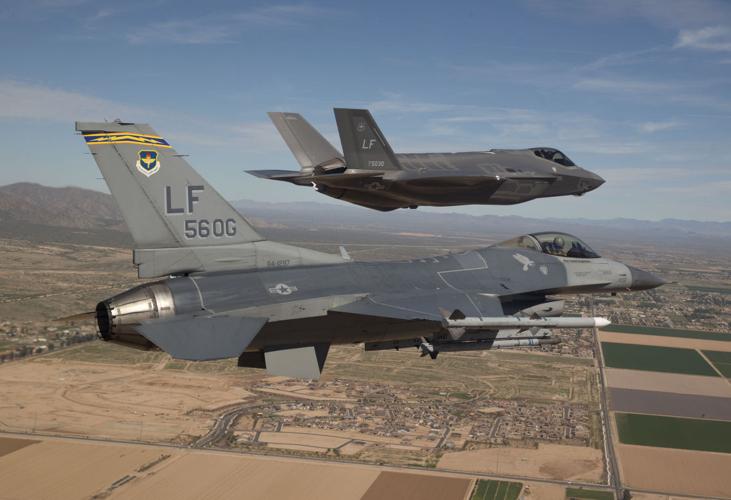



U.S. defense spending in Arizona fell 18 percent in the 2014 fiscal year, to $11.2 billion, according to the latest Pentagon figures. In Pima County, defense contract spending — a component of overall defense spending — slipped 4 percent to $4.6 billion.
Nationwide, all defense spending including contracts and payrolls fell 9 percent in fiscal 2014, to $418.4 billion or 2.4 percent of U.S. gross domestic product, according to a report by the Defense Department’s Office of Economic Adjustment.
In Arizona, the biggest factor in the statewide spending drop in fiscal 2014 was a 30 percent reduction in Maricopa County, where Phoenix-based TriWest Healthcare Alliance lost a major military health-care contract worth $2.6 billion in the prior year. That negative was partially offset by an increase in contracts to Boeing, which makes Apache attack helicopters in Mesa.
Arizona fell two spots, to 10th, in a ranking of states by overall defense spending as a percentage of state gross domestic product, at 4 percent compared with 5 percent in fiscal 2013, according to the Pentagon report.
Military head counts and payrolls dropped across Arizona and in Pima County in fiscal 2014, the report showed.
Statewide, the total defense payroll in fiscal 2014 was estimated at $1.9 billion, down from $2.1 billion in fiscal 2013, as total personnel fell to 43,185 from 44,969 in the prior fiscal year.
The personnel count includes active-duty, National Guard and reserve military members and civilian Defense Department employees but excludes private contractors.
In Pima County, the number of defense personnel fell about 2 percent, to 11,896 in fiscal 2014. Maricopa County’s military head count also fell more than 2 percent, to 12,991, the Pentagon report said. The report did not detail payroll spending by individual county or installation.
Pima County is home to Davis-Monthan Air Force Base, the Arizona Air National Guard 162nd Wing at Tucson International Airport and the Western Army National Guard Aviation Training Site in Marana. Arizona also hosts Luke Air Force Base near Phoenix and Marine Corps Air Station-Yuma.
On the contracting side, Pima County’s $4.6 billion in contract value for fiscal 2014 was driven by Tucson-based Raytheon Missile Systems, the region’s biggest private employer and the largest defense firm in the state by contract value. Raytheon reaped $4 billion in defense contracts in fiscal 2014, down from a reported $4.4 billion in fiscal 2013, the Pentagon report shows. The figures are not adjusted for inflation.
A University of Arizona economist said the overall decline in defense spending has slowed the economic recovery in Pima County, where defense outlays represent a much higher percentage of economic output — about 14 percent of gross domestic product in 2013 — than the state or the Phoenix area.
“There’s no doubt that this has been a significant drag on the economy,” said George Hammond, director of the Economic and Business Research Center at the UA’s Eller College of Management.
Hammond said that dynamic can also be seen in areas where defense spending is high as a percentage of output, such as Sierra Vista in Cochise County (25 percent) and Yuma (about 12 percent).
“The ones that have the biggest reliance (on defense spending) is where there is slow growth,” he said.
In Cochise County, home of the U.S. Army Intelligence Center and Fort Huachuca, the number of defense personnel dropped by about 420, or about 6 percent, from fiscal 2013 to fiscal 2014, the Defense Department report shows.
But those figures don’t capture changes in the number of students trained at Fort Huachuca or job changes at major contractors that work on the base, like General Dynamics Information Technology and Northrop Grumman, said Robert Carreira, director of the Center for Economic Research at Cochise College in Sierra Vista.
While it’s hard to gauge the impact of contract changes — which sometimes result in new civil-service workers taking over contractor duties — Carreira estimates that Fort Huachuca and Sierra Vista have lost upwards of 3,000 to 4,000 jobs overall in recent years.
“Certainly we’ve lost thousands of jobs,” Carreira said. “It’s hard to get a picture of the whole thing, but I’d say definitely across the board it’s been a downward trend.”
The bad news for Pima County and other Arizona defense centers is defense cuts are expected to continue, but not at the pace of reductions in 2013 and 2014, the UA’s Hammond said.
The Defense Department report noted that after a decade of expansion, federal government spending on national defense has been in decline since fiscal 2012, as the Budget Control Act of 2011 forced significant cuts in defense spending.
From fiscal 2011 to 2018, real defense spending is expected to decline 27 percent, the Pentagon report said, citing budget documents.
“It’s not likely to grow and it is likely to shrink as we go forward,” Hammond said. “The thing to keep in mind is, it’s not likely to shrink at the same pace as calendar 2013, when the sequester really hit.”
The fact that Arizona has so far been spared deeper cuts points up the state’s importance to the Pentagon and national security, said Ron Shoopman, president of the Southern Arizona Leadership Council.
But Shoopman, a retired Air Force brigadier general and a board member of the Southern Arizona Defense Alliance, said the military support group still has work to do to ensure the region’s bases survive ongoing budget cuts.
The alliance’s members coordinate periodic lobbying trips to Washington, and the group is in the process of hiring a consultant to strategize on how to protect the local bases.
“We’re very pleased with the progress we’ve made, but this is a long-term effort,” he said. “We have no intention of letting up.”

