


Shares in defense contractor Raytheon Co. rose Thursday after the company reported a 41 percent jump in second-quarter profits, beating analyst estimates on a one-time gain and stronger sales.
The company’s Tucson-based Missile Systems unit posted a 6 percent increase in second-quarter sales and a 21 percent jump in operating income, driven mainly by higher sales of Paveway guided-bomb systems.
The Waltham, Massachusetts-based parent company reported second-quarter net income from continuing operations of $710 million, or $2.38 per share, up from earnings of $504 million or $1.65 per share a year ago.
The results included a gain of $153 million, or 53 cents per share, from a restructuring of Raytheon joint venture with French defense contractor Thales Group, and a one-time tax benefit of 10 cents per share.
The adjusted earnings of $1.75 per share still beat the average estimate of Wall Street analysts of $1.70 per share, as surveyed by by Zacks Investment Research.
Raytheon’s revenue of $6.04 billion in the period also beat Street forecasts of $5.84 billion.
Raytheon also raised its full-year earnings forecast from $7.13 to $7.33 per share, from an earlier projection of $6.93 to $7.13, on an unchanged revenue forecast in the range of $24 billion to $24.5 billion.
Raytheon shares closed Thursday at $138.06, up $2.72 or 2 percent, in trading on the New York Stock Exchange.
Raytheon Missile Systems had second-quarter net sales of $1.66 billion, up 6 percent compared with the second quarter of 2015.
Operating income at Missile Systems rose 21 percent to $223 million, driven by program efficiencies and a favorable change in program mix, Raytheon said.
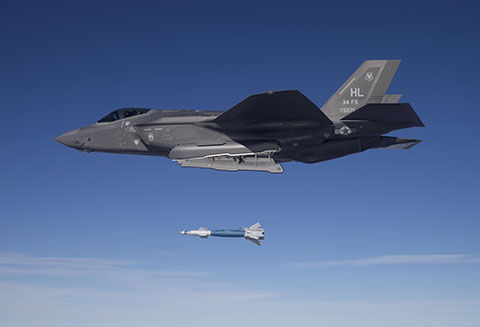
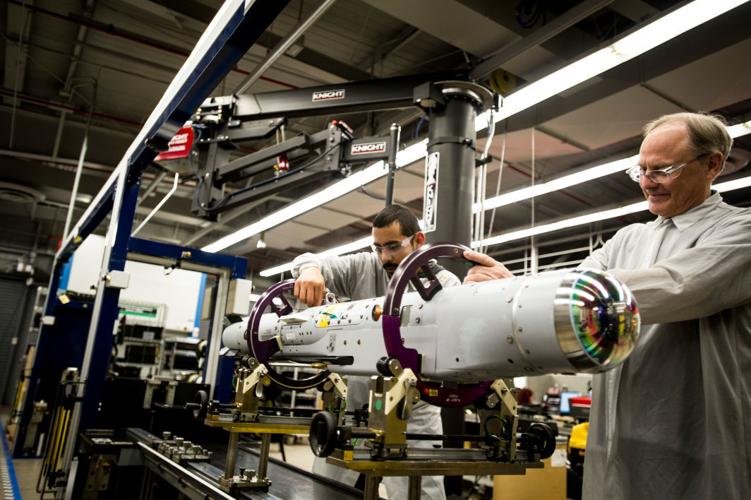
Raytheon said the increase in quarterly net sales was primarily driven by higher sales on the Paveway program, which accounted for $292 million in second-quarter bookings. About 40 nations use Raytheon’s Paveway bomb-guidance kits, which have been used extensively by the U.S. and its allies against Islamic State militants in Iraq and Syria.
Other major bookings during the quarter included $298 million for AIM-9X Sidewinder short-range air-to-air missiles, $230 million for Standard Missile-3 interceptors, $118 million for Evolved SeaSparrow Missile ship-defense missiles and $109 million for Advanced Medium-Range Air-to-Air Missiles, for both U.S. and international buyers.
Missile Systems also booked $186 million for a test-range upgrade for the Royal Australian Air Force and $122 million for the Miniature Air Launched Decoy for the U.S. Air Force.
Among other reporting Raytheon business units, Raytheon Space and Airborne Systems saw its net sales rise 9 percent, mainly driven by higher sales on classified programs, while Intelligence, Information and Services posted a 3 percent gain in net sales boosted by cybersecurity and special-missions programs.
Raytheon’s Integrated Defense Systems unit posted an 11 percent decline in net sales, mainly because of the recognition of previously deferred pre-contract costs on an international Patriot program, the company said.

