


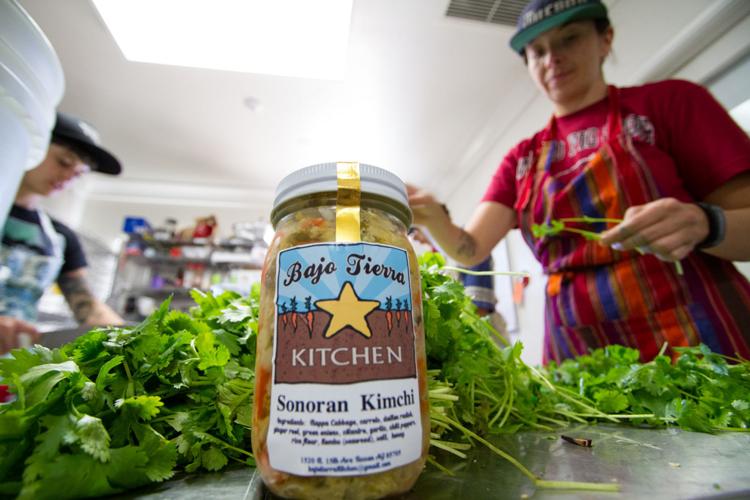

Sonoran Kimchi.
Once you hear that you want to know more, and it’s obvious Cynthia Smith and Elianna Madril chose the right product to launch their new business, Bajo Tierra Kitchen.
But it’s not just a gimmicky name; Sonoran Kimchi came to its gimmick honestly.
The women want all of their ingredients to be organic or naturally grown, they say, and they couldn’t find organic gochugaru, the chili pepper that gives traditional kimchi its bright red color.
“So we decided, since we live in the Sonoran desert where chilies are plentiful, that we would use fresh chili peppers,” Smith said.
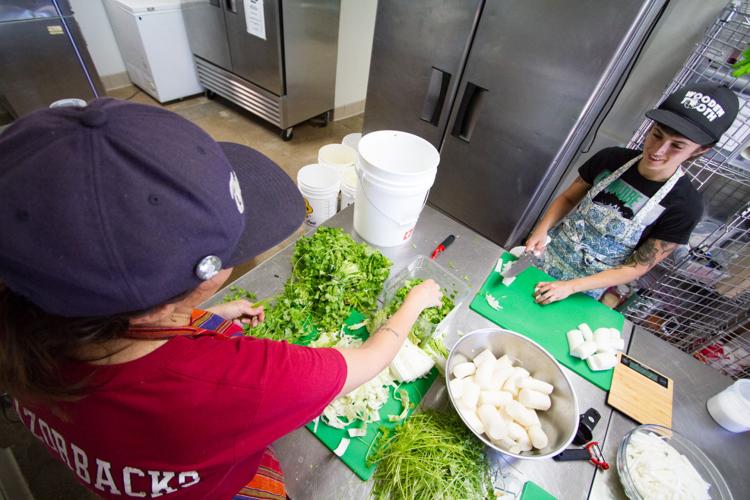
Their final recipe adds chiltepin and cilantro to classic ingredients — napa cabbage, carrots, daikon radish, green onions, garlic, ginger and rice flour — along with seaweed instead of fish sauce, so it’s vegetarian.
The kimchi is the first in what they hope will be a long line of fermented foods produced by Bajo Tierra Kitchen. But initially they want to take it slow.
It’s expensive to bring a food product to market. Just getting the recipe locked down means making test batches — sometimes a lot of them, they said — which in the case of kimchi came to more than $100 per batch.
Testing, which they did through the University of Arizona’s Food Product and Safety Laboratory, cost more than $600.
Smith and Madril raised more than $4,000 through a Go Fund Me campaign. That money helped with equipment and got them into a rented commercial kitchen. They also received a small-business loan through the Community Investment Corporation.
A jar of Sonoran Kimchi retails for $13 and is sold at the Food Conspiracy Co-Op on North Fourth Avenue. It is also scheduled to be on sale at the Santa Cruz and Heirloom Rillito Park farmers markets by the end of the month.
Loving food
Smith and Madril have made good food their lives’ work.
Smith, 36, has been in Tucson since 2005, and worked at restaurants and Sleeping Frog Farms in Benson. She traces her love of food to her grandparents’ farm in Louisiana, where she would spend time shelling peas, picking corn and helping her grandmother with canning.
Madril, 28, a fifth-generation Tucsonan, grew up in restaurants. When she was young, her father and his brothers owned Mt. Vesuvius pizza in Nogales. Her father later opened Longhorn Grill in Amado.
She’s worked in the restaurant business all her life, including at Bruegger’s Bagels, Time Market and 5 Points Market. She met Smith while they were both working at Café Passé and started working on business opportunities.
“Our initial goal was to take surplus vegetables from local farmers that otherwise had too much to sell at market or would throw them in the compost,” Madril said. “We wanted to take those vegetables and do something with them.”
They came up with the idea of fermentation together, they said.
“We both really think about nutrition a lot and when you can something and use heat, so much of the nutrition is lost,” Smith said. “That really bothered us, so we just started looking into other ways of preserving that didn’t involve heat.”
Fermented products are trendy right now, as more people think see them as a food source of probiotics, they said, but fermentation has been around the region for a long time.
“The indigenous people here in the Southwest had certain items that were fermented. I know they did tepache (drink) with pineapple and also the beginnings of tamales were a fermented product,” Smith said. “The corn was ground up to ferment in the husk for a certain amount of days.”
While they may venture into fermented tamales one day, right now Bajo Tierra Kitchen has a conservative multi-year development plan.
“Within the next three to five years having our own space is a goal, but the next two to three years is more about getting established and adding products,” Smith said.
They are working on producing sauerkraut next — but no, not Sonoran sauerkraut.
“It will be really traditional, there won’t be anything except for cabbage in it,” Smith said.
But there are more plans for things with a little extra spice.
“We have these zucchini pickles that we’ve made with local orange zest in them and chiltepin as well,” Madril said. “They have a really good sweet and sour flavor to them.”

