


God, Dr. Seuss inspire; ex-pastor in sex sting; plantation for sale
- Updated
Odd and interesting news from the Midwest.
- By William Smith Hawk Eye
- Updated
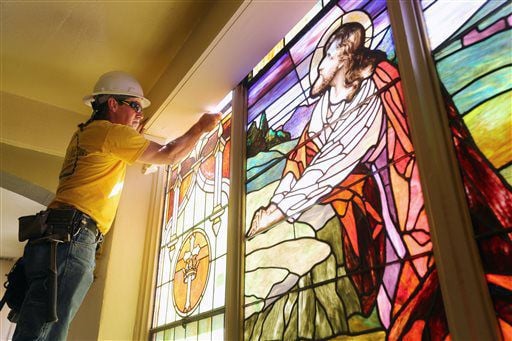
BURLINGTON, Iowa (AP) â When a piece of the sanctuary ceiling at First Congregational Church fell to the floor a few months ago, it was like a sign from God: An indication the church's motivated parishioners were well ahead of the game.
Fundraising for much-needed repairs and renovations to the church started last year, and the work itself has been going on through the summer.
"It emphasized the exact need that we need to restore the church to the way it was initially created," said longtime parishioner and fundraising chairwoman Barbara McRoberts. "Thankfully, it did not happen on a Sunday service where there are people back in that area. So we were fortunate there."
Those repairs and renovations have been underway since June, and the sanctuary ceiling already has been repaired.
But it's just the tip of the iceberg. Moisture has penetrated mortar joints and coping caps across the building over the years, and contractors have been hard at work sealing the gaps.
"I think it's just really exciting," McRoberts said. "This is a very historic structure in terms of architecture."
It's why the church board started the Restore and Preserve capital campaign last year. McRoberts and her committee want to raise $500,000 for those repairs, and 45 percent of that -- about $226,000 -- already has been raised. It was enough to start an exterior overhaul in June, and work on the interior will continue into October before resuming next year. Fundraising efforts will continue.
Since the church is listed on both the state and National Register of Historical Places, special care has to be taken to restore the building while maintaining its original look. The four front doors to the church are being replaced, and the wood trim on the arches above them will be displayed prominently. The doors themselves cost between $10,000 and $15,000 apiece.
"We have seen an increase in cost from where we started over a year ago, and the doors would be an example," said David McMurray, a church member who's overseeing the project.
The church's stone walls have eroded considerably over the past century, which is why private contractors have been sealing and repointing the mortar joints. Other exterior work includes repairing the gutters and downspouts, repairing and replacing some of the roof's shingles and maintaining the wood trim above the front doors. Work also has been done to re-enforce the church bell tower.
"There's still anticipated work on the west facade due to the deterioration to the mortar of the coping stones," McMurray said.
That's just the exterior work, though.
McRoberts is most excited about expanding the accessibility for the handicapped at the front doors with a longer wheelchair ramp, as well as a new interior wheelchair ramp inside the building. Work on the interior ramp has already begun, and will eliminate the need for older residents to use the interior stairs. An elevator already exists to take them to the second-floor sanctuary.
"The (present) ramp is very steep, and we don't have the accessibility we would like to our restrooms," McRoberts said.
Besides expanding the space in and around the restrooms, new boiler controls will be installed, as well as a permanent dehumidifier.
McRoberts said it wouldn't be possible without generous donations from the community.
"I'm always amazed by the contributions that come from non-members who spent time in our church," said McRoberts, who has been attending First Congregational since the 1950s.
According to church historian Ellen Fuller, First Congregational Church of Burlington was gathered Nov. 25, 1838. It was reorganized Dec. 28, 1843, at which time the Congregational name and form of government was adopted.
"The first church building, constructed at a cost of $6,000, was dedicated on Dec. 29, 1846, the year Iowa became a state," she said. "In that year, the Rev. William Salter, a member of the Iowa Band from Andover Theological Seminary in Massachusetts, began his 64-year ministry at the church. There was an original church on this site that looked like a little country church, and then congregation outgrew it."
The Iowa Band was a group of 12 seminarians, and each was charged to found a church and together they found a college. That college eventually became Grinnell College, which consistently is ranked among the top 15 liberal arts institutions in the country.
On July 4, 1867, the old church was torn down and the cornerstone was laid for the present church building, designed by local architect Charles A. Dunham. The new building was dedicated Christmas Day, 1870.
The church caught fire Sept. 19, 1899, and within two hours, all that remained of the building were the bare walls and tower. It was rebuilt and rededicated Nov. 11, 1900.
"The structure is built of dressed dolomite limestone in Gothic Revival style," Fuller said. "Its distinguished feature is a square crenelated tower."
In the early 1960s, the church was extensively remodeled, creating the intermediate level now housing the kitchen, Fellowship Hall, offices, chapel, parlor and restrooms.
"The building has been very important to the community," the Rev. Jim Francisco said in a previous interview. "Just the other day we had a couple that came in that aren't members of the church, but they were married here in 1954. They just wanted to look around."
The church celebrated its 175th anniversary in 2013.
First Congregational Church isn't the only local house of worship receiving a face lift. St. Mary's Catholic Church is also under renovation.
Burlington began in mid-August, and when it's done, the church will have a larger gathering space at the entrance. The entrance itself is being moved to the center of the building, and a new drop-off lane will allow parishioners to drop off elderly residents at the entrance. The current configuration causes traffic jams that spill onto Mount Pleasant Street.
The biggest addition will be running water and bathrooms for men and women, which has been a request at the church for a while now.
"The outside patio level will be all new, along with the handicap accessible ramp," said parish lay director Tom Chicken.
Chicken said plans for the additions have been in the works for the past two-and-a-half years, and he's hoping to have all the work done by Christmas. The history of the church can be traced all the way back to 1886, and it was founded with money advanced by the C.B. & Q. Land Company. A one room addition was built to the brick church and school to provide a home for nuns.
On the Feast of the Epiphany in 1913, the church, school and sister's convent were destroyed by fire. A new church was built and dedicated on Memorial Day, May 30, 1917.
Construction of the Grotto began in 1929 by parishioners and families from the area, and a statue of the Blessed Virgin Mary is located inside the Grotto. The Grotto is still maintained by volunteers.
___
Information from: The Hawk Eye, http://www.thehawkeye.com
An AP Member Exchange shared by the Hawk Eye

- By Seth Tupper Rapid City Journal
- Updated
RAPID CITY, S.D. (AP) â Barb Peterson is ideally suited to her job as a fire spotter in the Black Hills National Forest.
She likes solitude, which is good, because she spends her days at an elevation of 6,647 feet, pacing a catwalk around a rustic-looking tower and scanning forested hilltops and ridge lines for smoke, the Rapid City Journal reported (http://bit.ly/2d9LAxN ).
She enjoys company, too, which is also good, because she counted 1,600 public visits in July from curious motorists, ATVers and hikers, despite the relatively remote location of the Cement Ridge fire lookout tower. It's in the northwestern Black Hills, about 20 miles southwest of Spearfish via gravel roads and just across the Wyoming line.
Peterson has been a "lookout," as her position is known, for eight years since retiring from an accounting career, and she loves the simplicity of looking for smoke, talking to visitors and enjoying nature.
"To me, it's a coveted position," she said. "People say, 'I want this job,' and I say, 'Stand in line.' I'm not ready to give it up."
The Cement Ridge tower, which turns 75 years old this year, is one of seven fire lookout towers still being used in the Black Hills. There were about 25 active towers in the region, but many were deactivated as advances in technology â including aerial surveillance and automated lightning-strike detection â made forest managers less reliant on human lookouts.
The 25 tower sites in the Black Hills now range from the stone ruins of long-ago deactivated towers to the well-preserved, wood-and-stone or metal structures of active towers. Some of the tower sites are situated along roads, and others require a hike; some are open to the public, and others are restricted. The most well-known Black Hills lookout tower is the stone structure atop Black Elk Peak (formerly Harney Peak), which is no longer used for smoke detection but is visited by thousands of hikers annually.
The decline of lookout towers in the Black Hills has paralleled a national trend. The Forest Fire Lookout Association reports that among nearly 9,000 lookout towers that once stood across the nation, fewer than 3,000 are still standing and fewer than 1,000 are staffed.
But the disappearance of the towers may be slowing as people nationwide, and especially in the West, take action to preserve and protect lookout towers for their continued usefulness, unique architecture, history and scenic vistas.
In some places, unused lookout towers have been re-purposed as rental cabins. That has not yet happened in the Black Hills, where forest managers seem more focused on preserving active lookout towers in part by keeping them staffed with human lookouts.
Chris Huhnerkoch, assistant fire management officer for the Bearlodge Ranger District, said the Black Hills National Forest uses surveillance flights and other modern technology to find fires. But technology is expensive and sometimes fails, and it's comforting to know there are people in towers ready to report smoke within minutes of a fire starting.
Additionally, lookouts provide weather reports and serve as human repeaters for Forest Service personnel who might be out of radio range of each other, but within range of a lofty lookout tower.
"It's pretty handy having them up here for safety, weather and communication, aside from the primary smoke detection job," Huhnerkoch said, adding that he hopes to have people in lookout towers "as long as possible, as long as I'm here."
The Cement Ridge tower stands 15 feet tall, with a stone-constructed base. Inside the base is an empty room that's open year-round and is a popular warming spot for snowmobile riders.
Atop the tower is a 14-by-14-foot wooden, window-lined room, or cab, with a wraparound catwalk. A stroll around the catwalk affords a panoramic view of the northern Black Hills and the surrounding area, with visible landmarks including Terry Peak, Custer Peak, Crow Peak, Inyan Kara Mountain, Warren Peak and Sundance Mountain. On crystal-clear days, Peterson said, she can see the Bighorn Mountains of Wyoming about 150 miles to the west.
Inside the cab is a mix of old and new technology, all surrounding a device known as an Osborne Firefinder.
The Osborne Firefinder was invented during the winter of 1910-1911 by William B. Osborne, a Forest Service employee in Oregon. The device consists of a circular map mounted on a rotating steel disc atop a pedestal, with brass sighting mechanisms.
When Peterson spots smoke from the Cement Ridge tower, she lines up the smoke in the firefinder sight, and then takes readings from the sights and the map that help determine the approximate location of the smoke. If human lookouts in other towers see the same smoke, they can communicate by radio and help pinpoint the location by means of triangulation with strings and tacks on wall maps.
Lookouts have some modern technology, including radios and cell phones, but some towers are still very rustic. The Cement Ridge tower is powered by solar energy, and Peterson's work still revolves around a pair of binoculars and the Osborne Firefinder that is basically the same device, with some updates, that was used by lookouts more than 100 years ago.
"It still works today, and that's the most important thing," Peterson said. "It's tried and true technology, it's been used for decades. My philosophy is if it isn't broke, don't fix it."
Barb Peterson demonstrates how an Osborne Firefinder is used when determining where a fire is burning. The device was invented around 1910 and is still a vital tool today.
The value of fire lookout towers and human lookouts extends beyond smoke-detection, according to Michael Engelhart, North Zone archaeologist for the Black Hills National Forest. Lookout towers are architecturally and historically significant, they offer spectacular views, and the act of getting to a remote tower offers a recreational opportunity.
"It's kind of that nexus of utility and history and getting out and seeing the woods, all at the same time," Engelhart said. "I think that's why we get a lot of visitors."
Peterson's presence in the tower, and the presence of other lookouts in other towers, helps to protect and promote those multiple uses. Her presence deters vandals, and she does some upkeep on the tower during her downtime. And when people come to visit, as long as she's not busy calling in or monitoring a fire, she acts as a kind of docent, telling visitors about her duties and about the history of fire lookouts.
The proliferation of fire lookouts was related to the so-called Big Blowup of 1910, when an estimated 1,736 fires swept across the West and burned 3 million acres while destroying 7.5 billion board feet of timber, wiping out several small towns and killing at least 85 people.
After those fires, lookout towers began popping up around the country as land managers sought to spot and respond to fires before they raged out of control. At Cement Ridge, a log cabin was built in 1911. A crow's nest was added in 1921, but it and the cabin were replaced by a tower that was finished in 1941.
People hired as lookouts in the early days had to be adventurous and comfortable with isolation and danger. Some lookouts lived in towers for days on end, and at Cement Ridge there was a horse stable and a rock cellar for provisions. Printed guidebooks advised lookouts how to avoid being electrocuted by a lightning strike.
Cement Ridge was remote enough that no motorized vehicles reached it until 1927, when a ranger named Tom Sawyer drove his car to the top with his wife and young son inside. He reportedly cleared a path as he went, and when he got out of the car to clear rocks or branches out of the way, he stuck a sack of potatoes behind one of the car's wheels to prevent it from rolling downhill.
The tower that was built atop Cement Ridge in 1941 is the one that still stands, and it was added to the National Historic Lookout Register in 1993. The tower's 75th anniversary this year coincides with the 50th anniversary of the National Historic Preservation Act, which has done much to encourage the preservation of lookout towers and other historic structures all over the country.
Keith Argow, chairman of the board of the national Forest Fire Lookout Association, said historic preservation efforts are needed to prevent the disappearance of towers that help tell the history of forestry.
"They are a symbol of forestry in America going back 100 years," Argow said. "They're almost as important a symbol of responsible fire management as Smokey Bear."
The original Cement Ridge fire lookout was built between 1911 and 1913. At that time it was a one-room log cabin with a shingle roof. In 1921, a crow's nest with a glassed-in house was constructed. A new lookout was built by the Civilian Conservation Corps and finished in 1941.
Concern about the decline of lookout towers has motivated many people across the country to donate money, volunteer time, or buy lookout towers in order to preserve them, said Gary Weber, the Idaho-based treasurer for the national Forest Fire Lookout Association.
In eastern states, where lookout towers were typically less remote and the job of a lookout was less demanding, there seems to be less nostalgia for the towers, Weber said. But in the West, there is an active community of people committed to preserving the towers, even as remote controlled cameras and other technological replacements for human lookouts continue to cause more towers to be deactivated.
"I think there is more and more recognition that this is something that's fading off the landscape, and it will continue to fade if we don't do something," Weber said.
Peterson is doing her part at Cement Ridge. She drives 17 miles to the tower five or six days a week during the fire season, which typically spans from May to September. Her days range from eight to 12 hours, depending on fire activity.
In keeping with the historic nature of her role and her work site, she drives a 1978 pickup, which is stuffed with extra clothing and food and whatever else she might need in case of an extra-long day or unpredictable weather. Atop the tower, between visits from the public, she sometimes thinks about her predecessors and about lookouts in more remote towers across the country, and she's jealous of lookouts then and now who've ventured deeper into the wilderness.
Her longing for the wilderness helps explain the lasting appeal of lookout towers. They are reminiscent of a time when nature was more natural, solitude could still be found and life was uncomplicated by digital technology.
Visiting a place like Cement Ridge is one of the few modern ways to experience that bygone era or at least something like it.
"It's hard to overtly recognize it sometimes in ourselves, but we really seek out connections to the past, and I think that's part of the reason people come up here," Engelhart said. "It's part of our identity, really, in the Western forests."
___
Information from: Rapid City Journal, http://www.rapidcityjournal.com
An AP Exchange shared by the Rapid City Journal.
- By CAROLINE GRUESKIN Bismarck Tribune
- Updated
BISMARCK, N.D. (AP) â When Tyler Auck was recovering from his opiate addiction several years ago, a guy volunteered to help him.
"He took me out to eat, did stuff with me, took me golfing," Auck told The Bismark Tribune (http://bit.ly/2c1eMCF ). "I didn't have a lot of experience with that."
And Auck said that was important in helping him get better.
"Treatment centers, they take care of you when you're in there. They give you aftercare, which helps you get back into society. But they're not there for you when you go home," Auck said. "To have somebody that will teach you how to go out and eat and sit with somebody and have a conversation...To say, hey, I'm having a hard time, what would you do in that situation? To look at their life and say, I want part of that."
The friend was helping him for free, and Auck said that happens a lot in the treatment community. But around the country, peers are often trained and paid to work with addicts and people with mental illness.
Seen by experts as an important piece in drug and mental health treatment, peer coaches are rare in North Dakota, where there is no common certification process. But new funding sources and a growing interest in making them more available could bring them to cities around the state, potentially adding manpower to a thin treatment workforce.
A peer coach is someone recovering from an addiction or mental health issue who is trained to work with people while they get sober or participate in therapy. They can work within treatment centers alongside psychologists and addiction counselors or in recovery-focused groups.
Armed with 40 to 80 hours of training, coaches help people during their recovery by encouraging them to stay sober, involving them in activities or finding them housing. They can also do outreach on the front end to people who may be considering treatment.
Pam Sagness, director of the behavioral health division of the Department of Human Services, said a standardized peer coach program could be key to improving services.
"By investing in these programs, we will be reducing relapse, which is high-cost down the road," Sagness said.
It has been presented as a "primary need" in the interim Human Services Committee this year, with support from many stakeholders, she said.
"What we want to do is provide training across the state so that people working in this realm would be given the tools they need," Sagness said.
Steve Allen, a senior policy associate at the Council of State Governments, has also recommended them to the Incarceration Issues Committee as a way of improving treatment with the long-term goal of keeping people out of jail.
"Use of peer support specialists is an emerging best practice," Allen said, noting that Medicaid supports these roles to the extent of funding them in 31 states.
Allen also has said peer coaches and other paraprofessional workers, such as someone who coordinates between the multiple systems â behavioral health, criminal justice â that often affect the same group of people, could bolster workforces in areas with few treatment options. People who become peer coaches also may be inspired to continue their schooling and become clinicians.
Allen said hiring of coaches, who would be paid about $50,000 annually, could start within a year, though it may take several to build a full program.
"It is one thing the state could do fairly quickly," Allen said.
The few formal peer coaching programs in North Dakota have largely withered away for lack of funding. What exists today is mainly for youth.
For example, in 2012, Heartview Foundation in Bismarck had a two-year grant to train peer coaches to work with recovering addicts.
Auck was one of them.
He got paid to take people kayaking, Frisbee golfing and mountain biking. He worked with them on job resumes and finding housing.
But after the grant ended, there wasn't funding to continue paying people and it was costing the organization to coordinate.
"We tried to sustain those coaches on a volunteer basis, but these are folks that are active and engaged in the community," said Executive Director Kurt Snyder. "Without the support of the grant, it fizzled away."
If a process to train and certify coaches were put in place, funding from the state and federal governments could make these services more available.
Peer coaches are recognized by Medicaid in many states. If the state renegotiated its contract with the health care provider, local treatment centers could be reimbursed for offering certified peer services, Sagness said.
Additionally, a new state-funded voucher program for people with substance use disorders is just getting started, Sagness said. Recovery coaching is one of the services it is designed to reimburse.
In the meantime, a couple of initiatives are opening up to offer recovery coaching in both realms.
An organization called Face it Together is starting in Bismarck and Fargo. The idea is to recruit and train volunteer coaches, who would be available at all times to people struggling with addiction, said interim executive director Marnie Walth. The group, which intends to get funding from businesses, is on track to recruit volunteers in the fall.
Also, Mental Health America of North Dakota got a grant from the federal government for its executive director to become a mental health peer coach trainer.
Carlotta McCleary said she will be traveling soon to Connecticut for the training, which she hopes to bring back and teach to people in North Dakota as funding becomes available.
"We're trying to get that infrastructure in place," McCleary said. "That can't be one of the reasons we can't move forward."
___
Information from: Bismarck Tribune, http://www.bismarcktribune.com
An AP Exchange shared by the Bismarck Tribune.
- By William Smith Hawk Eye
BURLINGTON, Iowa (AP) â When a piece of the sanctuary ceiling at First Congregational Church fell to the floor a few months ago, it was like a sign from God: An indication the church's motivated parishioners were well ahead of the game.
Fundraising for much-needed repairs and renovations to the church started last year, and the work itself has been going on through the summer.
"It emphasized the exact need that we need to restore the church to the way it was initially created," said longtime parishioner and fundraising chairwoman Barbara McRoberts. "Thankfully, it did not happen on a Sunday service where there are people back in that area. So we were fortunate there."
Those repairs and renovations have been underway since June, and the sanctuary ceiling already has been repaired.
But it's just the tip of the iceberg. Moisture has penetrated mortar joints and coping caps across the building over the years, and contractors have been hard at work sealing the gaps.
"I think it's just really exciting," McRoberts said. "This is a very historic structure in terms of architecture."
It's why the church board started the Restore and Preserve capital campaign last year. McRoberts and her committee want to raise $500,000 for those repairs, and 45 percent of that -- about $226,000 -- already has been raised. It was enough to start an exterior overhaul in June, and work on the interior will continue into October before resuming next year. Fundraising efforts will continue.
Since the church is listed on both the state and National Register of Historical Places, special care has to be taken to restore the building while maintaining its original look. The four front doors to the church are being replaced, and the wood trim on the arches above them will be displayed prominently. The doors themselves cost between $10,000 and $15,000 apiece.
"We have seen an increase in cost from where we started over a year ago, and the doors would be an example," said David McMurray, a church member who's overseeing the project.
The church's stone walls have eroded considerably over the past century, which is why private contractors have been sealing and repointing the mortar joints. Other exterior work includes repairing the gutters and downspouts, repairing and replacing some of the roof's shingles and maintaining the wood trim above the front doors. Work also has been done to re-enforce the church bell tower.
"There's still anticipated work on the west facade due to the deterioration to the mortar of the coping stones," McMurray said.
That's just the exterior work, though.
McRoberts is most excited about expanding the accessibility for the handicapped at the front doors with a longer wheelchair ramp, as well as a new interior wheelchair ramp inside the building. Work on the interior ramp has already begun, and will eliminate the need for older residents to use the interior stairs. An elevator already exists to take them to the second-floor sanctuary.
"The (present) ramp is very steep, and we don't have the accessibility we would like to our restrooms," McRoberts said.
Besides expanding the space in and around the restrooms, new boiler controls will be installed, as well as a permanent dehumidifier.
McRoberts said it wouldn't be possible without generous donations from the community.
"I'm always amazed by the contributions that come from non-members who spent time in our church," said McRoberts, who has been attending First Congregational since the 1950s.
According to church historian Ellen Fuller, First Congregational Church of Burlington was gathered Nov. 25, 1838. It was reorganized Dec. 28, 1843, at which time the Congregational name and form of government was adopted.
"The first church building, constructed at a cost of $6,000, was dedicated on Dec. 29, 1846, the year Iowa became a state," she said. "In that year, the Rev. William Salter, a member of the Iowa Band from Andover Theological Seminary in Massachusetts, began his 64-year ministry at the church. There was an original church on this site that looked like a little country church, and then congregation outgrew it."
The Iowa Band was a group of 12 seminarians, and each was charged to found a church and together they found a college. That college eventually became Grinnell College, which consistently is ranked among the top 15 liberal arts institutions in the country.
On July 4, 1867, the old church was torn down and the cornerstone was laid for the present church building, designed by local architect Charles A. Dunham. The new building was dedicated Christmas Day, 1870.
The church caught fire Sept. 19, 1899, and within two hours, all that remained of the building were the bare walls and tower. It was rebuilt and rededicated Nov. 11, 1900.
"The structure is built of dressed dolomite limestone in Gothic Revival style," Fuller said. "Its distinguished feature is a square crenelated tower."
In the early 1960s, the church was extensively remodeled, creating the intermediate level now housing the kitchen, Fellowship Hall, offices, chapel, parlor and restrooms.
"The building has been very important to the community," the Rev. Jim Francisco said in a previous interview. "Just the other day we had a couple that came in that aren't members of the church, but they were married here in 1954. They just wanted to look around."
The church celebrated its 175th anniversary in 2013.
First Congregational Church isn't the only local house of worship receiving a face lift. St. Mary's Catholic Church is also under renovation.
Burlington began in mid-August, and when it's done, the church will have a larger gathering space at the entrance. The entrance itself is being moved to the center of the building, and a new drop-off lane will allow parishioners to drop off elderly residents at the entrance. The current configuration causes traffic jams that spill onto Mount Pleasant Street.
The biggest addition will be running water and bathrooms for men and women, which has been a request at the church for a while now.
"The outside patio level will be all new, along with the handicap accessible ramp," said parish lay director Tom Chicken.
Chicken said plans for the additions have been in the works for the past two-and-a-half years, and he's hoping to have all the work done by Christmas. The history of the church can be traced all the way back to 1886, and it was founded with money advanced by the C.B. & Q. Land Company. A one room addition was built to the brick church and school to provide a home for nuns.
On the Feast of the Epiphany in 1913, the church, school and sister's convent were destroyed by fire. A new church was built and dedicated on Memorial Day, May 30, 1917.
Construction of the Grotto began in 1929 by parishioners and families from the area, and a statue of the Blessed Virgin Mary is located inside the Grotto. The Grotto is still maintained by volunteers.
___
Information from: The Hawk Eye, http://www.thehawkeye.com
An AP Member Exchange shared by the Hawk Eye

- By Seth Tupper Rapid City Journal
RAPID CITY, S.D. (AP) â Barb Peterson is ideally suited to her job as a fire spotter in the Black Hills National Forest.
She likes solitude, which is good, because she spends her days at an elevation of 6,647 feet, pacing a catwalk around a rustic-looking tower and scanning forested hilltops and ridge lines for smoke, the Rapid City Journal reported (http://bit.ly/2d9LAxN ).
She enjoys company, too, which is also good, because she counted 1,600 public visits in July from curious motorists, ATVers and hikers, despite the relatively remote location of the Cement Ridge fire lookout tower. It's in the northwestern Black Hills, about 20 miles southwest of Spearfish via gravel roads and just across the Wyoming line.
Peterson has been a "lookout," as her position is known, for eight years since retiring from an accounting career, and she loves the simplicity of looking for smoke, talking to visitors and enjoying nature.
"To me, it's a coveted position," she said. "People say, 'I want this job,' and I say, 'Stand in line.' I'm not ready to give it up."
The Cement Ridge tower, which turns 75 years old this year, is one of seven fire lookout towers still being used in the Black Hills. There were about 25 active towers in the region, but many were deactivated as advances in technology â including aerial surveillance and automated lightning-strike detection â made forest managers less reliant on human lookouts.
The 25 tower sites in the Black Hills now range from the stone ruins of long-ago deactivated towers to the well-preserved, wood-and-stone or metal structures of active towers. Some of the tower sites are situated along roads, and others require a hike; some are open to the public, and others are restricted. The most well-known Black Hills lookout tower is the stone structure atop Black Elk Peak (formerly Harney Peak), which is no longer used for smoke detection but is visited by thousands of hikers annually.
The decline of lookout towers in the Black Hills has paralleled a national trend. The Forest Fire Lookout Association reports that among nearly 9,000 lookout towers that once stood across the nation, fewer than 3,000 are still standing and fewer than 1,000 are staffed.
But the disappearance of the towers may be slowing as people nationwide, and especially in the West, take action to preserve and protect lookout towers for their continued usefulness, unique architecture, history and scenic vistas.
In some places, unused lookout towers have been re-purposed as rental cabins. That has not yet happened in the Black Hills, where forest managers seem more focused on preserving active lookout towers in part by keeping them staffed with human lookouts.
Chris Huhnerkoch, assistant fire management officer for the Bearlodge Ranger District, said the Black Hills National Forest uses surveillance flights and other modern technology to find fires. But technology is expensive and sometimes fails, and it's comforting to know there are people in towers ready to report smoke within minutes of a fire starting.
Additionally, lookouts provide weather reports and serve as human repeaters for Forest Service personnel who might be out of radio range of each other, but within range of a lofty lookout tower.
"It's pretty handy having them up here for safety, weather and communication, aside from the primary smoke detection job," Huhnerkoch said, adding that he hopes to have people in lookout towers "as long as possible, as long as I'm here."
The Cement Ridge tower stands 15 feet tall, with a stone-constructed base. Inside the base is an empty room that's open year-round and is a popular warming spot for snowmobile riders.
Atop the tower is a 14-by-14-foot wooden, window-lined room, or cab, with a wraparound catwalk. A stroll around the catwalk affords a panoramic view of the northern Black Hills and the surrounding area, with visible landmarks including Terry Peak, Custer Peak, Crow Peak, Inyan Kara Mountain, Warren Peak and Sundance Mountain. On crystal-clear days, Peterson said, she can see the Bighorn Mountains of Wyoming about 150 miles to the west.
Inside the cab is a mix of old and new technology, all surrounding a device known as an Osborne Firefinder.
The Osborne Firefinder was invented during the winter of 1910-1911 by William B. Osborne, a Forest Service employee in Oregon. The device consists of a circular map mounted on a rotating steel disc atop a pedestal, with brass sighting mechanisms.
When Peterson spots smoke from the Cement Ridge tower, she lines up the smoke in the firefinder sight, and then takes readings from the sights and the map that help determine the approximate location of the smoke. If human lookouts in other towers see the same smoke, they can communicate by radio and help pinpoint the location by means of triangulation with strings and tacks on wall maps.
Lookouts have some modern technology, including radios and cell phones, but some towers are still very rustic. The Cement Ridge tower is powered by solar energy, and Peterson's work still revolves around a pair of binoculars and the Osborne Firefinder that is basically the same device, with some updates, that was used by lookouts more than 100 years ago.
"It still works today, and that's the most important thing," Peterson said. "It's tried and true technology, it's been used for decades. My philosophy is if it isn't broke, don't fix it."
Barb Peterson demonstrates how an Osborne Firefinder is used when determining where a fire is burning. The device was invented around 1910 and is still a vital tool today.
The value of fire lookout towers and human lookouts extends beyond smoke-detection, according to Michael Engelhart, North Zone archaeologist for the Black Hills National Forest. Lookout towers are architecturally and historically significant, they offer spectacular views, and the act of getting to a remote tower offers a recreational opportunity.
"It's kind of that nexus of utility and history and getting out and seeing the woods, all at the same time," Engelhart said. "I think that's why we get a lot of visitors."
Peterson's presence in the tower, and the presence of other lookouts in other towers, helps to protect and promote those multiple uses. Her presence deters vandals, and she does some upkeep on the tower during her downtime. And when people come to visit, as long as she's not busy calling in or monitoring a fire, she acts as a kind of docent, telling visitors about her duties and about the history of fire lookouts.
The proliferation of fire lookouts was related to the so-called Big Blowup of 1910, when an estimated 1,736 fires swept across the West and burned 3 million acres while destroying 7.5 billion board feet of timber, wiping out several small towns and killing at least 85 people.
After those fires, lookout towers began popping up around the country as land managers sought to spot and respond to fires before they raged out of control. At Cement Ridge, a log cabin was built in 1911. A crow's nest was added in 1921, but it and the cabin were replaced by a tower that was finished in 1941.
People hired as lookouts in the early days had to be adventurous and comfortable with isolation and danger. Some lookouts lived in towers for days on end, and at Cement Ridge there was a horse stable and a rock cellar for provisions. Printed guidebooks advised lookouts how to avoid being electrocuted by a lightning strike.
Cement Ridge was remote enough that no motorized vehicles reached it until 1927, when a ranger named Tom Sawyer drove his car to the top with his wife and young son inside. He reportedly cleared a path as he went, and when he got out of the car to clear rocks or branches out of the way, he stuck a sack of potatoes behind one of the car's wheels to prevent it from rolling downhill.
The tower that was built atop Cement Ridge in 1941 is the one that still stands, and it was added to the National Historic Lookout Register in 1993. The tower's 75th anniversary this year coincides with the 50th anniversary of the National Historic Preservation Act, which has done much to encourage the preservation of lookout towers and other historic structures all over the country.
Keith Argow, chairman of the board of the national Forest Fire Lookout Association, said historic preservation efforts are needed to prevent the disappearance of towers that help tell the history of forestry.
"They are a symbol of forestry in America going back 100 years," Argow said. "They're almost as important a symbol of responsible fire management as Smokey Bear."
The original Cement Ridge fire lookout was built between 1911 and 1913. At that time it was a one-room log cabin with a shingle roof. In 1921, a crow's nest with a glassed-in house was constructed. A new lookout was built by the Civilian Conservation Corps and finished in 1941.
Concern about the decline of lookout towers has motivated many people across the country to donate money, volunteer time, or buy lookout towers in order to preserve them, said Gary Weber, the Idaho-based treasurer for the national Forest Fire Lookout Association.
In eastern states, where lookout towers were typically less remote and the job of a lookout was less demanding, there seems to be less nostalgia for the towers, Weber said. But in the West, there is an active community of people committed to preserving the towers, even as remote controlled cameras and other technological replacements for human lookouts continue to cause more towers to be deactivated.
"I think there is more and more recognition that this is something that's fading off the landscape, and it will continue to fade if we don't do something," Weber said.
Peterson is doing her part at Cement Ridge. She drives 17 miles to the tower five or six days a week during the fire season, which typically spans from May to September. Her days range from eight to 12 hours, depending on fire activity.
In keeping with the historic nature of her role and her work site, she drives a 1978 pickup, which is stuffed with extra clothing and food and whatever else she might need in case of an extra-long day or unpredictable weather. Atop the tower, between visits from the public, she sometimes thinks about her predecessors and about lookouts in more remote towers across the country, and she's jealous of lookouts then and now who've ventured deeper into the wilderness.
Her longing for the wilderness helps explain the lasting appeal of lookout towers. They are reminiscent of a time when nature was more natural, solitude could still be found and life was uncomplicated by digital technology.
Visiting a place like Cement Ridge is one of the few modern ways to experience that bygone era or at least something like it.
"It's hard to overtly recognize it sometimes in ourselves, but we really seek out connections to the past, and I think that's part of the reason people come up here," Engelhart said. "It's part of our identity, really, in the Western forests."
___
Information from: Rapid City Journal, http://www.rapidcityjournal.com
An AP Exchange shared by the Rapid City Journal.
- By CAROLINE GRUESKIN Bismarck Tribune
BISMARCK, N.D. (AP) â When Tyler Auck was recovering from his opiate addiction several years ago, a guy volunteered to help him.
"He took me out to eat, did stuff with me, took me golfing," Auck told The Bismark Tribune (http://bit.ly/2c1eMCF ). "I didn't have a lot of experience with that."
And Auck said that was important in helping him get better.
"Treatment centers, they take care of you when you're in there. They give you aftercare, which helps you get back into society. But they're not there for you when you go home," Auck said. "To have somebody that will teach you how to go out and eat and sit with somebody and have a conversation...To say, hey, I'm having a hard time, what would you do in that situation? To look at their life and say, I want part of that."
The friend was helping him for free, and Auck said that happens a lot in the treatment community. But around the country, peers are often trained and paid to work with addicts and people with mental illness.
Seen by experts as an important piece in drug and mental health treatment, peer coaches are rare in North Dakota, where there is no common certification process. But new funding sources and a growing interest in making them more available could bring them to cities around the state, potentially adding manpower to a thin treatment workforce.
A peer coach is someone recovering from an addiction or mental health issue who is trained to work with people while they get sober or participate in therapy. They can work within treatment centers alongside psychologists and addiction counselors or in recovery-focused groups.
Armed with 40 to 80 hours of training, coaches help people during their recovery by encouraging them to stay sober, involving them in activities or finding them housing. They can also do outreach on the front end to people who may be considering treatment.
Pam Sagness, director of the behavioral health division of the Department of Human Services, said a standardized peer coach program could be key to improving services.
"By investing in these programs, we will be reducing relapse, which is high-cost down the road," Sagness said.
It has been presented as a "primary need" in the interim Human Services Committee this year, with support from many stakeholders, she said.
"What we want to do is provide training across the state so that people working in this realm would be given the tools they need," Sagness said.
Steve Allen, a senior policy associate at the Council of State Governments, has also recommended them to the Incarceration Issues Committee as a way of improving treatment with the long-term goal of keeping people out of jail.
"Use of peer support specialists is an emerging best practice," Allen said, noting that Medicaid supports these roles to the extent of funding them in 31 states.
Allen also has said peer coaches and other paraprofessional workers, such as someone who coordinates between the multiple systems â behavioral health, criminal justice â that often affect the same group of people, could bolster workforces in areas with few treatment options. People who become peer coaches also may be inspired to continue their schooling and become clinicians.
Allen said hiring of coaches, who would be paid about $50,000 annually, could start within a year, though it may take several to build a full program.
"It is one thing the state could do fairly quickly," Allen said.
The few formal peer coaching programs in North Dakota have largely withered away for lack of funding. What exists today is mainly for youth.
For example, in 2012, Heartview Foundation in Bismarck had a two-year grant to train peer coaches to work with recovering addicts.
Auck was one of them.
He got paid to take people kayaking, Frisbee golfing and mountain biking. He worked with them on job resumes and finding housing.
But after the grant ended, there wasn't funding to continue paying people and it was costing the organization to coordinate.
"We tried to sustain those coaches on a volunteer basis, but these are folks that are active and engaged in the community," said Executive Director Kurt Snyder. "Without the support of the grant, it fizzled away."
If a process to train and certify coaches were put in place, funding from the state and federal governments could make these services more available.
Peer coaches are recognized by Medicaid in many states. If the state renegotiated its contract with the health care provider, local treatment centers could be reimbursed for offering certified peer services, Sagness said.
Additionally, a new state-funded voucher program for people with substance use disorders is just getting started, Sagness said. Recovery coaching is one of the services it is designed to reimburse.
In the meantime, a couple of initiatives are opening up to offer recovery coaching in both realms.
An organization called Face it Together is starting in Bismarck and Fargo. The idea is to recruit and train volunteer coaches, who would be available at all times to people struggling with addiction, said interim executive director Marnie Walth. The group, which intends to get funding from businesses, is on track to recruit volunteers in the fall.
Also, Mental Health America of North Dakota got a grant from the federal government for its executive director to become a mental health peer coach trainer.
Carlotta McCleary said she will be traveling soon to Connecticut for the training, which she hopes to bring back and teach to people in North Dakota as funding becomes available.
"We're trying to get that infrastructure in place," McCleary said. "That can't be one of the reasons we can't move forward."
___
Information from: Bismarck Tribune, http://www.bismarcktribune.com
An AP Exchange shared by the Bismarck Tribune.
View this profile on Instagram#ThisIsTucson đĩ (@this_is_tucson) âĸ Instagram photos and videos
Most viewed stories
-
Horchata lattes and breakfast burritos: Tucson's Barista del Barrio opens 2nd location
-
Nearly 50 fun events happening in the month of January! â¨
-
New eats! 10 new restaurants that opened in Tucson this fall
-
What a delicious year: the best meals I ate in Tucson in 2025 đ
-
Free and fun events to check out this January!
-
Looking ahead to Tucson's new and cool for '26
-
Create the icy dessert of your dreams at this new frozen yogurt spot đ¨
-
Get ready to eat all the spicy tuna rolls you can at this viral sushi spot đŖ
-
23 exciting events to start your new year, January 2-4 2026! đĒŠâ¨


