

Soft rot affliction; transplant woes; better way to kill caterpillars
Answers to your gardening questions from an expert in Southern Arizona.
- By Peter L. Warren Special to the Arizona Daily Star
- Updated
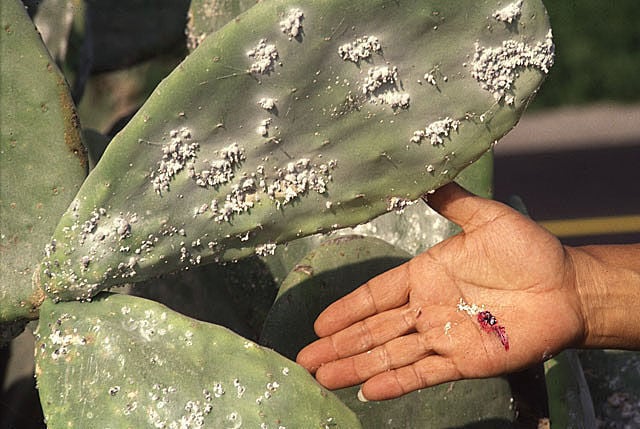
Q: I have a prickly pear with an increasing number of chalky-white splotches forming on the pads. Is this a fungus? Can it be treated? Should I just get rid of the plant? (It isn’t very big).
A: What you are seeing is signs of cochineal-scale insects (Dactylopius coccus) on your prickly pear cactus (Opuntia species). These insects produce a white waxy covering where they feed to protect themselves from predators and the environment. It can be treated with insecticides including a 1 percent solution of horticultural oil, but treating it is optional. Depending on how bad the infestation has grown, you can also leave it alone, hose it off, or in extreme cases remove infested pads. It may spread to nearby prickly pear cacti so doing nothing has its risks but the damage is usually minor.
These insects are endemic to our region and fairly commonly seen on these cacti. The interesting use of these scale insects to produce a red dye might make you think twice about keeping them around. The traditional use by indigenous people was for dying fabric. Other enterprising people later used it as a dye in things such as cosmetics and food. For some reason, not everyone likes the idea of eating insects, so they don’t usually call it that on the food or lipstick labels.
Peter L. Warren is the urban horticulture agent for the Pima County Cooperative Extension and the University of Arizona. Questions may be emailed to

- By Peter L. Warren Special to the Arizona Daily Star
- Updated
Q: Tiny black insects are making lace out of the leaves of my Yellow Bells. I spray with Sevin twice a day but it has had no effect.
A: The tiny black insects are actually the frass (aka poop) from tiny caterpillars. These caterpillars are sometimes called the Tecoma leaf tiers or sesame leaf tiers (Antigastra catalaunalis) due to the way they wrap themselves in leaves with their silk when ready to pupate. Before that happens they chew on the top leaves, the new growth, of Tecoma stans (yellow bells). Sevin should work on these caterpillars although applying it twice a day seems like way too much. Please check the label to see how often they recommend spraying. I am surprised it isn’t working. You might be spraying at a time when they aren’t active or in the line of fire. Sevin is a nerve poison that works when contacted or eaten so the caterpillars need to be present at the time you spray or soon after.
The unfortunate thing about Sevin is that it is toxic to beneficial insects including honeybees. Another insecticide you can use instead is Bt (Bacillus thuringiensis). This insecticide, sometimes sold as Dipel, can be sprayed on the leaves in the area where they are feeding.
The nice thing about Bt is it won’t harm other insects that might help you by eating the caterpillars.
Peter L. Warren is the urban horticulture agent for the Pima County Cooperative Extension and the University of Arizona. Questions may be emailed to

- By Peter L. Warren Special to the Arizona Daily Star
- Updated
Q: Attached is a picture of a barrel cactus in our yard that has begun to turn brown in recent weeks. This is the third one to do this in the last six to 12 months. What might be causing this and what can be done to prevent it? Is there any hope of salvaging a barrel once this begins?
A: It looks like an internal soft rot caused by species of Pythium, a soil borne pathogen that is favored by moist conditions. Pythium species can cause root and/or crown rot if plants are placed in the ground too deeply when transplanted or are wounded and then over-watered.
If a wound occurs before or during monsoon season, it could become infected through exposure to rain water carrying the pathogen. If you plan to replace this barrel with another, please keep in mind that barrel cacti should be planted so that the roots are placed firmly in the soil but no soil is placed around the base of the plant. Since the rot is internal, it is often too late to treat cacti once disease is detected. The best prevention is proper planting and watering.
Peter L. Warren is the urban horticulture agent for the Pima County Cooperative Extension and the University of Arizona. Questions may be emailed to

- By Peter L. Warren Special to the Arizona Daily Star
- Updated
Q: My neighbor and I planted an ash tree about a year and a half ago and it appears to have done well. However, now I’m noticing that its leaves are browning distally. Can you tell us what may be occurring here and thoughts on a remedy?
A: The symptom you are seeing is often due to lack of water and salt buildup in the root zone. Since the tree was planted fairly recently, you also need to consider that the roots are still getting established in the new location. Trees lose a majority of their roots when harvested and transplanted, so it can take a couple three years for the roots to grow back and for the tree to resume normal growth. The therapy for both of these situations is infrequent deep watering.
Ash trees naturally grow near water and in a desert landscape they need a good soak to a depth of 24 to 36 inches every two weeks during the summer and every three weeks in the spring, fall, and winter. If it hasn’t been getting this much irrigation, that is likely the problem.
Peter L. Warren is the urban horticulture agent for the Pima County Cooperative Extension and the University of Arizona. Questions may be emailed to
- By Peter L. Warren Arizona Daily Star
- Updated
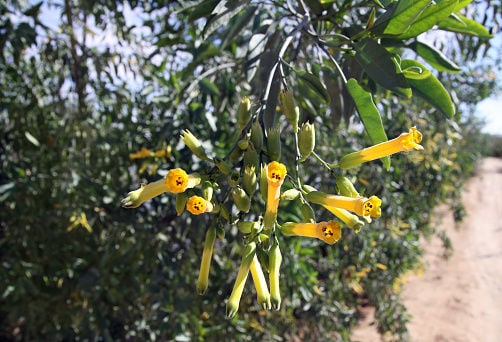
Q: Hearty “volunteer” plants have recently emerged within our side yard. No clue as to what this plant is. We suspect the seeds might have been deposited by visiting birds. Would be ever so pleased if plant could be of use for nectar-feeding hummingbirds. Would appreciate your assistance with plant identification and/or description of place within the great environmental scheme of things! Do hope the plant has positive place, as we have grown quite attached to its presence!
A: That is Nicotiana glauca, aka tree tobacco. It is native to South America and was introduced to the United States in the early 1800s as a landscape ornamental. It is moderately invasive and spread by seed that is moved around by rain mostly, although some animal ingesting could come into play. Some people like it for the flowers and others think it’s a weed. Like some other members of the Solanaceae plant family, tree tobacco is poisonous so be careful. Hummingbirds are the main pollinators of this plant due to the tubular flowers so you should see that benefit. You may find bees robbing nectar by chewing a hole in the side of the flowers.
Peter Warren is the urban horticulture agent for the Pima County Cooperative Extension and the UA. Questions may be emailed to tucsongardensage@gmail.com

- By Peter L. Warren Arizona Daily Star
- Updated
Q: I had a lawn in bad shape and recently had it completely replaced with new more shade-tolerant Bermuda. However after a few days it is becoming a field of nutgrass. Apparently they did not remove enough soil. Now what? I read online that there are specific herbicides that can be applied weed by weed repeatedly, and they will eventually work. Do you have one to recommend? Will it harm the new turf? Or do we have to start over?
A: Nutgrass, aka nutsedge, is a prohibited noxious weed in Arizona. There are actually two species, yellow nutsedge (Cyperus esculentus) and purple nutsedge (Cyperus rotundus). Even though they are sometimes called nutgrasses, they are sedges rather than grasses. You can tell the difference by grabbing the stem. Grasses have round stems and sedges have triangular stems. We say, “sedges have edges” because it’s the easy way to remember. These are tough perennial weeds that reproduce by rhizomes and tubers that are sometimes called nuts or nutlets even though they aren’t; they only resemble nuts in size and shape. Management of nutsedge is difficult. The best method is prevention by making sure they don’t get delivered with topsoil or new plants. Once established there are some herbicides that have some effect on nutsedge populations. According to UA turf specialist, Dave Kopec, when you find nutsedge in bermudagrass, you can choose from a handful of herbicides that can be used on nutsedge. They include Image (imazaquin), Sedgehammer (halosulfuron), Monument (trifloxysulfuron), Certainty (sulfusulfuron), Katana (flazosulfuron), and Dismiss South (mixture).
Peter Warren is the urban horticulture agent for the Pima County Cooperative Extension and the UA. Questions may be emailed to tucsongardensage@gmail.com

- By Peter L. Warren Arizona Daily Star
- Updated
Q: These caterpillars are everywhere!! Can’t walk outdoors without stepping on them. Also climbing garage doors etc. What kind of moth will they become?
A: These are the white-lined sphinx moth caterpillars (Hyles lineata). They are a well-known species because they can be found across most of the United States. The moths may be seen flying during the day and are sometimes referred to as hummingbird moths because they may be seen feeding on flowers while hovering. At this time of year the caterpillars are seen in great numbers as they feed on plants and then seek places to pupate for a couple of weeks before they emerge as adult moths. The caterpillars can be found eating a variety of plants, but they don’t do significant damage most of the time so they are not considered to be a pest worth managing. An interesting feature of this caterpillar is the variety of shades of yellow and green they take on as they mature. This is interesting enough that there is someone conducting research to study the differences.
Interested in being a citizen scientist? You can help by reporting your caterpillar findings by sending photos of these caterpillars to a PhD student at the UA. Her name is Cristina Francois, and her email is cfrancois@email.arizona.edu. She does visual surveys on the color ratios that they present, what plants they are eating, what other animals might be eating them, etc. All very important to understanding what ecological role this animal plays.
Peter Warren is the urban horticulture agent for the Pima County Cooperative Extension and the UA. Questions may be emailed to tucsongardensage@gmail.com

- By Peter L. Warren Arizona Daily Star
- Updated
Q: This is the first year we’ve had this much of a problem with splitting, rotting and dropping oranges from our orange tree. The tree is a semi dwarf Naval Orange tree that we planted about 10 years ago. It is now well over 10 feet tall and has been producing an abundance of oranges. I generally spray it two to three times a year for the fruit flies (with blue wings) that raise Cain eating the leaves and such. I’ve only gotten to them once this year. My problem is shown in the attached pictures. We’ve lost a good two-dozen oranges in the last month to this. Some fall off, and I see others that I have to take off the tree. Have you any ideas as to what may be causing this and what I can do to stop it?
A: Split fruit is generally a symptom of uneven irrigation. It’s no surprise it would happen now with the rain we have received recently. The way to mitigate the splitting problem is to provide enough irrigation during the dry parts of the year and make sure to turn down the irrigation when you receive rain. As Ben Franklin once said, “Moderation in all things — including moderation.” The recommended irrigation for citrus is once every seven to 10 days during the summer to a depth of 36 inches, once every 10 to 14 days in the spring and fall, and once every 14 to 21 days in the winter. By the way, you don’t need to spray your tree for fruit flies or any other insects for that matter. Most citrus insects are minor pests and only cause cosmetic damage to the tree and don’t affect fruit production or quality. So unless you are selling your oranges at the grocery store you can skip the insecticide. The big exception down the road would be the citrus psyllids that spread the citrus greening disease. So far we aren’t seeing this disease here.
Peter Warren is the urban horticulture agent for the Pima County Cooperative Extension and the UA. Questions may be emailed to tucsongardensage@gmail.com
- By Peter L. Warren Special to the Arizona Daily Star
- Updated
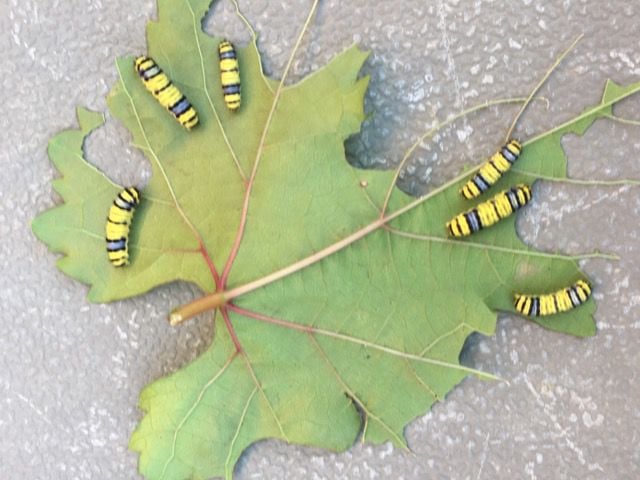
Q. Can you help identify these guys on my grapes?
A: These are the western grape leaf skeletonizers (Harrisina brillians). They are moth caterpillars and they can do quite a bit of damage to grape plants if allowed. Fortunately, there are some natural enemies out there that sometimes keep them in check. Bacillus thuringiensis (Bt) is a good organic insecticide for these caterpillars but it works best when they are small. Simply apply to the leaves where they are feeding as directed on the label. Also be careful when handling these caterpillars because they possess stinging hairs on their bodies that can cause some irritation on your skin.
Peter L. Warren is the urban horticulture agent for the Pima County Cooperative Extension and the University of Arizona. Questions may be emailed to tucsongardensage@gmail.com

- By Peter L. Warren Special to the Arizona Daily Star
- Updated
Q: I live in the Green Valley area and my cherry tomato plants are 4 feet tall and somewhat scraggly. Some blooms and a few fruit. My question: Is it too early to prune back and how much to prune, half, a third, two-thirds? No hornworms yet, I just jinxed that..
A: The rule of thumb is don’t prune more than a third of your plant at a time. Tomatoes can be left alone and don’t require pruning but you may improve your yield by removing the suckers from indeterminate plants like yours. Suckers are the growth from the stem at an approximately 45-degree angle between the leaves and the fruiting part. They grow right out of the crotch between those two and the energy spent growing suckers takes away from energy used to produce the fruit. The other reasons to prune are to allow for air and light to reach the leaves or to keep the leaves off the ground. If your plants are scraggly, this might not be a concern until they put out more leaves. Also at 4 feet tall they might need some support. Hopefully you are already using a trellis or a stake.
Peter L. Warren is the urban horticulture agent for the Pima County Cooperative Extension and the University of Arizona. Questions may be emailed to tucsongardensage@gmail.com
- By Peter L. Warren Special to the Arizona Daily Star
- Updated
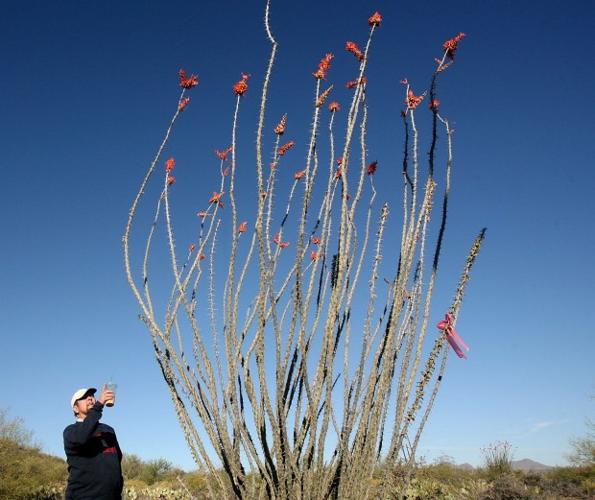
Q: My wife and I have had a several-months-long debate regarding an ocotillo that we transplanted. She says its dead. I say it’s just fine. The plant has several stems coming from the middle of the base of the plant that remain green. There are many shoots as well that are white in color. We transplanted it about 20 months ago. I also thought I read on an Arizona horticulture site that it can take two to three years before we start to see the green leaves on the plant. Is the plant OK? Not that I know anything (I’m a Midwesterner), but I have to believe as long as we see green, we will eventually see leaves growing back on the plant.
A: For most shrubs and trees, the shock of transplanting can set growth back a bit. The larger the plant, the longer it usually takes to recover and resume significant growth. Two to three years is a long time to wait but for woody plants that is sometimes how long it takes to see appreciable aboveground growth. If you were able to dig up a good portion of the roots when you transplanted, that would be a good start for the plant. Hopefully the spot you chose is similar desert soil with full sun exposure and you didn’t plant it too deep. Ocotillos do best in well-drained native soil. If all this is true, you are probably OK. Judging from your estimate of 20 months planting time, you transplanted in the cool part of the year and that is good as well. These plants can use a good, deep soak of water every two to three weeks when it’s not raining. The green parts should be encouraging and you might see some leaves following the monsoon rains.
Peter L. Warren is the urban horticulture agent for the Pima County Cooperative Extension and the University of Arizona. Questions may be emailed to tucsongardensage@gmail.com

- By Peter L. Warren Special to the Arizona Daily Star
- Updated
Q: I found these in my garden. They are eating my tomatoes and eggplants. What is the best natural way to get rid of these critters?
A: These are tobacco hornworms (Manduca sexta). From the photo, you are already using the best natural method of getting rid of hornworms. Picking them off is as effective as any pesticide you might use. This is sometimes a challenge because they are the same color as the plant. Just look for damaged or missing leaves and they won’t be too far away. You can just toss them aside or feed them your chickens if you have chickens. The trick is to examine your plants once a week so you catch them while they are still small and not eating as much. If you don’t get a thrill from the hunt and want to try something else, the organic insecticide Bacillus thuringiensis (Bt) is effective against the very small caterpillars. It is sometimes sold under the brand name Dipel. Simply apply it to the foliage as directed. This strain of Bt is toxic to caterpillars but nobody else. It may require repeat applications during the caterpillar-growing season because rain will wash it off the leaves and it degrades in the sun. Also, planting a variety of flowering plants around your vegetable garden will bring in some beneficial insects that may parasitize these caterpillars. The wasps that sting them feed on the pollen in your flowering plants and lay their eggs in the caterpillars.
Peter L. Warren is the urban horticulture agent for the Pima County Cooperative Extension and the University of Arizona. Questions may be emailed to tucsongardensage@gmail.com
- By Peter L. Warren Special to the Arizona Daily Star
- Updated
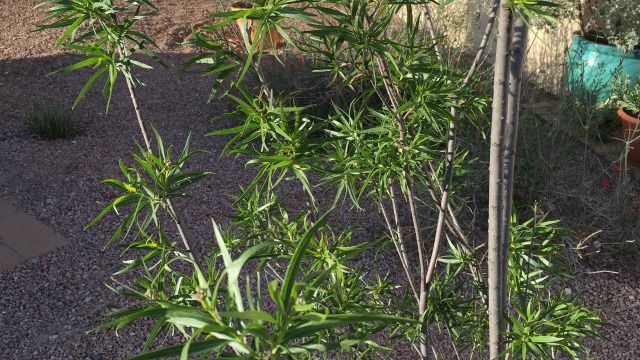
Q: I am sending two photos of my desert willow tree, now in its fourth spring. The buds form, grow and then dry out before opening. Have taken samples to Mesquite Valley. They saw no evidence of pests or disease and recommended more water and fertilizer. The leaves seem smaller, shorter than others I see. I don’t want to give up on it. Any advice?
A: Based on the photos, I agree with Mesquite Valley. Smaller leaf size and dropping buds and flowers are symptoms of drought. If you aren’t already doing so, make sure it gets water every two or three weeks to a depth of 24 to 36 inches during the spring, fall, and summer. Obviously, you can skip that during the monsoon season if it receives sufficient rain. These plants don’t require a lot of fertilizer so that might not be required more than once in the spring and then again in the fall.
Peter L. Warren is the urban horticulture agent for the Pima County Cooperative Extension and the University of Arizona. Questions may be emailed to

- By Peter L. Warren Special to the Arizona Daily Star
- Updated
Q: We are curious to know the identity of a tree we saw in a park, surviving the Southwest climate that has leaves that look like a maple and a round spiky seed pod. Can you tell us?
A: I am guessing you saw a sycamore tree. Sycamore trees are found across the U.S. The native variety we have in Arizona is sometimes called the Arizona sycamore (Platanus wrightii). It is also possible to find the hybrid London plane tree (Platanus x hispanica) in these parts. The Arizona native leaf shape looks more like the California native western sycamore (Platanus racemosa) and some say they are the same tree with variations due to the geographical separation between Arizona and California. The eastern American sycamore (Platanus occidentalis) more closely resembles the London plane tree in leaf shape. TMI? All these are fairly large trees for their habitats and they require lots of water to survive. In their native habitat, they are found growing near water. They are considered tough urban trees so you can find them in shopping centers but they are often stressed by the surrounding hardscape and don’t live as long as their rural relatives.
Peter L. Warren is the urban horticulture agent for the Pima County Cooperative Extension and the University of Arizona. Questions may be emailed to
- By Peter L. Warren Special to the Arizona Daily Star
- Updated
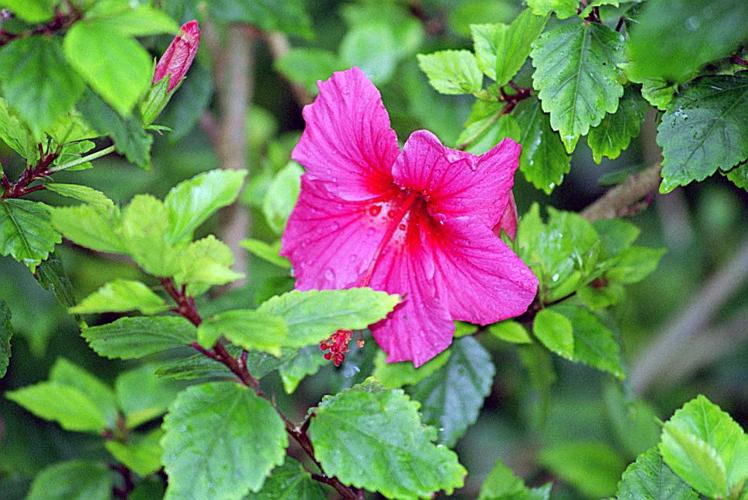
Q: This past year I bought a healthy hibiscus and put it in a 5-gallon pot. I watered the plant, fed it, etc. The hibiscus looks healthy but it hasn’t given me any flowers. I don’t know what I am doing wrong. I am wondering is it possible that the soil just isn’t good?
A: There are a few reasons why plants don’t bloom and they mostly have to do with basic needs: light, water, and soil. Make sure your plant is located in a spot where it will receive the sunlight it requires. Hibiscus is a plant that does well in the sun but not always in the desert sun. Depending on which hibiscus you planted, it might be best at an east-facing window to provide enough sun and still protect it from the intense western sun in the afternoon. This plant also requires well-drained soil so make sure your pot has a way to drain in case you add too much water. Adding fertilizer to your irrigation water will help keep the nutrients available. Containers don’t hold fertilizer as well because they require more frequent watering. Watering should be done before the soil completely dries. You can just poke around with your finger to test if the soil is still moist below the surface.
Peter L. Warren is the urban horticulture agent for the Pima County Cooperative Extension and the University of Arizona. Questions may be emailed to
- By Peter L. Warren Special to the Arizona Daily Star
- Updated
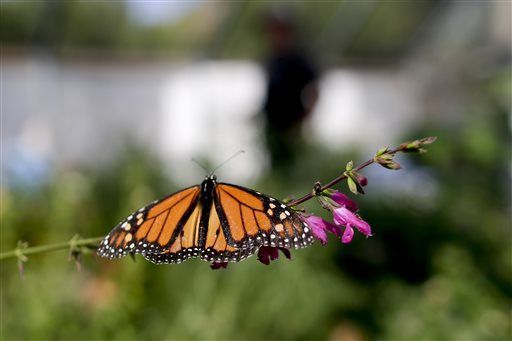
Q: My yard in downtown Tucson has been devoid of bees and butterflies this spring and summer, the first time in seven years here that there has been a noticeable lack of insects. There are very few to no moths or mosquitoes in the evening — outdoor lights at night illuminate no insects hovering about. Even the bat population is nonexistent because there are no bugs for the bats to eat. I am wondering if anyone else in Tucson, or near the downtown Tucson area, has noticed the lack of pollinators this year. I also wonder if any kind of municipal spraying has contributed to the lack of insects this year.
A: I can’t speak for everyone, but my midtown environment is loaded with insects and bats. Each area is potentially subject to a variety of influences such as irrigation, weather, available food plants, available bat habitat and pesticides. It’s hard to say why your yard is devoid of all these creatures without more information about what is and has been going on with regard to your landscape and the surrounding area. In my conversations with the city departments that manage the municipal landscape I learned that they use very few insecticides on city property so that is not likely the reason.
Peter L. Warren is the urban horticulture agent for the Pima County Cooperative Extension and the University of Arizona. Questions may be emailed to
- By Peter L. Warren Special to the Arizona Daily Star
- Updated
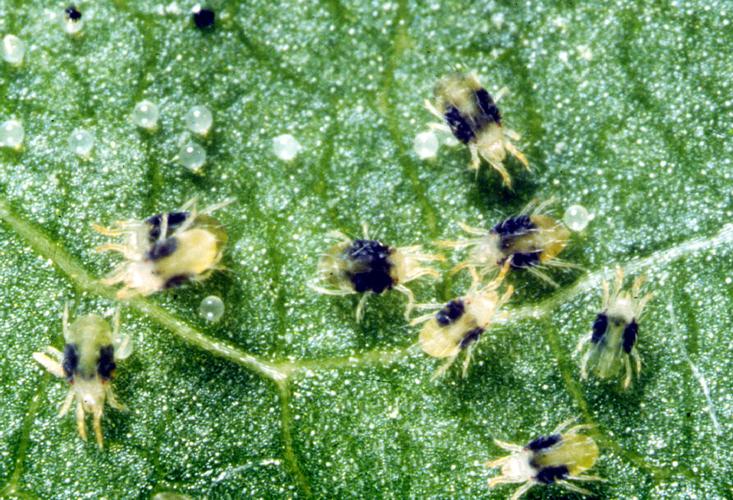
Q: Every year at this time I have a problem with spider mites attacking my orange jubilee and torch bougainvillea. I’ve tried everything but nothing seems to stop them (except hosing them down). Any suggestions?
A: The hose is a good solution, especially in drier times of the year. Since mite infestations are directly proportionate to increasingly warmer and drier temperatures, it would be best to keep an eye on these plants early in the spring and knock back the populations before they get out of hand. Also be sure to maintain the overall health of the plant so it can better handle the pest pressure. Irrigate in dry weather, of course, and avoid over fertilization because the extra nitrogen makes them more attractive. In addition to the hose, infested areas can also be sprayed with insecticidal soap and horticultural oil products. During the winter or early spring control can be obtained with a dormant oil application in many cases. During the summer or growing season use a miticide or insecticidal soap. Check local stores to see what’s for sale. Most insecticides are not effective on mites and some, especially broad-spectrum products such as carbaryl (Sevin) result in increased mite damage by killing their natural enemies. The important thing is to check the label to make sure a product is not hazardous to beneficial predators. And of course any time you use a pesticide it is important to read the label for your own safety and the safety of nontarget organisms around the area.
Peter L. Warren is the urban horticulture agent for the Pima County Cooperative Extension and the University of Arizona. Questions may be emailed to

- By Peter L. Warren Special to the Arizona Daily Star
- Updated
Q: I have a number of Afghan pines that have some whitish cottony stuff on the ends of many branches. Can you tell me what this is and if it is a problem?
A: The pine samples I collected show signs of insects in and around where the needles attach to the stem. These insects are called adelgids and they make the white, cottony material to protect them from the environment. High populations can cause yellowing, early drop of needles, drooping and dieback of terminals, and can slow the growth of trees. Vigorous plants tolerate moderate adelgid populations so the best plan is to keep your trees healthy. Appropriate watering and fertilization is important. These trees need deep watering every seven to 14 days in the summer to a depth of 24 to 36 inches. In the spring and fall, water them every 10 to 21 days and in the winter every 14 to 21 days. Avoid excess fertilization and quick-release formulations, which can promote adelgid populations. A forceful stream of water directed at the cottony masses dislodges and kills many adelgids when they are active in the spring.
Peter L. Warren is the urban horticulture agent for the Pima County Cooperative Extension and the University of Arizona. Questions may be emailed to

- By Peter L. Warren Special to the Arizona Daily Star
- Updated
Q: We have an infestation of fungus gnats inside our house. We have had our bug service spray the plants, the windows, everything twice. They have put granular insecticides in each plant soil twice,and even tried mosquito crystals. Then we had the two rooms containing the plants bombed. Our exterminator used PT Pro-Control Formula 2 (one can in each room). We completely sealed off the rest of the house. Two days later they were back, about 40 percent of what they were. We have a fluorescent light that has a sticky back that we were filling up nearly daily; now it takes about two days to fill. But we still have the gnats. Do you have any suggestions on how to get rid of these persistent bugs?
A: Fungus gnats are often found in places that are moist, have decaying plant matter, and, of course, fungus. The larvae of these flies feed on the fungus so that is where the adults lay their eggs. The management method that works best is making the habitat less inviting. With indoor plants this often means less watering to allow the soil to dry out between watering, killing off the fungus. You can also repot and lightly prune plants that seem to have a lot of decaying material and fungus present. There are products that are effective against the gnats but if you continue to provide the fungal habitat, they will be back. Sticky traps are great for monitoring your progress in reducing the population and their habitat.
Peter L. Warren is the urban horticulture agent for the Pima County Cooperative Extension and the University of Arizona. Questions may be emailed to

- By Peter L. Warren Special to the Arizona Daily Star
- Updated
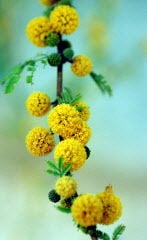
Q: I have the weed in the attached picture growing after lots of summer monsoon weather in Tucson. Can you help me identify it?
A: The plant is called Coulter’s spiderling (Boerhavia coulteri) and it’s an annual in the four o’clock family (Nyctaginaceae). It can be easily found in washes and flat areas in the Sonoran Desert. I have some in my yard if you need any. It spreads like a groundcover, it produces spikes of tiny pink flowers, and it reproduces by seed. It’s native to the Southwest and found throughout most of the state. It is especially noticeable in summer in Southern Arizona. Some call it a weed and others call it a wildflower since it’s a native. It certainly grows like a weed so you have to decide if you like it enough to keep it or dislike it enough to pull it up before it produces seed.
Peter L. Warren is the urban horticulture agent for the Pima County Cooperative Extension and the University of Arizona. Questions may be emailed to
- By Peter L. Warren Special to the Arizona Daily Star
- Updated
Q: We have sweet acacia trees at the entrance of a property in Chandler that are having severe limb breakage and dieback lately. It looks like borer signs and I’m wondering if there is a good alternative tree I can recommend to the HOA board. Would a Red Push Pistache work well here? There are also a few ash trees that are showing similar signs throughout the same neighborhood. Do you think this could be caused by the same borer/pest?
A: The acacia tree in your photos is indeed suffering but in this case the borers are likely only a symptom rather than the cause. The holes indicate flat-headed borers and most species in this family of beetles are attracted to dead and dying trees. I recommend checking the history of irrigation practices for these trees. The species you mentioned should be receiving water every seven to 14 days during the summer to a depth of 24 to 36 inches. You can back this off to once every 10 to 21 days in the spring and fall, and every 14 to 21 days in the winter. The red push pistache is a good substitute as long as there is space for its mature size. It would likely have the same issue with irrigation if that were the problem so it would be good to address that before replanting. Since different tree species have somewhat different pests, it would be difficult to say the ash trees are having the same problem without seeing them.
Peter L. Warren is the urban horticulture agent for the Pima County Cooperative Extension and the University of Arizona. Questions may be emailed to tucsongardensage@gmail.com

- By Peter L. Warren Special to the Arizona Daily Star
- Updated
Q: We have a very large/old saguaro in our front yard, as well as some other barrel cacti and other saguaros. About two years ago, we discovered we had the beginning of termite damage in our ceiling (attic space). We had the home treated and no problems since. The termite company said they were subterranean termites and that we may see the termites move and begin to do minimal damage to other wood outside the home. I started noticing what I believe are termite tunnels on our large saguaro. The damage became more evident later as the tunnels turned into craters left on the saguaro. The saguaro seems to be surviving. Now I’m noticing what looks like evidence of termites in the barrel cacti. Should we be treating the termites attacking the cacti or will they cause minimal damage and move on to other sources? Are they also subterranean termites and could you recommend a treatment that would not harm the succulents?
A: Termites on cacti are fairly common and don’t need to be treated. Termites are only interested in the dead wood on the outside of your cacti and can coexist with these plants. They are likely desert-encrusting termites (Gnathamitermes perplexus) rather than the subterranean variety that infested your attic. Termites are categorized as decomposers and they help recycle dead plant material into soil. It’s only when they get into our homes that we should be concerned and you already took care of that part.
Peter L. Warren is the urban horticulture agent for the Pima County Cooperative Extension and the University of Arizona. Questions may be emailed to tucsongardensage@gmail.com
- By Peter L. Warren Special to the Arizona Daily Star
- Updated
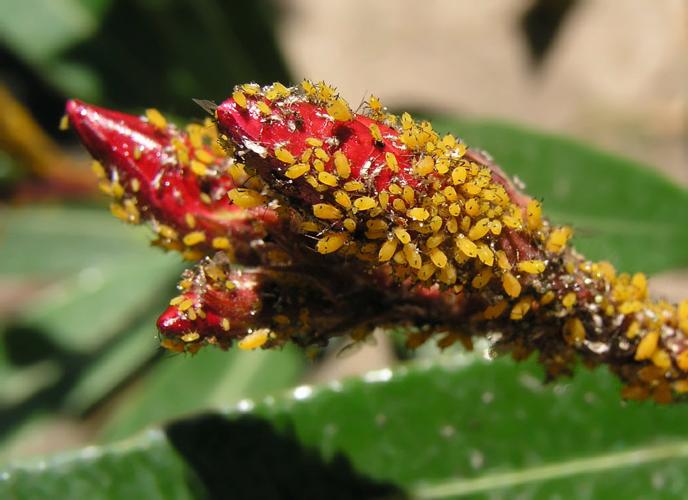
Q: Please tell me if these yellow insects are harmless. They are multiplying fast but only on these flowers.
A: They aren’t harmless but in the grand scheme of things, they aren’t terrible either. Aphids as a family will suck sap from your plants and reduce their vigor. The good news is they are tiny and each one does very little damage. This species are sometimes called oleander aphids (Aphis nerii) and they prefer certain types of plants such as milkweed and oleander. A simple spray with your hose once in a while will keep the population down enough to protect your plants.
Peter L. Warren is the urban horticulture agent for the Pima County Cooperative Extension and the University of Arizona. Questions may be emailed to tucsongardensage@gmail.com

- By Peter L. Warren Special to the Arizona Daily Star
- Updated
Q: Since there are so many fig beetles this year, I wonder if I need to treat the soil with nematodes to stop the larvae from eating my vegetable roots. What do you advise?
A: The fig beetle (Cotinus mutabilis), also known as figeater, June beetle, green fruit beetle, or June bug, isn’t as harmful as you might expect. The adults that are plentiful now are seeking nectar and fruit juice from wherever they can. They aren’t the best fliers and so we find them crashing into things as they search for food. I found them very entertaining while eating outside this week. Not every restaurant patron is as excited to see them though so it’s fortunate they won’t be around for very long. They are attracted to ripe figs, as their common name suggests, although they are more likely taking advantage of holes in ripe fruit made by birds and other animals. They can be found on a wide variety of plants including fruit trees, flowering landscape plants with accessible nectar, tomatoes, and cacti. Their larvae are often found in garden compost and other decaying organic matter. They don’t feed on roots like their relatives back east so you don’t need to treat the soil to control them.
Peter L. Warren is the urban horticulture agent for the Pima County Cooperative Extension and the University of Arizona. Questions may be emailed to tucsongardensage@gmail.com

- By Peter L. Warren Special to the Arizona Daily Star
- Updated
Q: My neighbor moved into her home last October. The prior owner was from San Diego so she had many Southern California plants in her yard. Just after our latest monsoon she noticed some plants coming up and only a day or two later one had this beautiful pink lily-type flower. The other stalks flowered in the next days and the flowers last a few days, there are no leaves. Any idea what type of plant this is?
A: The plants are a type of lily (Amaryllis belladonna) that are sometimes called naked ladies due to the way they flower without foliage on naked stems. They are native to South Africa and widely popular as a bulb. They are suitable for our landscapes, as they don’t require much water.
Peter L. Warren is the urban horticulture agent for the Pima County Cooperative Extension and the University of Arizona. Questions may be emailed to tucsongardensage@gmail.com

- By Peter L. Warren Special to the Arizona Daily Star
- Updated
Q: I saw a recent post about not recommending cat claw to cover a chain-link fence because it tends to congregate at the top. I have the same situation. I have a chain-link fence and would like to plant vines to create a “green” fence and hide the chain link. I liked the cat claw because of its low water use; it’s fast-growing and has year-round green leaves. If not cat claw, what do you recommend?
A: You are correct; the cat claw tends to clump at the top. A nice alternative is star jasmine (Trachelospermum jasminoides). This is a beautiful evergreen vine with thick, leathery, dark-green leaves and fragrant clusters of white, star-shaped flowers in great profusion each spring. Part shade is best, but it will tolerate more sun if planted in deep, well-prepared soil and watered generously. East or north exposure is desirable in low-desert areas. It can be used near a patio or house where the sweet fragrance can be enjoyed to the fullest. It is also effective spilling over a planter wall or billowing up a post. This plant spreads widely, so you don’t have to buy a lot of them unless you have a lot of fence. One every 6 to 8 feet should do it. If this description doesn’t meet your requirements or you want to see what else is available, you might check out our publication available online called “Landscape Vines for Southern Arizona” (AZ1606) or visit a local nursery .
Peter L. Warren is the urban horticulture agent for the Pima County Cooperative Extension and the University of Arizona. Questions may be emailed to tucsongardensage@gmail.com

- By Peter L. Warren Special to the Arizona Daily Star
- Updated
Question: Last week I discovered more than 30 dead or dying fig beetles under a desert willow that grew from seed near the foundation of my home. We had decided to leave the tree, and it has grown at an angle away from the home and is now about 6 years old and as tall as the house (maybe 14-16 feet). I picked up the beetles, but every day since there has been a similar number of dead or dying beetles. So in the past week we have had more than 200 dead beetles and dozens of dead or dying bees and wasps, mostly carpenter bees, a few blue mud daubers and various other striped bees and wasps I could not identify. My first thought because of the tree’s close proximity to the house is that the pesticides that are applied every other month may have been systemic and been absorbed by the tree and put out in its nectar and pollen, especially since the bugs are all nectar drinkers and are all on their back with their legs twitching the way they do when killed by pesticides. I called the pest-control company and they insisted this was not the case. My exterminator uses bifenthrin, which according to info I can find is not systemic. All the info I can find seems to indicate the fig beetle mates and leaves their eggs in turf, so my thought that they were mating and reaching the end of their life cycle in my tree seems inaccurate. I worry about this because we were planning on putting in a raised vegetable garden in that corner of the yard.
A: Bifenthrin is not a systemic but rather a contact poison and an effective tool against a variety of insect pests. It will kill all of the insects you mentioned and is toxic to bees. It shouldn’t be sprayed on or near flowering plants, to protect pollinators and other nectar feeders. You will need to avoid spraying bifenthrin in a raised vegetable garden, so you might want to ask your pest-control company which pests they are seeing in that part of your yard to determine if they might be pests of your garden. While you are at it, you might evaluate the need for a regular insecticide treatment. Sometimes a calendar spray is recommended, but many times it is just recreational pesticide use. It really depends on the pest problem you are addressing.Make sure you know what pests they are seeing and ask them to show you specimens so you aren’t paying and spraying for no good reason.
Peter L. Warren is the urban horticulture agent for the Pima County Cooperative Extension and the University of Arizona. Questions may be emailed to tucsongardensage@gmail.com
- By Peter L. Warren Special to the Arizona Daily Star
- Updated
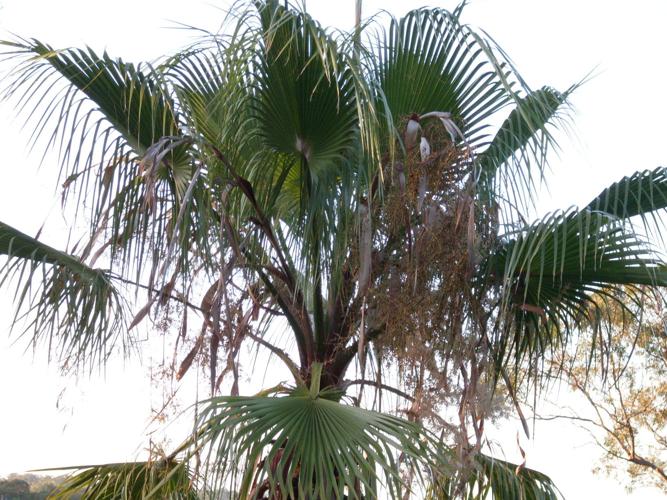
Q: We have this Mexican Fan Palm (I think) that faces Southwest where all our wind and rain come from. We have been told to clean off the damage because it's a home for insects and some have told us no as it protects the tree. It is a great tree protecting us from golf balls and providing morning shade to our patio. What should we do?
A: The so-called damage is really just the base of old leaves; what is left on the outside of the tree after years of fronds sloughing off as it grows. To some extent the leftover parts do protect the tree and they are a potential home for insects and birds. I like insects and birds so it’s not a problem for me. Cleaning up the tree is optional. Some people think these leaf bases add to the character of the trees and others think they look messy so it’s really your call. The tree will eventually self-clean by dropping them as it ages.
Peter L. Warren is the urban horticulture agent for the Pima County Cooperative Extension and the University of Arizona. Questions may be emailed to tucsongardensage@gmail.com

- By Peter L. Warren Special to the Arizona Daily Star
- Updated
Q: I just noticed your great pruning information in the paper, and I have a question. I planted this palo brea last year, in hopes that over time it would become a tallish beautiful tree that with a high arching branching pattern (surely at a minimum that we can walk under). The info you provided only addresses deciduous trees. I wonder if, when, and how to prune the branches. Also, any suggestion about staking so that it grows pretty straight up, or is that unnecessary?
A: The mature size of the palo brea (Parkinsonia praecox) is 20 to 30 feet tall with an even wider spread so I expect your hope for a beautiful shade tree will be realized in time. It’s hard to tell from your photo but it appears you allowed enough space for this desert specimen to reach mature size without any restrictions.
Because it spreads so wide, it isn’t for every landscape. Pruning shouldn’t be a big deal because it has adequate space. The normal pruning we give to trees to remove damaged, crossing, and rubbing branches should be sufficient. If you need more advice on pruning, please let me know.
Staking is typically done for the first year or so if a newly planted tree requires it. Trees need to be able to sway a bit in the breeze to develop the necessary trunk flare that will support it for many years to come. Staking too tightly and for too long inhibits this development.
Peter L. Warren is the urban horticulture agent for the Pima County Cooperative Extension and the University of Arizona. Questions may be emailed to tucsongardensage@gmail.com
- By Peter L. Warren Special to the Arizona Daily Star
- Updated
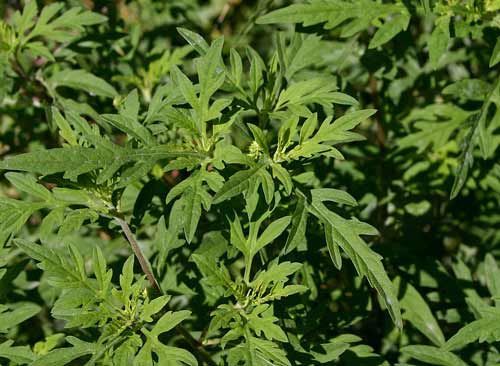
Q: I recently removed a large amount of entangled vines and plants from around the back of my home. They had been there since before I purchased it in 1969. I would like to get rid of the roots before they start growing new sprouts so I can plant a garden. They cannot be dug out because they are really embedded into the house foundation. A friend suggested Round Up but I do not want anything toxic. I have two desert tortoises that live there, and a cat.
A: Roundup and similar products made with the active ingredient glyphosate are toxic to desert tortoises, among other things, so I am glad you asked before experimenting. Your best solution is the one you already used. Keeping the weeds under control by continued and persistent removal of the above ground green parts will eventually starve the plants.
Without the ability to photosynthesize, there won’t be any food to send to the roots and eventually they will die. Unfortunately, this doesn’t happen quickly much of the time, especially if the weeds have been growing since 1969. But don’t let that discourage you. If we could put a man on the moon, we should certainly be able to kill a few weeds.
Peter L. Warren is the urban horticulture agent for the Pima County Cooperative Extension and the University of Arizona. Questions may be emailed to tucsongardensage@gmail.com

- By Peter L. Warren Special to the Arizona Daily Star
- Updated
Q: I am looking for a yellow flowering vine I can grow in a large 36-inch pot. It is south facing with late afternoon west filtered sun. I’m thinking the primrose jasmine might be a good choice to grow up onto the wooden arbor we have on our south-facing arbor. What do you think?
A: I think you have a good idea. Primrose jasmine (Jasminum mesnyi) is a sprawling evergreen shrub that has slender arching branches 5 to 10 feet long and bright yellow double flowers 1 to 2 inches across in mid to late winter.
It develops a vine-like growth habit when branches are tied to a trellis and allowed to trail down so your arbor would work well. It makes an attractive mounding foundation plant 3 feet high if cut back once a year. It grows best in full sun or part shade and is an interesting specimen plant with graceful cascading growth habit and early flower display.
Peter L. Warren is the urban horticulture agent for the Pima County Cooperative Extension and the University of Arizona. Questions may be emailed to tucsongardensage@gmail.com

- By Peter L. Warren Special to the Arizona Daily Star
- Updated
Q: Three years ago I bought a bonita ash tree because of its size, beauty, easy maintenance, and short period of leaf dropping. So impressed over the past year I was instrumental in the planting of four more in our little community. Once established how often do you feel they need to be watered?
A: The recommended water schedule for ash trees is once every seven to 10 days during the summer to a depth of 24 to 36 inches. In the spring and fall you can back it off to once every 10 to 21 days and in the winter every 14 to 21 days.
Also, I assume you are using drip irrigation arranged in a circular fashion around the drip line of the tree. When they are young you can get away with a hose at the base of the tree, but not once the absorbing roots extend farther out.
Peter L. Warren is the urban horticulture agent for the Pima County Cooperative Extension and the University of Arizona. Questions may be emailed to tucsongardensage@gmail.com
- By Peter L. Warren Special to the Arizona Daily Star
Q: I have a prickly pear with an increasing number of chalky-white splotches forming on the pads. Is this a fungus? Can it be treated? Should I just get rid of the plant? (It isn’t very big).
A: What you are seeing is signs of cochineal-scale insects (Dactylopius coccus) on your prickly pear cactus (Opuntia species). These insects produce a white waxy covering where they feed to protect themselves from predators and the environment. It can be treated with insecticides including a 1 percent solution of horticultural oil, but treating it is optional. Depending on how bad the infestation has grown, you can also leave it alone, hose it off, or in extreme cases remove infested pads. It may spread to nearby prickly pear cacti so doing nothing has its risks but the damage is usually minor.
These insects are endemic to our region and fairly commonly seen on these cacti. The interesting use of these scale insects to produce a red dye might make you think twice about keeping them around. The traditional use by indigenous people was for dying fabric. Other enterprising people later used it as a dye in things such as cosmetics and food. For some reason, not everyone likes the idea of eating insects, so they don’t usually call it that on the food or lipstick labels.
Peter L. Warren is the urban horticulture agent for the Pima County Cooperative Extension and the University of Arizona. Questions may be emailed to
- By Peter L. Warren Special to the Arizona Daily Star
Q: Tiny black insects are making lace out of the leaves of my Yellow Bells. I spray with Sevin twice a day but it has had no effect.
A: The tiny black insects are actually the frass (aka poop) from tiny caterpillars. These caterpillars are sometimes called the Tecoma leaf tiers or sesame leaf tiers (Antigastra catalaunalis) due to the way they wrap themselves in leaves with their silk when ready to pupate. Before that happens they chew on the top leaves, the new growth, of Tecoma stans (yellow bells). Sevin should work on these caterpillars although applying it twice a day seems like way too much. Please check the label to see how often they recommend spraying. I am surprised it isn’t working. You might be spraying at a time when they aren’t active or in the line of fire. Sevin is a nerve poison that works when contacted or eaten so the caterpillars need to be present at the time you spray or soon after.
The unfortunate thing about Sevin is that it is toxic to beneficial insects including honeybees. Another insecticide you can use instead is Bt (Bacillus thuringiensis). This insecticide, sometimes sold as Dipel, can be sprayed on the leaves in the area where they are feeding.
The nice thing about Bt is it won’t harm other insects that might help you by eating the caterpillars.
Peter L. Warren is the urban horticulture agent for the Pima County Cooperative Extension and the University of Arizona. Questions may be emailed to
- By Peter L. Warren Special to the Arizona Daily Star
Q: Attached is a picture of a barrel cactus in our yard that has begun to turn brown in recent weeks. This is the third one to do this in the last six to 12 months. What might be causing this and what can be done to prevent it? Is there any hope of salvaging a barrel once this begins?
A: It looks like an internal soft rot caused by species of Pythium, a soil borne pathogen that is favored by moist conditions. Pythium species can cause root and/or crown rot if plants are placed in the ground too deeply when transplanted or are wounded and then over-watered.
If a wound occurs before or during monsoon season, it could become infected through exposure to rain water carrying the pathogen. If you plan to replace this barrel with another, please keep in mind that barrel cacti should be planted so that the roots are placed firmly in the soil but no soil is placed around the base of the plant. Since the rot is internal, it is often too late to treat cacti once disease is detected. The best prevention is proper planting and watering.
Peter L. Warren is the urban horticulture agent for the Pima County Cooperative Extension and the University of Arizona. Questions may be emailed to
- By Peter L. Warren Special to the Arizona Daily Star
Q: My neighbor and I planted an ash tree about a year and a half ago and it appears to have done well. However, now I’m noticing that its leaves are browning distally. Can you tell us what may be occurring here and thoughts on a remedy?
A: The symptom you are seeing is often due to lack of water and salt buildup in the root zone. Since the tree was planted fairly recently, you also need to consider that the roots are still getting established in the new location. Trees lose a majority of their roots when harvested and transplanted, so it can take a couple three years for the roots to grow back and for the tree to resume normal growth. The therapy for both of these situations is infrequent deep watering.
Ash trees naturally grow near water and in a desert landscape they need a good soak to a depth of 24 to 36 inches every two weeks during the summer and every three weeks in the spring, fall, and winter. If it hasn’t been getting this much irrigation, that is likely the problem.
Peter L. Warren is the urban horticulture agent for the Pima County Cooperative Extension and the University of Arizona. Questions may be emailed to
- By Peter L. Warren Arizona Daily Star
Q: Hearty “volunteer” plants have recently emerged within our side yard. No clue as to what this plant is. We suspect the seeds might have been deposited by visiting birds. Would be ever so pleased if plant could be of use for nectar-feeding hummingbirds. Would appreciate your assistance with plant identification and/or description of place within the great environmental scheme of things! Do hope the plant has positive place, as we have grown quite attached to its presence!
A: That is Nicotiana glauca, aka tree tobacco. It is native to South America and was introduced to the United States in the early 1800s as a landscape ornamental. It is moderately invasive and spread by seed that is moved around by rain mostly, although some animal ingesting could come into play. Some people like it for the flowers and others think it’s a weed. Like some other members of the Solanaceae plant family, tree tobacco is poisonous so be careful. Hummingbirds are the main pollinators of this plant due to the tubular flowers so you should see that benefit. You may find bees robbing nectar by chewing a hole in the side of the flowers.
Peter Warren is the urban horticulture agent for the Pima County Cooperative Extension and the UA. Questions may be emailed to tucsongardensage@gmail.com
- By Peter L. Warren Arizona Daily Star
Q: I had a lawn in bad shape and recently had it completely replaced with new more shade-tolerant Bermuda. However after a few days it is becoming a field of nutgrass. Apparently they did not remove enough soil. Now what? I read online that there are specific herbicides that can be applied weed by weed repeatedly, and they will eventually work. Do you have one to recommend? Will it harm the new turf? Or do we have to start over?
A: Nutgrass, aka nutsedge, is a prohibited noxious weed in Arizona. There are actually two species, yellow nutsedge (Cyperus esculentus) and purple nutsedge (Cyperus rotundus). Even though they are sometimes called nutgrasses, they are sedges rather than grasses. You can tell the difference by grabbing the stem. Grasses have round stems and sedges have triangular stems. We say, “sedges have edges” because it’s the easy way to remember. These are tough perennial weeds that reproduce by rhizomes and tubers that are sometimes called nuts or nutlets even though they aren’t; they only resemble nuts in size and shape. Management of nutsedge is difficult. The best method is prevention by making sure they don’t get delivered with topsoil or new plants. Once established there are some herbicides that have some effect on nutsedge populations. According to UA turf specialist, Dave Kopec, when you find nutsedge in bermudagrass, you can choose from a handful of herbicides that can be used on nutsedge. They include Image (imazaquin), Sedgehammer (halosulfuron), Monument (trifloxysulfuron), Certainty (sulfusulfuron), Katana (flazosulfuron), and Dismiss South (mixture).
Peter Warren is the urban horticulture agent for the Pima County Cooperative Extension and the UA. Questions may be emailed to tucsongardensage@gmail.com
- By Peter L. Warren Arizona Daily Star
Q: These caterpillars are everywhere!! Can’t walk outdoors without stepping on them. Also climbing garage doors etc. What kind of moth will they become?
A: These are the white-lined sphinx moth caterpillars (Hyles lineata). They are a well-known species because they can be found across most of the United States. The moths may be seen flying during the day and are sometimes referred to as hummingbird moths because they may be seen feeding on flowers while hovering. At this time of year the caterpillars are seen in great numbers as they feed on plants and then seek places to pupate for a couple of weeks before they emerge as adult moths. The caterpillars can be found eating a variety of plants, but they don’t do significant damage most of the time so they are not considered to be a pest worth managing. An interesting feature of this caterpillar is the variety of shades of yellow and green they take on as they mature. This is interesting enough that there is someone conducting research to study the differences.
Interested in being a citizen scientist? You can help by reporting your caterpillar findings by sending photos of these caterpillars to a PhD student at the UA. Her name is Cristina Francois, and her email is cfrancois@email.arizona.edu. She does visual surveys on the color ratios that they present, what plants they are eating, what other animals might be eating them, etc. All very important to understanding what ecological role this animal plays.
Peter Warren is the urban horticulture agent for the Pima County Cooperative Extension and the UA. Questions may be emailed to tucsongardensage@gmail.com
- By Peter L. Warren Arizona Daily Star
Q: This is the first year we’ve had this much of a problem with splitting, rotting and dropping oranges from our orange tree. The tree is a semi dwarf Naval Orange tree that we planted about 10 years ago. It is now well over 10 feet tall and has been producing an abundance of oranges. I generally spray it two to three times a year for the fruit flies (with blue wings) that raise Cain eating the leaves and such. I’ve only gotten to them once this year. My problem is shown in the attached pictures. We’ve lost a good two-dozen oranges in the last month to this. Some fall off, and I see others that I have to take off the tree. Have you any ideas as to what may be causing this and what I can do to stop it?
A: Split fruit is generally a symptom of uneven irrigation. It’s no surprise it would happen now with the rain we have received recently. The way to mitigate the splitting problem is to provide enough irrigation during the dry parts of the year and make sure to turn down the irrigation when you receive rain. As Ben Franklin once said, “Moderation in all things — including moderation.” The recommended irrigation for citrus is once every seven to 10 days during the summer to a depth of 36 inches, once every 10 to 14 days in the spring and fall, and once every 14 to 21 days in the winter. By the way, you don’t need to spray your tree for fruit flies or any other insects for that matter. Most citrus insects are minor pests and only cause cosmetic damage to the tree and don’t affect fruit production or quality. So unless you are selling your oranges at the grocery store you can skip the insecticide. The big exception down the road would be the citrus psyllids that spread the citrus greening disease. So far we aren’t seeing this disease here.
Peter Warren is the urban horticulture agent for the Pima County Cooperative Extension and the UA. Questions may be emailed to tucsongardensage@gmail.com
- By Peter L. Warren Special to the Arizona Daily Star
Q. Can you help identify these guys on my grapes?
A: These are the western grape leaf skeletonizers (Harrisina brillians). They are moth caterpillars and they can do quite a bit of damage to grape plants if allowed. Fortunately, there are some natural enemies out there that sometimes keep them in check. Bacillus thuringiensis (Bt) is a good organic insecticide for these caterpillars but it works best when they are small. Simply apply to the leaves where they are feeding as directed on the label. Also be careful when handling these caterpillars because they possess stinging hairs on their bodies that can cause some irritation on your skin.
Peter L. Warren is the urban horticulture agent for the Pima County Cooperative Extension and the University of Arizona. Questions may be emailed to tucsongardensage@gmail.com
- By Peter L. Warren Special to the Arizona Daily Star
Q: I live in the Green Valley area and my cherry tomato plants are 4 feet tall and somewhat scraggly. Some blooms and a few fruit. My question: Is it too early to prune back and how much to prune, half, a third, two-thirds? No hornworms yet, I just jinxed that..
A: The rule of thumb is don’t prune more than a third of your plant at a time. Tomatoes can be left alone and don’t require pruning but you may improve your yield by removing the suckers from indeterminate plants like yours. Suckers are the growth from the stem at an approximately 45-degree angle between the leaves and the fruiting part. They grow right out of the crotch between those two and the energy spent growing suckers takes away from energy used to produce the fruit. The other reasons to prune are to allow for air and light to reach the leaves or to keep the leaves off the ground. If your plants are scraggly, this might not be a concern until they put out more leaves. Also at 4 feet tall they might need some support. Hopefully you are already using a trellis or a stake.
Peter L. Warren is the urban horticulture agent for the Pima County Cooperative Extension and the University of Arizona. Questions may be emailed to tucsongardensage@gmail.com
- By Peter L. Warren Special to the Arizona Daily Star
Q: My wife and I have had a several-months-long debate regarding an ocotillo that we transplanted. She says its dead. I say it’s just fine. The plant has several stems coming from the middle of the base of the plant that remain green. There are many shoots as well that are white in color. We transplanted it about 20 months ago. I also thought I read on an Arizona horticulture site that it can take two to three years before we start to see the green leaves on the plant. Is the plant OK? Not that I know anything (I’m a Midwesterner), but I have to believe as long as we see green, we will eventually see leaves growing back on the plant.
A: For most shrubs and trees, the shock of transplanting can set growth back a bit. The larger the plant, the longer it usually takes to recover and resume significant growth. Two to three years is a long time to wait but for woody plants that is sometimes how long it takes to see appreciable aboveground growth. If you were able to dig up a good portion of the roots when you transplanted, that would be a good start for the plant. Hopefully the spot you chose is similar desert soil with full sun exposure and you didn’t plant it too deep. Ocotillos do best in well-drained native soil. If all this is true, you are probably OK. Judging from your estimate of 20 months planting time, you transplanted in the cool part of the year and that is good as well. These plants can use a good, deep soak of water every two to three weeks when it’s not raining. The green parts should be encouraging and you might see some leaves following the monsoon rains.
Peter L. Warren is the urban horticulture agent for the Pima County Cooperative Extension and the University of Arizona. Questions may be emailed to tucsongardensage@gmail.com
- By Peter L. Warren Special to the Arizona Daily Star
Q: I found these in my garden. They are eating my tomatoes and eggplants. What is the best natural way to get rid of these critters?
A: These are tobacco hornworms (Manduca sexta). From the photo, you are already using the best natural method of getting rid of hornworms. Picking them off is as effective as any pesticide you might use. This is sometimes a challenge because they are the same color as the plant. Just look for damaged or missing leaves and they won’t be too far away. You can just toss them aside or feed them your chickens if you have chickens. The trick is to examine your plants once a week so you catch them while they are still small and not eating as much. If you don’t get a thrill from the hunt and want to try something else, the organic insecticide Bacillus thuringiensis (Bt) is effective against the very small caterpillars. It is sometimes sold under the brand name Dipel. Simply apply it to the foliage as directed. This strain of Bt is toxic to caterpillars but nobody else. It may require repeat applications during the caterpillar-growing season because rain will wash it off the leaves and it degrades in the sun. Also, planting a variety of flowering plants around your vegetable garden will bring in some beneficial insects that may parasitize these caterpillars. The wasps that sting them feed on the pollen in your flowering plants and lay their eggs in the caterpillars.
Peter L. Warren is the urban horticulture agent for the Pima County Cooperative Extension and the University of Arizona. Questions may be emailed to tucsongardensage@gmail.com
- By Peter L. Warren Special to the Arizona Daily Star
Q: I am sending two photos of my desert willow tree, now in its fourth spring. The buds form, grow and then dry out before opening. Have taken samples to Mesquite Valley. They saw no evidence of pests or disease and recommended more water and fertilizer. The leaves seem smaller, shorter than others I see. I don’t want to give up on it. Any advice?
A: Based on the photos, I agree with Mesquite Valley. Smaller leaf size and dropping buds and flowers are symptoms of drought. If you aren’t already doing so, make sure it gets water every two or three weeks to a depth of 24 to 36 inches during the spring, fall, and summer. Obviously, you can skip that during the monsoon season if it receives sufficient rain. These plants don’t require a lot of fertilizer so that might not be required more than once in the spring and then again in the fall.
Peter L. Warren is the urban horticulture agent for the Pima County Cooperative Extension and the University of Arizona. Questions may be emailed to
- By Peter L. Warren Special to the Arizona Daily Star
Q: We are curious to know the identity of a tree we saw in a park, surviving the Southwest climate that has leaves that look like a maple and a round spiky seed pod. Can you tell us?
A: I am guessing you saw a sycamore tree. Sycamore trees are found across the U.S. The native variety we have in Arizona is sometimes called the Arizona sycamore (Platanus wrightii). It is also possible to find the hybrid London plane tree (Platanus x hispanica) in these parts. The Arizona native leaf shape looks more like the California native western sycamore (Platanus racemosa) and some say they are the same tree with variations due to the geographical separation between Arizona and California. The eastern American sycamore (Platanus occidentalis) more closely resembles the London plane tree in leaf shape. TMI? All these are fairly large trees for their habitats and they require lots of water to survive. In their native habitat, they are found growing near water. They are considered tough urban trees so you can find them in shopping centers but they are often stressed by the surrounding hardscape and don’t live as long as their rural relatives.
Peter L. Warren is the urban horticulture agent for the Pima County Cooperative Extension and the University of Arizona. Questions may be emailed to
- By Peter L. Warren Special to the Arizona Daily Star
Q: This past year I bought a healthy hibiscus and put it in a 5-gallon pot. I watered the plant, fed it, etc. The hibiscus looks healthy but it hasn’t given me any flowers. I don’t know what I am doing wrong. I am wondering is it possible that the soil just isn’t good?
A: There are a few reasons why plants don’t bloom and they mostly have to do with basic needs: light, water, and soil. Make sure your plant is located in a spot where it will receive the sunlight it requires. Hibiscus is a plant that does well in the sun but not always in the desert sun. Depending on which hibiscus you planted, it might be best at an east-facing window to provide enough sun and still protect it from the intense western sun in the afternoon. This plant also requires well-drained soil so make sure your pot has a way to drain in case you add too much water. Adding fertilizer to your irrigation water will help keep the nutrients available. Containers don’t hold fertilizer as well because they require more frequent watering. Watering should be done before the soil completely dries. You can just poke around with your finger to test if the soil is still moist below the surface.
Peter L. Warren is the urban horticulture agent for the Pima County Cooperative Extension and the University of Arizona. Questions may be emailed to
- By Peter L. Warren Special to the Arizona Daily Star
Q: My yard in downtown Tucson has been devoid of bees and butterflies this spring and summer, the first time in seven years here that there has been a noticeable lack of insects. There are very few to no moths or mosquitoes in the evening — outdoor lights at night illuminate no insects hovering about. Even the bat population is nonexistent because there are no bugs for the bats to eat. I am wondering if anyone else in Tucson, or near the downtown Tucson area, has noticed the lack of pollinators this year. I also wonder if any kind of municipal spraying has contributed to the lack of insects this year.
A: I can’t speak for everyone, but my midtown environment is loaded with insects and bats. Each area is potentially subject to a variety of influences such as irrigation, weather, available food plants, available bat habitat and pesticides. It’s hard to say why your yard is devoid of all these creatures without more information about what is and has been going on with regard to your landscape and the surrounding area. In my conversations with the city departments that manage the municipal landscape I learned that they use very few insecticides on city property so that is not likely the reason.
Peter L. Warren is the urban horticulture agent for the Pima County Cooperative Extension and the University of Arizona. Questions may be emailed to
- By Peter L. Warren Special to the Arizona Daily Star
Q: Every year at this time I have a problem with spider mites attacking my orange jubilee and torch bougainvillea. I’ve tried everything but nothing seems to stop them (except hosing them down). Any suggestions?
A: The hose is a good solution, especially in drier times of the year. Since mite infestations are directly proportionate to increasingly warmer and drier temperatures, it would be best to keep an eye on these plants early in the spring and knock back the populations before they get out of hand. Also be sure to maintain the overall health of the plant so it can better handle the pest pressure. Irrigate in dry weather, of course, and avoid over fertilization because the extra nitrogen makes them more attractive. In addition to the hose, infested areas can also be sprayed with insecticidal soap and horticultural oil products. During the winter or early spring control can be obtained with a dormant oil application in many cases. During the summer or growing season use a miticide or insecticidal soap. Check local stores to see what’s for sale. Most insecticides are not effective on mites and some, especially broad-spectrum products such as carbaryl (Sevin) result in increased mite damage by killing their natural enemies. The important thing is to check the label to make sure a product is not hazardous to beneficial predators. And of course any time you use a pesticide it is important to read the label for your own safety and the safety of nontarget organisms around the area.
Peter L. Warren is the urban horticulture agent for the Pima County Cooperative Extension and the University of Arizona. Questions may be emailed to
- By Peter L. Warren Special to the Arizona Daily Star
Q: I have a number of Afghan pines that have some whitish cottony stuff on the ends of many branches. Can you tell me what this is and if it is a problem?
A: The pine samples I collected show signs of insects in and around where the needles attach to the stem. These insects are called adelgids and they make the white, cottony material to protect them from the environment. High populations can cause yellowing, early drop of needles, drooping and dieback of terminals, and can slow the growth of trees. Vigorous plants tolerate moderate adelgid populations so the best plan is to keep your trees healthy. Appropriate watering and fertilization is important. These trees need deep watering every seven to 14 days in the summer to a depth of 24 to 36 inches. In the spring and fall, water them every 10 to 21 days and in the winter every 14 to 21 days. Avoid excess fertilization and quick-release formulations, which can promote adelgid populations. A forceful stream of water directed at the cottony masses dislodges and kills many adelgids when they are active in the spring.
Peter L. Warren is the urban horticulture agent for the Pima County Cooperative Extension and the University of Arizona. Questions may be emailed to
- By Peter L. Warren Special to the Arizona Daily Star
Q: We have an infestation of fungus gnats inside our house. We have had our bug service spray the plants, the windows, everything twice. They have put granular insecticides in each plant soil twice,and even tried mosquito crystals. Then we had the two rooms containing the plants bombed. Our exterminator used PT Pro-Control Formula 2 (one can in each room). We completely sealed off the rest of the house. Two days later they were back, about 40 percent of what they were. We have a fluorescent light that has a sticky back that we were filling up nearly daily; now it takes about two days to fill. But we still have the gnats. Do you have any suggestions on how to get rid of these persistent bugs?
A: Fungus gnats are often found in places that are moist, have decaying plant matter, and, of course, fungus. The larvae of these flies feed on the fungus so that is where the adults lay their eggs. The management method that works best is making the habitat less inviting. With indoor plants this often means less watering to allow the soil to dry out between watering, killing off the fungus. You can also repot and lightly prune plants that seem to have a lot of decaying material and fungus present. There are products that are effective against the gnats but if you continue to provide the fungal habitat, they will be back. Sticky traps are great for monitoring your progress in reducing the population and their habitat.
Peter L. Warren is the urban horticulture agent for the Pima County Cooperative Extension and the University of Arizona. Questions may be emailed to
- By Peter L. Warren Special to the Arizona Daily Star
Q: I have the weed in the attached picture growing after lots of summer monsoon weather in Tucson. Can you help me identify it?
A: The plant is called Coulter’s spiderling (Boerhavia coulteri) and it’s an annual in the four o’clock family (Nyctaginaceae). It can be easily found in washes and flat areas in the Sonoran Desert. I have some in my yard if you need any. It spreads like a groundcover, it produces spikes of tiny pink flowers, and it reproduces by seed. It’s native to the Southwest and found throughout most of the state. It is especially noticeable in summer in Southern Arizona. Some call it a weed and others call it a wildflower since it’s a native. It certainly grows like a weed so you have to decide if you like it enough to keep it or dislike it enough to pull it up before it produces seed.
Peter L. Warren is the urban horticulture agent for the Pima County Cooperative Extension and the University of Arizona. Questions may be emailed to
- By Peter L. Warren Special to the Arizona Daily Star
Q: We have sweet acacia trees at the entrance of a property in Chandler that are having severe limb breakage and dieback lately. It looks like borer signs and I’m wondering if there is a good alternative tree I can recommend to the HOA board. Would a Red Push Pistache work well here? There are also a few ash trees that are showing similar signs throughout the same neighborhood. Do you think this could be caused by the same borer/pest?
A: The acacia tree in your photos is indeed suffering but in this case the borers are likely only a symptom rather than the cause. The holes indicate flat-headed borers and most species in this family of beetles are attracted to dead and dying trees. I recommend checking the history of irrigation practices for these trees. The species you mentioned should be receiving water every seven to 14 days during the summer to a depth of 24 to 36 inches. You can back this off to once every 10 to 21 days in the spring and fall, and every 14 to 21 days in the winter. The red push pistache is a good substitute as long as there is space for its mature size. It would likely have the same issue with irrigation if that were the problem so it would be good to address that before replanting. Since different tree species have somewhat different pests, it would be difficult to say the ash trees are having the same problem without seeing them.
Peter L. Warren is the urban horticulture agent for the Pima County Cooperative Extension and the University of Arizona. Questions may be emailed to tucsongardensage@gmail.com
- By Peter L. Warren Special to the Arizona Daily Star
Q: We have a very large/old saguaro in our front yard, as well as some other barrel cacti and other saguaros. About two years ago, we discovered we had the beginning of termite damage in our ceiling (attic space). We had the home treated and no problems since. The termite company said they were subterranean termites and that we may see the termites move and begin to do minimal damage to other wood outside the home. I started noticing what I believe are termite tunnels on our large saguaro. The damage became more evident later as the tunnels turned into craters left on the saguaro. The saguaro seems to be surviving. Now I’m noticing what looks like evidence of termites in the barrel cacti. Should we be treating the termites attacking the cacti or will they cause minimal damage and move on to other sources? Are they also subterranean termites and could you recommend a treatment that would not harm the succulents?
A: Termites on cacti are fairly common and don’t need to be treated. Termites are only interested in the dead wood on the outside of your cacti and can coexist with these plants. They are likely desert-encrusting termites (Gnathamitermes perplexus) rather than the subterranean variety that infested your attic. Termites are categorized as decomposers and they help recycle dead plant material into soil. It’s only when they get into our homes that we should be concerned and you already took care of that part.
Peter L. Warren is the urban horticulture agent for the Pima County Cooperative Extension and the University of Arizona. Questions may be emailed to tucsongardensage@gmail.com
- By Peter L. Warren Special to the Arizona Daily Star
Q: Please tell me if these yellow insects are harmless. They are multiplying fast but only on these flowers.
A: They aren’t harmless but in the grand scheme of things, they aren’t terrible either. Aphids as a family will suck sap from your plants and reduce their vigor. The good news is they are tiny and each one does very little damage. This species are sometimes called oleander aphids (Aphis nerii) and they prefer certain types of plants such as milkweed and oleander. A simple spray with your hose once in a while will keep the population down enough to protect your plants.
Peter L. Warren is the urban horticulture agent for the Pima County Cooperative Extension and the University of Arizona. Questions may be emailed to tucsongardensage@gmail.com
- By Peter L. Warren Special to the Arizona Daily Star
Q: Since there are so many fig beetles this year, I wonder if I need to treat the soil with nematodes to stop the larvae from eating my vegetable roots. What do you advise?
A: The fig beetle (Cotinus mutabilis), also known as figeater, June beetle, green fruit beetle, or June bug, isn’t as harmful as you might expect. The adults that are plentiful now are seeking nectar and fruit juice from wherever they can. They aren’t the best fliers and so we find them crashing into things as they search for food. I found them very entertaining while eating outside this week. Not every restaurant patron is as excited to see them though so it’s fortunate they won’t be around for very long. They are attracted to ripe figs, as their common name suggests, although they are more likely taking advantage of holes in ripe fruit made by birds and other animals. They can be found on a wide variety of plants including fruit trees, flowering landscape plants with accessible nectar, tomatoes, and cacti. Their larvae are often found in garden compost and other decaying organic matter. They don’t feed on roots like their relatives back east so you don’t need to treat the soil to control them.
Peter L. Warren is the urban horticulture agent for the Pima County Cooperative Extension and the University of Arizona. Questions may be emailed to tucsongardensage@gmail.com
- By Peter L. Warren Special to the Arizona Daily Star
Q: My neighbor moved into her home last October. The prior owner was from San Diego so she had many Southern California plants in her yard. Just after our latest monsoon she noticed some plants coming up and only a day or two later one had this beautiful pink lily-type flower. The other stalks flowered in the next days and the flowers last a few days, there are no leaves. Any idea what type of plant this is?
A: The plants are a type of lily (Amaryllis belladonna) that are sometimes called naked ladies due to the way they flower without foliage on naked stems. They are native to South Africa and widely popular as a bulb. They are suitable for our landscapes, as they don’t require much water.
Peter L. Warren is the urban horticulture agent for the Pima County Cooperative Extension and the University of Arizona. Questions may be emailed to tucsongardensage@gmail.com
- By Peter L. Warren Special to the Arizona Daily Star
Q: I saw a recent post about not recommending cat claw to cover a chain-link fence because it tends to congregate at the top. I have the same situation. I have a chain-link fence and would like to plant vines to create a “green” fence and hide the chain link. I liked the cat claw because of its low water use; it’s fast-growing and has year-round green leaves. If not cat claw, what do you recommend?
A: You are correct; the cat claw tends to clump at the top. A nice alternative is star jasmine (Trachelospermum jasminoides). This is a beautiful evergreen vine with thick, leathery, dark-green leaves and fragrant clusters of white, star-shaped flowers in great profusion each spring. Part shade is best, but it will tolerate more sun if planted in deep, well-prepared soil and watered generously. East or north exposure is desirable in low-desert areas. It can be used near a patio or house where the sweet fragrance can be enjoyed to the fullest. It is also effective spilling over a planter wall or billowing up a post. This plant spreads widely, so you don’t have to buy a lot of them unless you have a lot of fence. One every 6 to 8 feet should do it. If this description doesn’t meet your requirements or you want to see what else is available, you might check out our publication available online called “Landscape Vines for Southern Arizona” (AZ1606) or visit a local nursery .
Peter L. Warren is the urban horticulture agent for the Pima County Cooperative Extension and the University of Arizona. Questions may be emailed to tucsongardensage@gmail.com
- By Peter L. Warren Special to the Arizona Daily Star
Question: Last week I discovered more than 30 dead or dying fig beetles under a desert willow that grew from seed near the foundation of my home. We had decided to leave the tree, and it has grown at an angle away from the home and is now about 6 years old and as tall as the house (maybe 14-16 feet). I picked up the beetles, but every day since there has been a similar number of dead or dying beetles. So in the past week we have had more than 200 dead beetles and dozens of dead or dying bees and wasps, mostly carpenter bees, a few blue mud daubers and various other striped bees and wasps I could not identify. My first thought because of the tree’s close proximity to the house is that the pesticides that are applied every other month may have been systemic and been absorbed by the tree and put out in its nectar and pollen, especially since the bugs are all nectar drinkers and are all on their back with their legs twitching the way they do when killed by pesticides. I called the pest-control company and they insisted this was not the case. My exterminator uses bifenthrin, which according to info I can find is not systemic. All the info I can find seems to indicate the fig beetle mates and leaves their eggs in turf, so my thought that they were mating and reaching the end of their life cycle in my tree seems inaccurate. I worry about this because we were planning on putting in a raised vegetable garden in that corner of the yard.
A: Bifenthrin is not a systemic but rather a contact poison and an effective tool against a variety of insect pests. It will kill all of the insects you mentioned and is toxic to bees. It shouldn’t be sprayed on or near flowering plants, to protect pollinators and other nectar feeders. You will need to avoid spraying bifenthrin in a raised vegetable garden, so you might want to ask your pest-control company which pests they are seeing in that part of your yard to determine if they might be pests of your garden. While you are at it, you might evaluate the need for a regular insecticide treatment. Sometimes a calendar spray is recommended, but many times it is just recreational pesticide use. It really depends on the pest problem you are addressing.Make sure you know what pests they are seeing and ask them to show you specimens so you aren’t paying and spraying for no good reason.
Peter L. Warren is the urban horticulture agent for the Pima County Cooperative Extension and the University of Arizona. Questions may be emailed to tucsongardensage@gmail.com
- By Peter L. Warren Special to the Arizona Daily Star
Q: We have this Mexican Fan Palm (I think) that faces Southwest where all our wind and rain come from. We have been told to clean off the damage because it's a home for insects and some have told us no as it protects the tree. It is a great tree protecting us from golf balls and providing morning shade to our patio. What should we do?
A: The so-called damage is really just the base of old leaves; what is left on the outside of the tree after years of fronds sloughing off as it grows. To some extent the leftover parts do protect the tree and they are a potential home for insects and birds. I like insects and birds so it’s not a problem for me. Cleaning up the tree is optional. Some people think these leaf bases add to the character of the trees and others think they look messy so it’s really your call. The tree will eventually self-clean by dropping them as it ages.
Peter L. Warren is the urban horticulture agent for the Pima County Cooperative Extension and the University of Arizona. Questions may be emailed to tucsongardensage@gmail.com
- By Peter L. Warren Special to the Arizona Daily Star
Q: I just noticed your great pruning information in the paper, and I have a question. I planted this palo brea last year, in hopes that over time it would become a tallish beautiful tree that with a high arching branching pattern (surely at a minimum that we can walk under). The info you provided only addresses deciduous trees. I wonder if, when, and how to prune the branches. Also, any suggestion about staking so that it grows pretty straight up, or is that unnecessary?
A: The mature size of the palo brea (Parkinsonia praecox) is 20 to 30 feet tall with an even wider spread so I expect your hope for a beautiful shade tree will be realized in time. It’s hard to tell from your photo but it appears you allowed enough space for this desert specimen to reach mature size without any restrictions.
Because it spreads so wide, it isn’t for every landscape. Pruning shouldn’t be a big deal because it has adequate space. The normal pruning we give to trees to remove damaged, crossing, and rubbing branches should be sufficient. If you need more advice on pruning, please let me know.
Staking is typically done for the first year or so if a newly planted tree requires it. Trees need to be able to sway a bit in the breeze to develop the necessary trunk flare that will support it for many years to come. Staking too tightly and for too long inhibits this development.
Peter L. Warren is the urban horticulture agent for the Pima County Cooperative Extension and the University of Arizona. Questions may be emailed to tucsongardensage@gmail.com
- By Peter L. Warren Special to the Arizona Daily Star
Q: I recently removed a large amount of entangled vines and plants from around the back of my home. They had been there since before I purchased it in 1969. I would like to get rid of the roots before they start growing new sprouts so I can plant a garden. They cannot be dug out because they are really embedded into the house foundation. A friend suggested Round Up but I do not want anything toxic. I have two desert tortoises that live there, and a cat.
A: Roundup and similar products made with the active ingredient glyphosate are toxic to desert tortoises, among other things, so I am glad you asked before experimenting. Your best solution is the one you already used. Keeping the weeds under control by continued and persistent removal of the above ground green parts will eventually starve the plants.
Without the ability to photosynthesize, there won’t be any food to send to the roots and eventually they will die. Unfortunately, this doesn’t happen quickly much of the time, especially if the weeds have been growing since 1969. But don’t let that discourage you. If we could put a man on the moon, we should certainly be able to kill a few weeds.
Peter L. Warren is the urban horticulture agent for the Pima County Cooperative Extension and the University of Arizona. Questions may be emailed to tucsongardensage@gmail.com
- By Peter L. Warren Special to the Arizona Daily Star
Q: I am looking for a yellow flowering vine I can grow in a large 36-inch pot. It is south facing with late afternoon west filtered sun. I’m thinking the primrose jasmine might be a good choice to grow up onto the wooden arbor we have on our south-facing arbor. What do you think?
A: I think you have a good idea. Primrose jasmine (Jasminum mesnyi) is a sprawling evergreen shrub that has slender arching branches 5 to 10 feet long and bright yellow double flowers 1 to 2 inches across in mid to late winter.
It develops a vine-like growth habit when branches are tied to a trellis and allowed to trail down so your arbor would work well. It makes an attractive mounding foundation plant 3 feet high if cut back once a year. It grows best in full sun or part shade and is an interesting specimen plant with graceful cascading growth habit and early flower display.
Peter L. Warren is the urban horticulture agent for the Pima County Cooperative Extension and the University of Arizona. Questions may be emailed to tucsongardensage@gmail.com
- By Peter L. Warren Special to the Arizona Daily Star
Q: Three years ago I bought a bonita ash tree because of its size, beauty, easy maintenance, and short period of leaf dropping. So impressed over the past year I was instrumental in the planting of four more in our little community. Once established how often do you feel they need to be watered?
A: The recommended water schedule for ash trees is once every seven to 10 days during the summer to a depth of 24 to 36 inches. In the spring and fall you can back it off to once every 10 to 21 days and in the winter every 14 to 21 days.
Also, I assume you are using drip irrigation arranged in a circular fashion around the drip line of the tree. When they are young you can get away with a hose at the base of the tree, but not once the absorbing roots extend farther out.
Peter L. Warren is the urban horticulture agent for the Pima County Cooperative Extension and the University of Arizona. Questions may be emailed to tucsongardensage@gmail.com
Tags


View this profile on Instagram#ThisIsTucson 🌵 (@this_is_tucson) • Instagram photos and videos
Most viewed stories
-
Over 40 free events happening in Tucson this December! ⛄
-
Save the date! Here's the ultimate list of Tucson holiday events 🎄
-
Where to get your tamales this holiday season, recommended by our readers
-
A large list of fun and festive events in December! 🎄❄️
-
17 festive holiday markets that support Tucson artisans
-
A giant guide to gifts made by Tucson makers and small businesses
-
20 gifts under $20 from Tucson shops! 🎄🎁
-
Get fresh bread and flaky, buttery croissants at the MSA Annex's new micro-bakery 🥖