


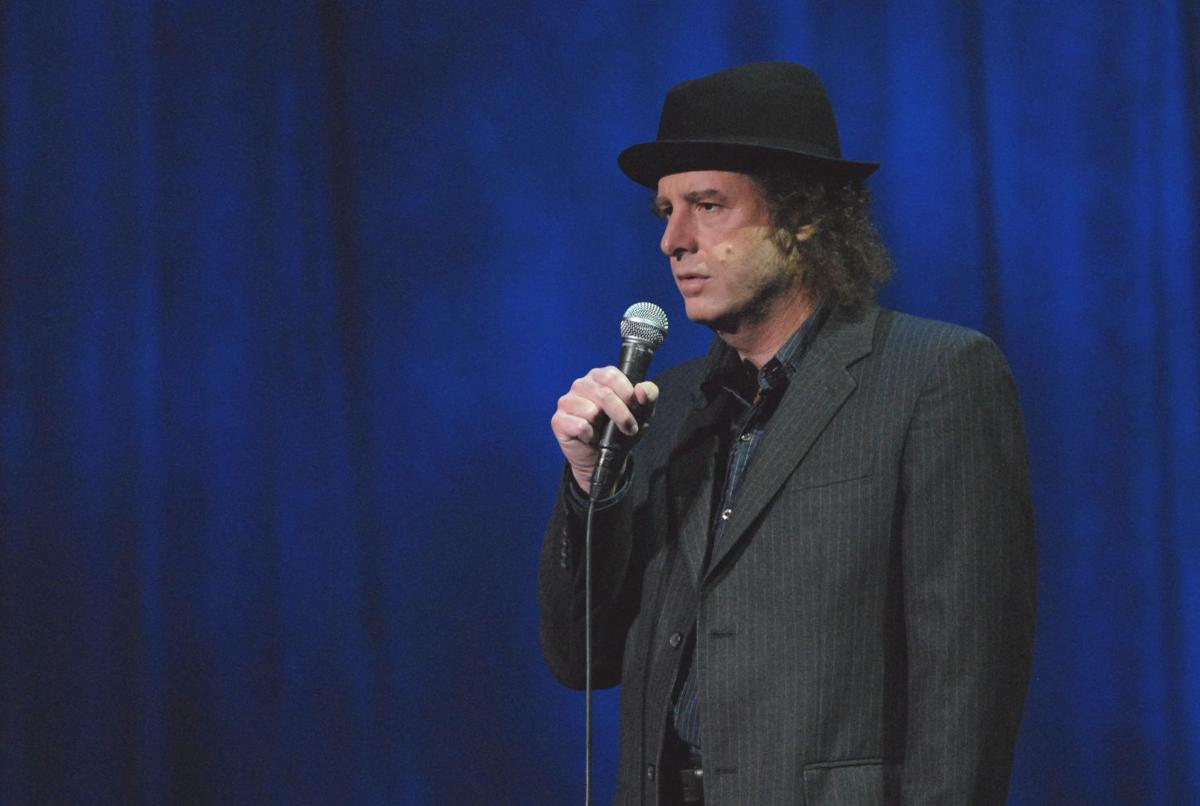
Steven Wright says he thrives on the “electricity” of performing live.
“There’s another amazing thing: Me, using the word ‘electricity,’” Wright said during a telephone interview to promote his appearance Friday, Nov. 13, at the Rialto Theatre.
You might exhaust a thesaurus of synonyms for “laconic” to describe what Wright does. “Electric” would not be a consideration.
In his act, he delivers a string of observations on everyday life, related only in that each of them is amusingly ironic and often hilarious.
His delivery is deadpan, with the occasional hint of a smile.
“What’s another word for thesaurus?” — Steven Wright
It’s an accidental approach, Wright said. His comedy hero, George Carlin, told stories to elicit laughter. Wright tells short jokes.
“I never thought I’d do all one-liners. It just happened.” He became so well-known for delivering one-liners that when he met the late Henny Youngman at the Montreal Comedy Festival, “He accused me of stealing his act.”
Wright said the George Carlin influence has nothing to do with the structure of the jokes or their delivery. It is all about the subject matter.
“He talked about everyday little things that everyone experiences. He would twist it or comment on it. My whole act is on that. I don’t talk about people in the news or celebrities or anything. It’s these little things that we all deal with.”
Think Henny Youngman, updated; Seinfeld, severely edited.
“I went to a restaurant that serves ‘breakfast at any time’. So I ordered French toast during the Renaissance.” — Steven Wright
Wright said he’s been to Tucson before. “Maybe more than once. I know the audiences were good, but I don’t have a specific recollection — Oh, now I remember, I grew up there.”
He didn’t.
The act will be familiar and different this time, he said. “My act is like a painting that’s never finished; it has just slowly evolved. I move things around, put new things in, get rid of things.”
New jokes are always a risk, he said — something he learned early in his career.
Wright studied broadcast communications at Emerson College in Boston, in preparation for a job in radio. He had wanted to be a stand-up comedian since his teenage years but didn’t really expect to achieve that. “It’s like wanting to be an astronaut or a baseball player.”
But after graduation, he gave it a try at open mic night at the Comedy Connection in Boston. He had three minutes and the audience laughed at half his jokes. He initially deemed it a failure.
“In hindsight, half was incredible. The overall real ratio is one-in-four will get a good enough laugh to stay in my act.”
Wright doesn’t acknowledge the ones that fail — doesn’t deliver self-deprecating lines or tap dance like his early idol, Johnny Carson.
“I just go on to the next one — go on to one that I know works.” That’s where the sheer volume of short jokes comes in handy.
“When you see the show. I seem to talk slow, but I’m saying joke after joke after joke. It’s an audio illusion.”
Stand-up comedy is not like being funny for your friends in social situations, where people are saying things and doing things, he said.
“There is nothing happening on stage. There is nothing there, so you have to bring the entire thing. I had no idea I could do it.”
He’s done it for 35 years. Club work in Boston led to a series of appearances on Carson’s “Tonight Show” beginning in 1982, followed by HBO specials, national stand-up tours and a Grammy nomination for his first comedy album.
Along the way, he’s also appeared in movies and won an Academy Award for co-writing and starring in the short film, “The Appointments of Dennis Jennings.”
For the past two seasons he has worked on the FX series “Louie” with his friend Louis C.K. “It’s fantastic. He’s brilliant. He’s an amazing mind.,” said Wright.
Wright, whose title is consulting producer, said he serves as a “sounding board.”
“I’ll read the episode. I’ll give him feedback on the story. Occasionally, I’ll suggest a funny line, but very rarely.”
He enjoys the discussions about how comedy works and finds it a nice change from stand-up, where “you’re all alone. You write it. You figure out what works. There are no discussions.”
Onstage, he’s just a guy at a microphone — and that’s where the payoff comes.
“This is not like a job to me. It’s like being in a never-ending kindergarten. “I like being on stage. I like the electricity.”

