

Polynesia is an ocean away, but that doesn't mean you can't live the island life with both feet planted in the Sonoran Desert.
Sit at the bar at Kon Tiki - Tucson's oldest tiki bar - sip a yellow scorpion through a long, red straw, and you can almost hear the waves crashing.
Next week, Pacific island culture will be on display as Kon Tiki throws a giant party to celebrate the relighting of the two torches in front of the restaurant. April 10 will mark the first time the torches have been lighted in 25 years.
Former Kon Tiki owner Chung Kim (who now owns a Jerry Bob's restaurant) says he extinguished the torches at the request of a Tucson fire inspector who worried that a nearby tree could catch on fire.
"The tree is gone now," Kim says.
Dubbed "Relight the Night," the event will feature live music and a performance by Flam Chen, a local pyrotechnic group.
While the origins of tiki are quite spiritual - in Maori mythology, Tiki is the first man, similar to Adam the Bible - most modern American tiki aficionados are more concerned with spirits. They've embraced the 1950s tiki-bar phenomenon most closely associated with fruity rum drinks.
"What we are into is based on the Poly-pop tiki bars," says Mark Bloom, who along with his wife, Maggie Rickard, is organizing "Relight the Night."
"It's so far removed from anything religious."
Tucson tiki history
Tiki bars got their start in California.
Ernest Gantt (aka Donn Beach) opened Don the Beachcomber restaurant in Los Angeles in 1933. Decorated with artifacts that Gantt picked up on a trip to the tropics, the bar served a variety of exotic rum drinks (including the Sumatra kula and zombie cocktail) and Cantonese dishes.
Whether intentional or not, Gantt hit on something big. Americans, in the midst of the Great Depression, were eager for an island escape. Later, troops returning from Pacific deployments flocked to tiki bars looking to relive their days spent abroad.
Trader Vic's, the world's most recognizable tiki chain, boasted 25 restaurants in the 1950s and '60s, at the peak of the tiki fad.
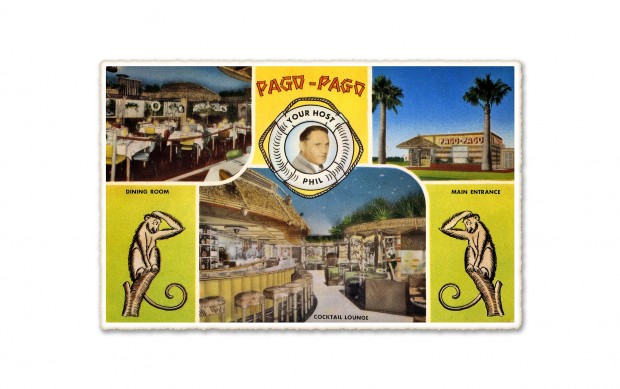
Tucson's first tiki bar was Pago-Pago (mispronounced Paygo-Paygo by the locals), which opened in the 1940s. The restaurant featured an atrium with live parrots, turtles and monkeys.
Inside the dining room there were rope-wrapped poles and blowfish lights hanging in fishnets. There was a 6-foot ship steering wheel attached to the hostess stand, and incoming customers were each handed a plastic lei.
In the 1960s, Dean Short bought the restaurant and changed the name to Ports O' Call.
He also opened a second tiki restaurant - Kon Tiki.
Named for the balsa-wood raft that a Norwegian crew sailed from Peru to Raroia in the Tuamotu Islands, Kon Tiki's interior resembled a luxurious hut, with deep red carpets, bamboo furniture and Japanese parasols that doubled as lampshades.
Alas, as Kon Tiki's red carpeting faded, so did the allure of Poly-pop culture nationwide. Gradually, Americans turned their attention away from bars with thatch roofs and toward those with disco balls and karaoke.
Similar bars in other cities closed but Tucson's tiki temple stayed open, thanks largely to university students who never lost a taste for fruity rum drinks served in bowls. It's now owned by Paul Christopher, who started out as a dishwasher.
Tiki revival
Tiki has found a following among fans of retro culture, those who crave kitsch, and seniors looking to reconnect with their past.
"People come at it from different angles," says Max Cannon, a local cartoonist with a lifelong love of tiki. "I have a friend who loves surf music, and he loves tiki from a surf angle."
Web sites have sprung up that catalog tiki bars, events, festivals and merchandise.
Wanna know where you can find a scorpion bowl while on business in Prague? The Web site Tiki Central (www.tikiroom.com/ tikicentral) has the answer. (One poster recommends Aloha Wave Cocktail Lounge and Cafe).
Looking for a ranking of the top 25 tiki destinations? Critiki.com has you covered (Tucson's Kon Tiki ranks 18th).
"The Internet has really helped the revival of tiki," Rickard says.
Tiki festivals have become popular with enthusiasts looking to spend a weekend in a floral-patterned, rum-fueled haze.
San Diego's Tiki Oasis is the largest, attracting nearly 2,000 tiki aficionados over four days last August.
Tiki mugs
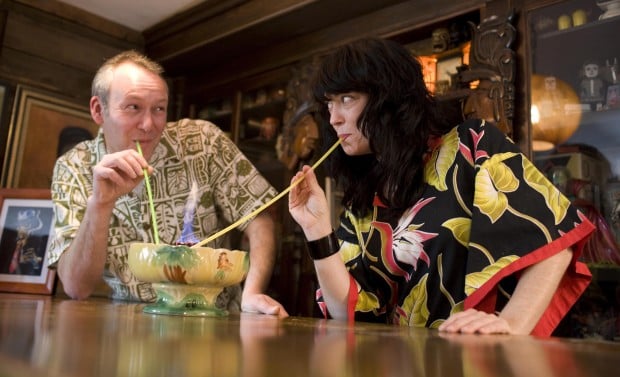
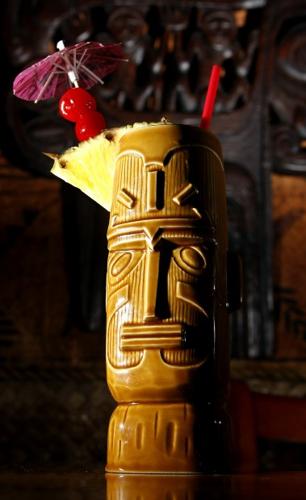
Bloom and Rickard, like many tiki fans, collect tiki mugs. The colorful ceramic vessels fill the cabinet behind the couple's home bar. There are more in a second hutch in the living room. Some of the mugs are from Kon Tiki, while others were bought online and at tiki bars across the country.
All told, Rickard and Bloom estimate they have more than 400 mugs.
"This one is a replica, but if you bought an original on eBay, it would cost $800 to $1,000," Rickard says, holding a mug that's shaped not like a wooden carving but like a man's decapitated head, with blood dripping from the neck.
Douglas "Fini" Finical, an operating partner the Fourth Avenue bar called The Hut, knows all about the Ren Clark Severed Head mug, which was used at Clark's Polynesian Village in Fort Worth, Texas. Clark was a magician, and the mug was a nod to a magic act he performed at the restaurant.
Finical bought one of the rare mugs on eBay five years ago and keeps it in his private collection. He doesn't remember how much he paid for the mug, but he vows to hang on to it.
"I'm not selling them," he says. "They're worth more to me than I could get on the open market."
More tiki
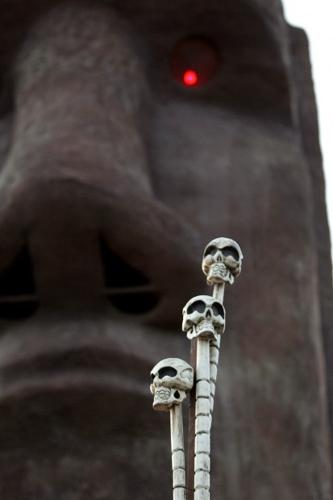
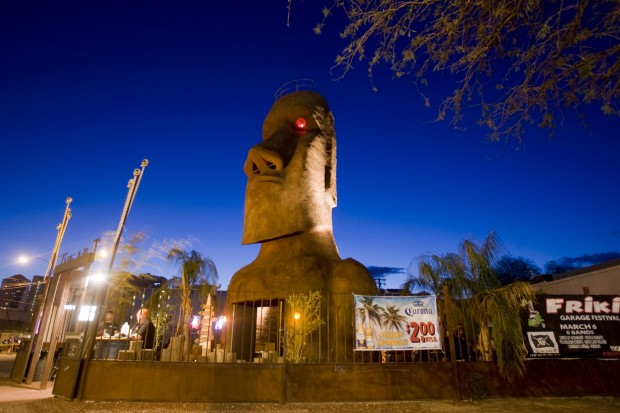
The Hut, which regularly features rockabilly and blues bands and boasts an indoor bar that looks like a Quonset hut, recently unveiled a 40-plus-foot-tall Moai - a replica of the monolithic human figures carved from rock on Chile's Easter Island.
The giant head was built in the late '60s by folk artist Lee Koplin. It was one of the featured oddities at Magic Carpet Golf for decades, until an automotive group bought the minigolf course in 2008.
The giant head was unveiled to great fanfare in August and is now the signature design element of Fourth Avenue's bar district.
Finical says The Hut isn't a full-fledged tiki bar.
"We're a neo-tiki bar, because we incorporate a lot of tiki elements, but also a lot of Americana music and reggae."
Soon, The Hut will start serving Hawaiian burgers, Jamaican jerk chicken and "Hut" dogs out of a converted Airstream trailer.
Other Tucson tiki touches can be found at the Tiki Motel on Oracle Road, which has a colorful neon sign but is otherwise sans tiki. Also, the Eden Rock Apartments, near Gene C. Reid Park, boast a tiki fountain that lights up at night.
"That fountain is something I keep an eye on," Finical says. "It's something all it takes is one person to come along and say, 'We don't need this anymore.' "
Tiki-philes
Rickard and Bloom moved here from New York seven years ago after they fell in love with Tucson's warm weather, affordable real estate and the Kon Tiki.
Today they have two 4-foot-tall carved wooden heads in their backyard - one created by famed entertainer and Tucson resident Ernie Menehune, who toured extensively with his Polynesian dance troupe during the '60s and '70s, and played a five-year engagement at Caesars Palace in Las Vegas.
Lemon, sour orange and grapefruit trees shade Rickard and Bloom's tikis. Rickard uses the fruits to make homemade sour mix for her tropical cocktails.
The couple's house is close enough to the Kon Tiki that they bicycle to and from the restaurant - Bloom on an old black Raleigh cruiser, Rickard on a blue electric tricycle.
"What we love more than anything else about the Kon Tiki is that it hasn't been messed with, updated or adapted since 1963," Bloom says.
Tiki can, indeed, be a family thing. Cannon got his kids into the act by building them a tiki-themed treehouse.
"It's our tiki fort," he says. "To them it's everything from a pirate ship to a Swiss-Family-Robinson-style treehouse."
To young and old, tiki beckons - and it asks only one thing in return.
"The only thing that's required to enjoy the Polynesian Poly-pop culture is that you want to have some fun," Rickard says. "Sometimes, having a place to escape to is a really good thing."
How to make a Kamehameha
Kon Tiki shared the recipe for one of its most popular tropical drinks, the Kamehameha, which sells for $8, or $12 with a souvenir glass (at right).
• 2 parts mango rum
• 1 part light rum
• 1 part dark rum
• 4 parts pineapple juice
• Splash of amaretto

