


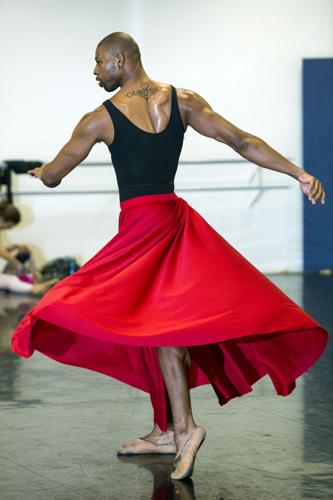



Isaiah Sumler is in his first official season with Ballet Tucson.
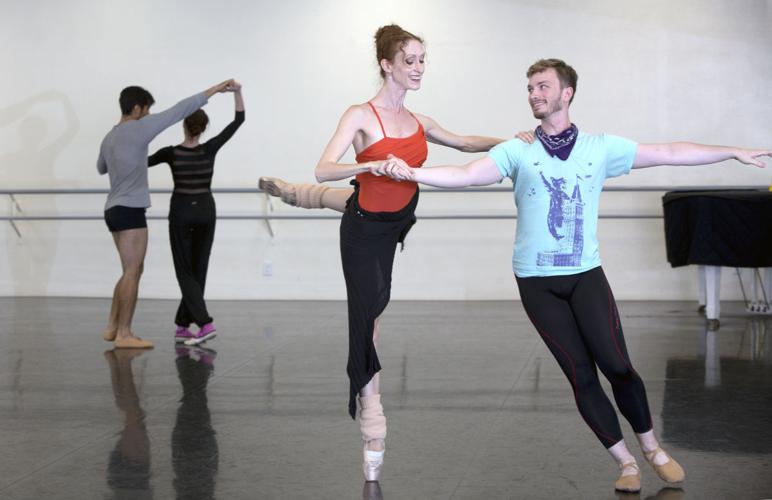
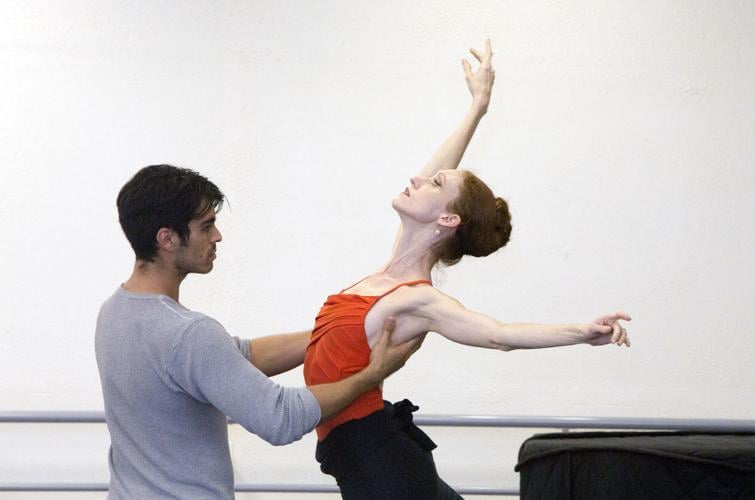
Jenna Johnson, lead dancer with Ballet Tucson, rehearses with Mauricio Vergara in the company’s 8,000-square-foot South Tucson Boulevard studio,
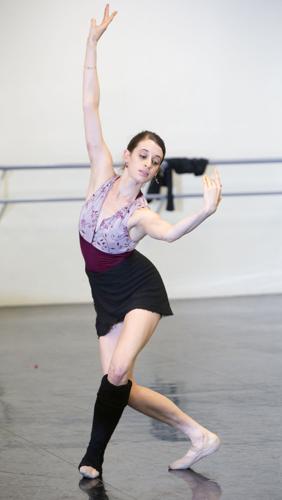
Megan Steffens is Ivy in “Jekyll and Hyde” and the soloist in “Carmina Burana.”
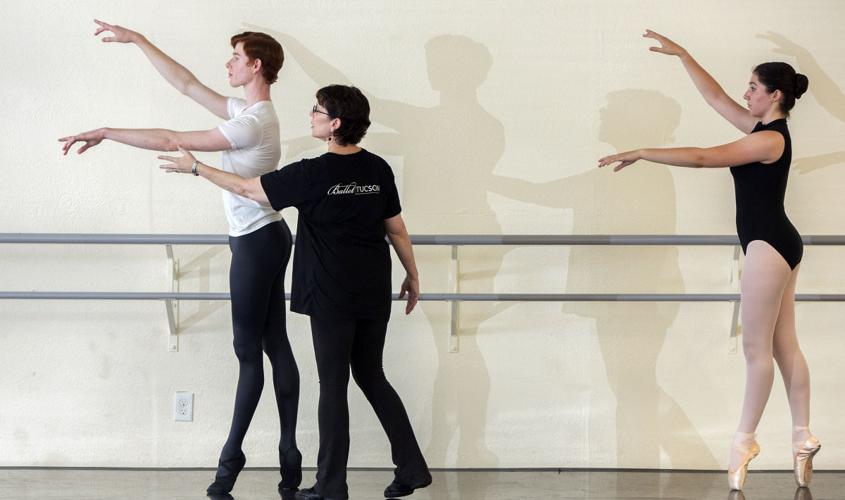
Mary Beth Cabana, founder of Ballet Tucson, helps students Ross Sounart and Liz Ketcham, who will appear in the company’s holiday “Nutcracker” presentation.
Mary Beth Cabana leads a class of students who will appear in the company’s “Nutcracker” this Christmas.
Mary Beth Cabana has gone steampunk.
The founding artistic director of Ballet Tucson loves the way the movement is like “the past looking at the future.”
She and Chieko Imada, her assistant artistic director, had been talking about a steampunk ballet for several years. This is the year they do it.
The centerpiece of Ballet Tucson’s season opener this weekend is a steampunk version of “Jekyll and Hyde,” choreographed by Cabana and Imada.
“We are a classically based ballet company, but we want to keep current,” says Cabana, taking a break from preparing for her 30th season. “We want to attract new audiences. And a steampunk alternate version of Victorian history with sci-fi elements is a perfect fit for a ballet.”
If you go steampunk, you’ve got to embrace the elaborate costumes. Creating ones that are movable for the dancers is a tricky process, Cabana says. For the season-opener, Ballet Tucson’s costumers have created and adjusted wardrobe pieces that incorporate the leather, Victorian dresses, buckles and elaborate coats that define steampunk and allow the dancers to move freely. Having worked with Cabana for more than 20 years, they were up to the challenge.
As was Cabana, who launched the company 30 seasons ago.
At a recent class, the Ballet Tucson dancers glide, bend, stretch, and sweat.
They leap through the air and land with barely a sound. Though they are using nearly every muscle, they never seem to strain.
They adjust their bodies and feet according to the instructions of Cabana, who watches closely for technique.
Class done, they begin rehearsal for Friday’s opening of Ballet Tucson’s latest season.
They spend about 40 hours a week like this, moving to music and Cabana’s instructions.
Ballet is hard work. Dancers ignore pain, coddle their feet and are fearless in their mission to tell a story through impossibly beautiful body movement.
They live their passion.
Especially Cabana, who launched the, professional dance company and its training school Ballet Arts, in 1986.
“Dance is my life force,” says Cabana. “It gets me out of the bed in the morning.”
In the beginning…
Cabana, who grew up in Worcester, Massachusetts, says her father was her first teacher.
“He was a champion amateur foxtrot dancer,” she says. “He would teach me to dance, my feet on his. ... He was a fabulous dancer.”
But she never thought of it as a career until she was about 6 and she saw a 13-year-old Joyce Cuoco — known for her amazing balance and multiple dizzying pirouettes — on the Ed Sullivan Show in the 1960s. “It captivated me,” says Cabana.
She told her mother that she wanted to dance like Cuoco and began to study ballet.
She was just 14 when she launched her career as a professional dancer with the Pittsburgh Ballet Theatre. She went on to become a principal dancer with the Cleveland Ballet, Ballet Oklahoma and the San Diego Ballet.
Cabana was in her mid-20s when she joined the Tucson-based Arizona Dance Theatre; she danced with the company and ran the training school. Two seasons later, in April 1986, Arizona Dance Theatre merged with the Phoenix Ballet to become Ballet Arizona based out of Phoenix.
A ballet school and company is born — and a dancer is threatened
Though she had the option to move with the company, Cabana decided to stay in the Old Pueblo.
“I wanted to come to a place where I could develop a professional training school and company on my own terms in an environment that was wide-open for it,” Cabana says. “This was a great opportunity to keep professional ballet growing in Tucson.”
The company’s first home then was a large room in a strip mall in central Tucson. When the plaza was demolished, Cabana found a high-ceilinged, 8,000-square-foot building on South Tucson Boulevard, where Ballet Tucson is still headquartered. The former warehouse space has several rooms off a long, narrow hall. Each is lined with mirrors with a ballet barre stretched across them. The floors are sprung basket weave with a marley surface — easy on the dancers’ feet.
Cabana danced with her new company for a few years, but at 27 she decided to devote her energies to teaching, directing and choreographing.
But in 2005, all that was threatened when she was faced with what many dancers face: ankles that were worn down after years of dance.
If Cabana wanted to continue in her chosen career, she needed bone and cartilage transplants.
“There is a one-in-three failure rate to them, but this was my only shot at continuing to be mobile in any way,” Cabana says. “I had to have it twice because the first time failed. My entire identity was challenged.”
While she was forbidden to put weight on her ankles for three months, she knew once she got on her feet her ankles would be too fragile to demonstrate dance to students and performers.
But that would not stop her.
She has a demonstrator when she is teaching young ballet students; the professionals know the language of dance, so a demonstrator isn’t necessary.
And she and Imada, who has been with the organization for 28 years, have become close collaborators, creating ballets and directing together. “We have an artistic marriage, in a way,” says Cabana.
Throughout the struggles and the pain, her passion for ballet never waned.
“It’s more than a profession,” says Cabana.
“It’s a way of life to me.”
Looking ahead
The nonprofit Ballet Tucson and Ballet Arts operates on a tight budget, about $600,000 annually, raised through tuition, donations and ticket prices.
But the bulk of the people who manage the organization are volunteers, including the general manager, James Edwin Kee, a retired George Washington University professor in public policy and administration.
“When I look at other companies who are at our level of programming, they typically have a $1 million budget,” says Kee.
And that is the budget the organization is aiming for, though it will be taken step by step.
“The first step is we need to go to a $750,000 budget,” he says. “That would allow us to hire the staff we need.”
There are other dreams: To eventually have a dance company on a year-round contract, increase the outreach to the community, and to raise its profile in Tucson.
When or if they hit that $1 million mark, all those dreams should be realized, says Kee.
Then it will be time to have new ones.

