



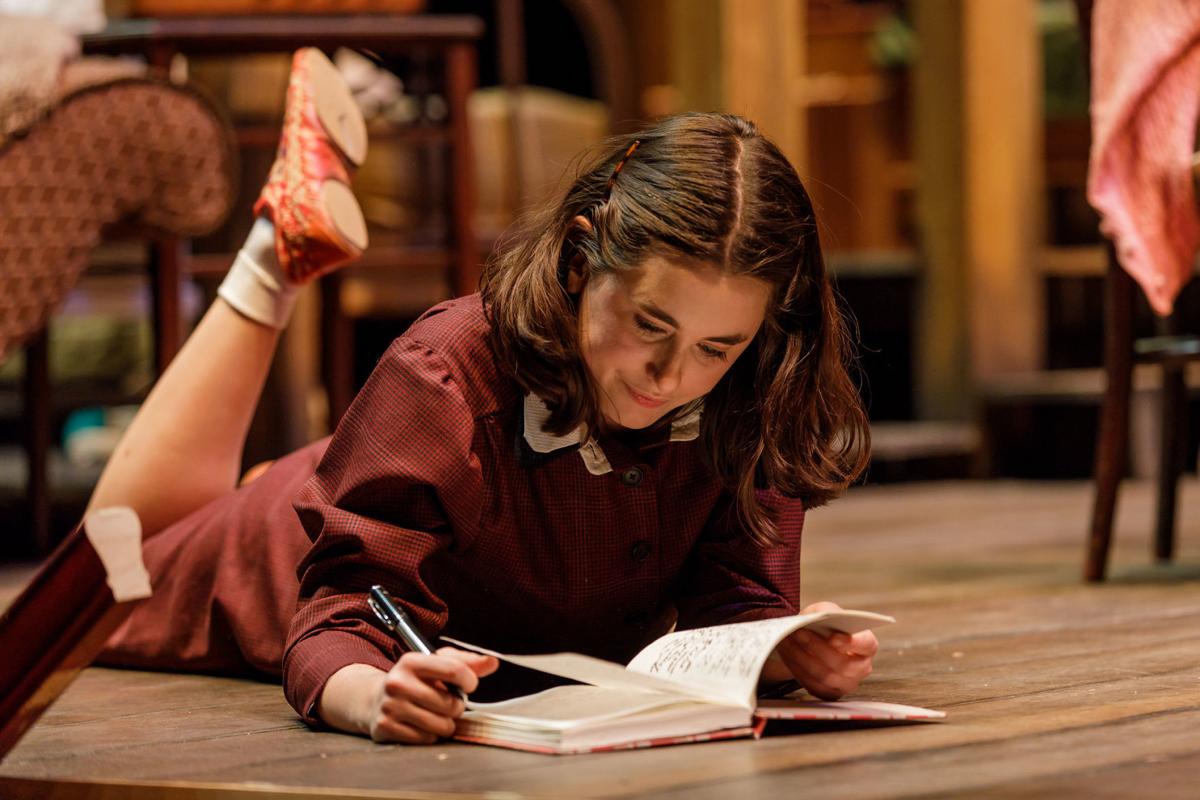
David Ira Goldstein is back at Arizona Theatre Company.
Goldstein is directing the company’s season-ender, “The Diary of Anne Frank,” which opens in previews Saturday, April 21.
Goldstein stepped down as ATC’s longtime artistic director last year, but not before selecting this season.
Choosing — and directing — “Anne Frank” was a no-brainer for him.
“It’s a play I’ve wanted to do for a long time,” he says, speaking from his Phoenix home.
“Being Jewish, and a citizen of the world, this is a topic and a story that feels important, both personally and to this particular moment.”
According to a recently released Anti-Defamation League study, anti-Semitic incidents in 2017 increased 57 percent over 2016. And a survey released early this month found that close to one-third of all Americans have very shaky knowledge of Holocaust facts. The time is ripe for a reminder of the Nazis and the Holocaust, says Goldstein.
“The story needs to be told again and again.”
Anne was a Jewish teen in Amsterdam. When the Germans occupied the Netherlands, she, her family and a few others went into hiding in concealed rooms in the building where her father worked. She kept a diary for those two years, 1942-44. When they were discovered, the family was sent to concentration camps; only her father, Otto, survived. After the war, he returned to Amsterdam and found her diary (it had been saved by one of the workers in the building). He had the diary published as “Anne Frank: The Diary of a Young Girl.”
“The Diary of Anne Frank” was fashioned into a play by Albert Hackett and Frances Goodrich, and in 1997, Wendy Kesselman revised the script. That is the version ATC is staging.
“It’s not a story where the audience doesn’t know the ending,” says Goldstein.
“Knowing how it ends it is doubly important to find the life and humor that these eight people found while trapped in the annex. … These were lively, colorful, interesting people living from moment to moment.”
Goldstein had the luxury of time, which allowed for some deep research for this production.
Included in that research was a trip to Amsterdam and tours through the Anne Frank House, the city’s Jewish quarters and the Holocaust Museum there. “Seeing the actual rooms where they stayed informed (the production) in a physical and tactical way,” he says.
Just as important was a cast meeting with Holocaust survivor Steven Hess as the play was rehearsing at the Geva Theatre Center in Rochester, New York, which is co-producing “Anne Frank” with ATC. Hess lived in Amsterdam and was imprisoned at the Bergen-Belsen concentration camp at the same time Anne Frank and her sister Margo were.
“Having him there to help guide us through this story brings home the reality of the situation; fictional accounts don’t have that same impact,” says Goldstein.
“It was very meaningful to have a survivor with us,” says Naama Potok, who plays Anne’s mother in the production.
Potok is particularly moved by the play — her late father, the writer Chaim Potok, lost more than 100 family members in the Holocaust, and she has worked in organizations that helped some victims of the Nazis get restitution.
“For a period of time, I really needed to distance myself from the Holocaust and this connection,” she said in a phone interview from her New York City home.
“When this play came around, I was overjoyed and grateful to be cast. And then at one point, I thought I couldn’t do it.
“Then I realized this is exactly what I needed to be doing.”
The experience, she says, “has been very powerful and very wonderful.”

