


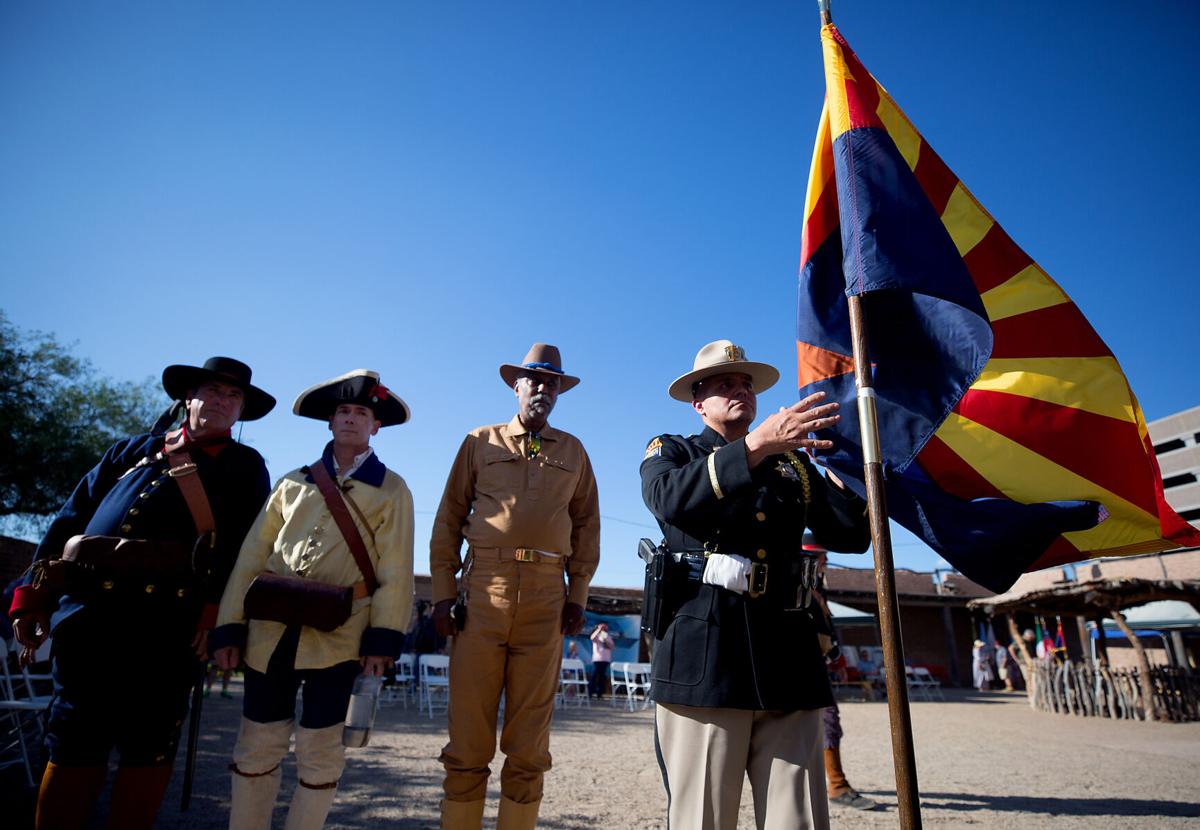
This Friday, Tucson is blowing out the candles on its 246th birthday at the Presidio San Agustín del Tucson Museum, downtown.
The museum will be honoring the city’s heritage with a “Celebration of All Things Tucson/S-cuk Son,” amid the historical reconstruction of the Spanish military fort, established way back in 1775.
The presidio’s name for this year’s event recognizes the roots of the Old Pueblo’s beginnings. S-cuk Son, pronounced “Skuk-shone” in the O’odham language, means “spring at the base of the black mountain.” It was adapted by early Spanish arrivals to Tucson.
Recognizing the history of Tucson beyond the founding of the presidio and displaying Tucson’s cultural complexity is an evolution of the historic celebration, said Amy Hartmann-Gordon, executive director of the museum.
“August 20 is a date, and it is the date on the official charter of the city, and we will continue to use that date as our birthday,” Hartmann-Gordon said. “But we also want to recognize that it’s a much bigger story than that. We are trying to make it a celebration that’s inclusive of everything that has happened.”
Hartmann-Gordon sees the eclectic community of Tucson as the focus of this year’s celebration. This year, she said an effort has been made to bring in as many community partners as possible to represent the cultural puzzle pieces that make the city unique.
The celebration will feature mariachi music performed by Los Changuitos Feos de Tucson, traditional folklórico dancing by the Cienega High School Folklórico Club, and waila music by Gertie N the T.O. Boyz.
Waila music is the polka-inspired dance music of the Tohono O’odham Nation, Hartmann-Gordon said. The name waila developed from the Spanish word “bailar,” meaning to dance.
Community partners will be providing a range of activities to bring the history of the presidio to life and put Tucson’s community on full display.
Old Pueblo Archaeology, the Chinese Cultural Center, and Buffalo Soldier re-enactors will all be in attendance. The museum wants to capture the diversity of Tucson.
“We have been building up this idea of the community partners, and I am really thrilled this year that we have so many,” Hartmann-Gordon said.
Going into the fall, the museum is looking to expand its educational outreach beyond the downtown presidio and out into local schools.
The “Portable Presidio” program has been in development over the past 15 months and was created in response to the restrictions brought on by the pandemic.
“Due to COVID, school groups were not coming to us, so we wanted to figure out how can we serve schools in different ways,” Hartmann-Gordon said. “We’re really focusing this year on trying to kind of support schools that have, you know, had rough times and be available to them.”
The program includes options where the museum can travel to the schools and virtual programs focusing on supporting local curricula.
“Portable Presidio” will bring supplies to the school, and then a teacher can conduct the lesson, or a docent can come and present.
The community outreach moves the educational opportunities beyond the wall of the presidio. Pre-COVID, the museum was serving 1,200 students per year. The pandemic stopped that, but now Hartmann-Gordon wants to get back to educating.
“It’s about being available to as many students as possible,” she said. “The third-and fourth-grade state standards are where local social studies are focused. We want to reach out to as many third and fourth graders as we can to give them that understanding of where they are and who they are, and what this valley is all about.”

