


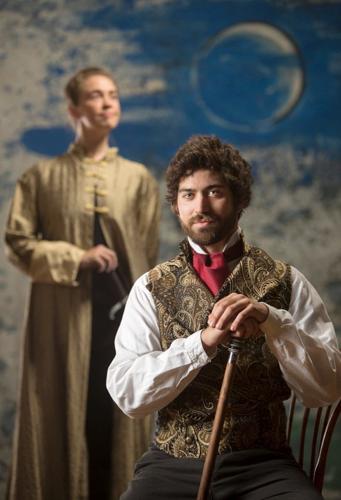

Oscar Wilde’s words are like music.
So it makes sense that the Rogue Theatre would swing into step with the Artifact Dance Project for Rogue’s summer offering, “A House of Pomegranates,” a Christopher Johnson adaptation of three Wilde short stories.
Johnson was true to Wilde, using much of his dialogue and plenty of his razor-sharp wit. Wilde threw out — and Johnson retained — lines such as “The proper basis for marriage is a mutual misunderstanding” and “The world is a stage but the play is badly cast.” It’s very easy to be seduced by Wilde, and Johnson’s take on him lets us breathe in the riches he wrote.
“Lord Arthur Savile’s Crime: A Study of Duty,” opened the production. It is a swift and funny story about a palm reader who tells Lord Arthur that he’ll be committing a murder, and the poor fellow figures he best do it before he marries. It’s the most recognizably Wilde of the three, with the wit and the humor spilling off the stage. It ends abruptly — as it did in the short story — and that can be a bit jarring. But we forgive much where Wilde is concerned.
“The Happy Prince” is a sweet and predictable parable about mercy: a bird who does the bidding of the Happy Prince, a statue who longs to relieve the suffering of the people in his town. The evening closed out with “The Fisherman and His Soul,” a dark, hedonistic nod to Hans Christian Andersen’s “The Little Mermaid.” In this, rather than the mermaid’s search for a soul so she can join the human she loves, a fisherman gets rid of his soul, a requirement so he can be with the mermaid with whom he has fallen in love. Don’t expect a Disney version of this tale.
“House” was likely a challenge for the Rogue and director Joseph McGrath — three short stories, vastly different save for that luscious language. The only real connector is Wilde.
But the cast was up for the challenge, breathing life into the wide collection of characters.
The dance was sublime — not surprising; Artifact rarely disappoints.
But — there’s always a but, isn’t there? — with the exception of the first piece, “Lord Arthur Savile’s Crime,” where dance was integrated smoothly, Wilde’s wonderful storytelling stopped as Ashley Bowman’s often-beautiful choreography interpreted a scene with movement. The dance sometimes chopped up the storytelling, and vice versa. At times, one longed for a dance performance alone, or the play alone — each could have easily stood on its own.
In the end, the play felt over-produced, a tad disjointed, and a bit strained.
Still, one leaves the theater with Wilde’s words fresh, and the sumptuous image of dancers moving with grace and imagination. That adds up to a good night.

