





Rio Lee is pretty beat up for a 22-year-old.
He has torn a biceps. Broken fingers. He has had aches and pains most 60-year-olds don’t know.
And each is hard won: Lee is a champion bareback rider, who competes in rodeos around the country, including this year’s Tucson Rodeo.
“Bareback riding is pretty violent,” says Lee, who has been competing since he was 13. “Every bareback ride is like a 50-mile-per-hour crash.”
According to prorodeo.com, “Bareback riders endure more abuse, suffer more injuries and carry away more long-term damage than all other rodeo cowboys.”
Ouch. So why do it?
“Bareback is the most electric, most fun,” Lee explains. Besides, he says, “it’s way better than a desk job.”
But that doesn’t mean he is cavalier about protecting himself.
Nearly every piece a bareback rider wears — for Lee, that’s about 40 pounds of mostly-leather — is to protect him and/or the horse.
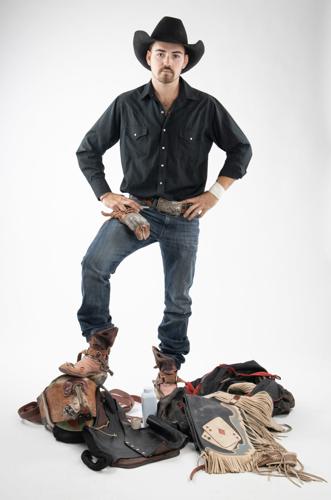
We asked Lee to give us a detailed look at what a typical bareback rider steps into before sitting on a steed, and to tell us about what he carries in the oversized duffle bag he brings to competitions.

Professional cowboy Rio Lee shows the well-worn custom boots he uses for bareback riding. These boots were originally cherry black. The spurs are dull, to protect the horses.
Boots and spurs
Lee’s boots have seen better days: They are worn, have holes and the once cherry black boots have faded to a pink.
But his feet feel good in them; he loves them.
A leather buckle is tightly wrapped about the upper part of the boots to keep them from flying off.
The spurs — bareback riders have longer ones — are on the back of the boots. Lee rolls the wheel-like rowels of his spurs over the hand of a reporter to demonstrate how dull they are. “There are (Professional Rodeo Cowboys Association) rules on how sharp spurs can be,” he says. If the rowels don’t roll, the spurs are too sharp or if the horse is injured as a result of something the rider does, disqualification follows.
Not using the spurs correctly also means disqualification: When coming out of the chute, the rider’s spurs must be held over the break of the horse’s shoulders until its hoofs touch the ground.That’s called “marking out.”
During the ride, the toes are turned out and the spurs are run along the horses hide in the rhythm of the buck’s broncing.
The chaps
Chaps don’t just provide a layer of protection between the horse and the rider’s legs.
Put on over the jeans and buckled in the back, they can make a statement, too. Lee designed his chaps; his cousin made them.
There are a pair of aces on each leg near the bottom of his chaps. “Everything in rodeo is a gamble,” Lee explains. The cross on the upper part has a purpose, too. “To keep the divinity rolling,” he explains.
And that fringe? It emphasizes the rider’s spurring action. And it looks cool.
Vests
The leather is just another layer of protection in case the rider is thrown. It, too, looks cool.

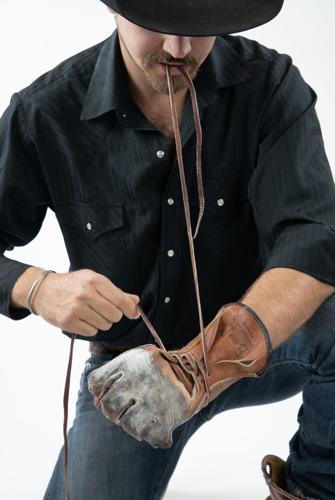
Lee ties the glove on the hand he will use to grip his rigging. He tightens the leather ties and then loops them around his wrist.
Gloves
These are important for a bareback rider: they help with gripping and the heavy leather protects the hand. Lee treats his gloves with Benzoin to harden the gloves — that allows for a better grip. Then he dusts on rosin, which helps make them sticky.
The bareback gloves are heavy and bulky. The palm and back side are padded, and there is a wedge at the knuckle of the pinkie, which helps with the grip.
The backside of the glove is laced up with a leather tie.
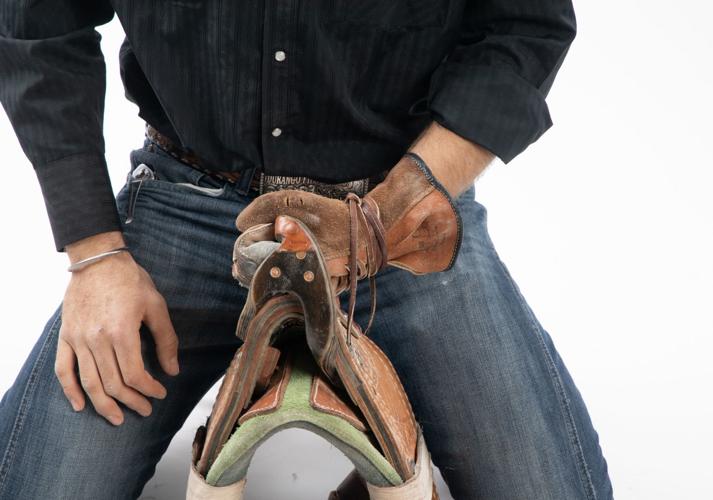
In bareback riding competition, the rider is only allowed to hold on with one hand — he can’t touch himself or the horse with the free hand — so everything about the glove is geared toward allowing for a tight grip. By the time Lee is ready to slip his hand into the rig, it is so bulky he has to use his other hand to pull it through.
Hats
Cowboy hats are required. It’s like a dress code, Lee says, adding his usually flies off the minute he is out of the chute. That’s expected and points are not lost if the rider loses his hat.
Neckroll
Neck rolls keep the whiplash down, says Lee. His thick neck roll is attached to straps that he slips his arms through. He uses a leather lace to tighten it and keep it in place.

Lee goes through four rolls of athletic tape per ride. The tape helps stabilize his arm as he fights the bucking action of a horse.
Athletic tape
Lee wraps his arm with athletic tape, making it extra thick around the wrist and biceps. This helps limit injuries. “There is no brace as strong as tape,” says Lee, who goes through about four rolls a ride. But it doesn’t always work — two years ago, Lee tore the biceps on his right arm. It was not only painful, it meant he couldn’t compete with that arm. So he taught himself to be left-handed.
The rigging
Think of a heavy piece of leather with a suitcase handle on it. That’s what the rig for bareback riding looks like. There are several different types of rigs. Lee uses a Wyoming High Lift. “I can sit straighter on the horse and it helps keep my arms pinned down,” he explains. The rigging is held on with a latigo, cinched with a pad under the horse’s girth. A leather strap is wrapped around the horse’s flank and is pulled tightly just as the chute opens. That increases the horse’s bucking. That’s not because it’s pulled so tight; it’s not painful for the horse, just irritating. The Professional Rodeo Cowboy Association has several rules in place to protect the animals from being abused.
The horses
The horses, which are bred for bucking, are raised and brought to the rodeo grounds by stock contractors; competitors draw for which one they will ride. Lee’s full time job is competing at rodeos around the country and it is rare that he has drawn the same horse.

